OpenStax Microbiology Test Bank
Chapter 2: How We See the Invisible World
Chapter 2: How We See the Invisible World
* = Correct answer
Multiple Choice
1. Which term is used to refer to a wave’s rate of vibration?
A. amplitude
B. frequency*
C. trough
D. wavelength
Difficulty: Easy
ASM Standard: N/A
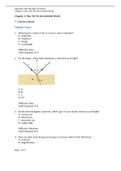
2. On the figure, which letter represents a refracted ray of light?
A. A
B. B
C. C
D. D*
Difficulty: Easy
ASM Standard: N/A
3. On the electromagnetic spectrum, which type of wave has the shortest wavelength?
A. cosmic ray*
B. infrared ray
C. ultraviolet ray
D. visible light
Difficulty: Moderate
ASM Standard: N/A
4. Dyes are often used during microscopy to increase which of the following?
A. contrast*
B. magnification
Page 1 of 17
,OpenStax Microbiology Test Bank
Chapter 2: How We See the Invisible World
C. motility
D. resolution
Difficulty: Easy
ASM Standard: 32
5. Which of the following was the first to use the term “cells”?
A. Robert Hooke*
B. Robert Koch
C. Carolus Linnaeus
D. Antonie van Leeuwenhoek
Difficulty: Easy
ASM Standard: N/A
6. Which of the following is the typical magnification of an object viewed using a 10× ocular
lens and a 100× objective lens on a brightfield microscope?
A. 1×
B. 10×
C. 100×
D. 1000×*
Difficulty: Moderate
ASM Standard: 32
7. Most modern microscopes have two eyepieces, meaning that they are which of the
following?
A. binocular*
B. monocular
C. oil immersion
D. trinocular
Difficulty: Easy
ASM Standard: 32
8. An annular stop is used for which type of microscopy?
A. confocal
B. darkfield
C. fluorescence
D. phase contrast*
Difficulty: Easy
ASM Standard: 32
9. Which of the following is the specific name for a stain that colors the background but not the
specimen?
Page 2 of 17
, OpenStax Microbiology Test Bank
Chapter 2: How We See the Invisible World
A. acid-fast stain
B. counterstain
C. differential stain
D. negative stain*
Difficulty: Easy
ASM Standard: 32
10. Which type of microscopy would work best for viewing internal cell structures?
A. atomic force microscopy
B. scanning electron microscopy
C. scanning tunneling microscopy
D. transmission electron microscopy*
Difficulty: Moderate
ASM Standard: 32
11. The Gram-staining procedure is best described as which of the following?
A. complex staining
B. differential staining*
C. negative staining
D. simple staining
Difficulty: Easy
ASM Standard: 32
12. When there is a substantial difference in refractive index between two materials, which of the
following describes what will happen to light passing from one material to the other?
A. It will fail to be refracted.
B. It will undergo a large amount of refraction.*
C. It will undergo a small amount of refraction.
D. It will undergo a variable amount of refraction.
Difficulty: Moderate
ASM Standard: N/A
13. In microscopy, the focal length refers to which of the following?
A. a description of the wavelength needed for an image to be in focus
B. a measure of the amount of refraction produced by a lens
C. a measure of the thickness of the lens needed for an image to be in focus
D. the distance to the image point (at which all light entering a lens is parallel)*
Difficulty: Moderate
ASM Standard: 32
14. Which of the following are pigments used in microscopy to absorb and reflect light?
A. chromatographs
Page 3 of 17
Chapter 2: How We See the Invisible World
Chapter 2: How We See the Invisible World
* = Correct answer
Multiple Choice
1. Which term is used to refer to a wave’s rate of vibration?
A. amplitude
B. frequency*
C. trough
D. wavelength
Difficulty: Easy
ASM Standard: N/A
2. On the figure, which letter represents a refracted ray of light?
A. A
B. B
C. C
D. D*
Difficulty: Easy
ASM Standard: N/A
3. On the electromagnetic spectrum, which type of wave has the shortest wavelength?
A. cosmic ray*
B. infrared ray
C. ultraviolet ray
D. visible light
Difficulty: Moderate
ASM Standard: N/A
4. Dyes are often used during microscopy to increase which of the following?
A. contrast*
B. magnification
Page 1 of 17
,OpenStax Microbiology Test Bank
Chapter 2: How We See the Invisible World
C. motility
D. resolution
Difficulty: Easy
ASM Standard: 32
5. Which of the following was the first to use the term “cells”?
A. Robert Hooke*
B. Robert Koch
C. Carolus Linnaeus
D. Antonie van Leeuwenhoek
Difficulty: Easy
ASM Standard: N/A
6. Which of the following is the typical magnification of an object viewed using a 10× ocular
lens and a 100× objective lens on a brightfield microscope?
A. 1×
B. 10×
C. 100×
D. 1000×*
Difficulty: Moderate
ASM Standard: 32
7. Most modern microscopes have two eyepieces, meaning that they are which of the
following?
A. binocular*
B. monocular
C. oil immersion
D. trinocular
Difficulty: Easy
ASM Standard: 32
8. An annular stop is used for which type of microscopy?
A. confocal
B. darkfield
C. fluorescence
D. phase contrast*
Difficulty: Easy
ASM Standard: 32
9. Which of the following is the specific name for a stain that colors the background but not the
specimen?
Page 2 of 17
, OpenStax Microbiology Test Bank
Chapter 2: How We See the Invisible World
A. acid-fast stain
B. counterstain
C. differential stain
D. negative stain*
Difficulty: Easy
ASM Standard: 32
10. Which type of microscopy would work best for viewing internal cell structures?
A. atomic force microscopy
B. scanning electron microscopy
C. scanning tunneling microscopy
D. transmission electron microscopy*
Difficulty: Moderate
ASM Standard: 32
11. The Gram-staining procedure is best described as which of the following?
A. complex staining
B. differential staining*
C. negative staining
D. simple staining
Difficulty: Easy
ASM Standard: 32
12. When there is a substantial difference in refractive index between two materials, which of the
following describes what will happen to light passing from one material to the other?
A. It will fail to be refracted.
B. It will undergo a large amount of refraction.*
C. It will undergo a small amount of refraction.
D. It will undergo a variable amount of refraction.
Difficulty: Moderate
ASM Standard: N/A
13. In microscopy, the focal length refers to which of the following?
A. a description of the wavelength needed for an image to be in focus
B. a measure of the amount of refraction produced by a lens
C. a measure of the thickness of the lens needed for an image to be in focus
D. the distance to the image point (at which all light entering a lens is parallel)*
Difficulty: Moderate
ASM Standard: 32
14. Which of the following are pigments used in microscopy to absorb and reflect light?
A. chromatographs
Page 3 of 17