

Haemostasis II - Coagulation and secondary haemostasis
Secondary haemostasis:
- Platelet plug alone is not enough to stem the blood loss
- Needs to be reinforced
- This is where the coagulation pathways come into play
- Secondary haemostasis (coagulation) is usually initiated simultaneously with primary haemostasis upon
endothelial damage
- Result of activation of coagulation pathways is that soluble fibrinogen is converted to insoluble fibrin
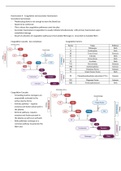
Coagulation cascade - key complexes: Coagulation factors:
Coagulation Cascade:
- Circulating inactive zymogens are
sequentially activated to the
active enzyme forms
- Intrinsic pathway – requires
enzymes and factors all present in
the plasma.
- Extrinsic pathway- requires
enzymes and factors present in
the plasma as well as an activator
- Both pathways converge on a
common pathway to generate the
fibrin clot
, Events of coagulation:
1. Endothelial injury exposes tissue factor (TF) – factor which
binds its circulating ligand in plasma, the pro-enzyme FVII
2. Binding to TF activates FVII and promotes activity
3. The TF-FVIIa complex then activates the pro-enzyme FX
4. FXa is able to cleave its substrate prothrombin (FII) to
thrombin
5. Only a small amount of FXa is generated by this reaction
Extrinsic pathway:
1. FXa + FVa
2. Need phospholipids (PL) and Ca2+ ions
3. This is the prothrombinase complex
4. It is able to cleave its substrate prothrombin (FII) to thrombin
5. Only small amounts of thrombin are generated by this
reaction
Secondary haemostasis:
- Platelet plug alone is not enough to stem the blood loss
- Needs to be reinforced
- This is where the coagulation pathways come into play
- Secondary haemostasis (coagulation) is usually initiated simultaneously with primary haemostasis upon
endothelial damage
- Result of activation of coagulation pathways is that soluble fibrinogen is converted to insoluble fibrin
Coagulation cascade - key complexes: Coagulation factors:
Coagulation Cascade:
- Circulating inactive zymogens are
sequentially activated to the
active enzyme forms
- Intrinsic pathway – requires
enzymes and factors all present in
the plasma.
- Extrinsic pathway- requires
enzymes and factors present in
the plasma as well as an activator
- Both pathways converge on a
common pathway to generate the
fibrin clot
, Events of coagulation:
1. Endothelial injury exposes tissue factor (TF) – factor which
binds its circulating ligand in plasma, the pro-enzyme FVII
2. Binding to TF activates FVII and promotes activity
3. The TF-FVIIa complex then activates the pro-enzyme FX
4. FXa is able to cleave its substrate prothrombin (FII) to
thrombin
5. Only a small amount of FXa is generated by this reaction
Extrinsic pathway:
1. FXa + FVa
2. Need phospholipids (PL) and Ca2+ ions
3. This is the prothrombinase complex
4. It is able to cleave its substrate prothrombin (FII) to thrombin
5. Only small amounts of thrombin are generated by this
reaction


