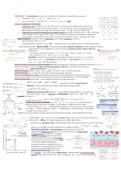
Chemistry → thermodynamics: reactions at equilibrium ∆G=0 (Gabbs free energy) (chemical speciation).
a. at equilibrium: rateforward = ratereverse → NaCl (s) ↔ Na+ + Cl-
𝑐 𝑑
[𝐶] [𝐷]
b. mass law equation: Kw = [OH-][H+] = 10-14 → aA + bB ↔ cC + dD → K = 𝑎 𝑏
[𝐴] [𝐵]
2 ways of calculating free concentration:
1. Solubility of a miner: Al(OH)3 (s) ↔ Al3+ (aq) + 3OH- (aq) → for a given pH and solubility product (Ksp) the free
concentration is calculated from the mass law equation → the concentration of other chemical species (FEX.
Al(OH)2+ (aq)) can be calculated by using a mass law equation again → Al3+ (aq) + OH- (aq) ↔ Al(OH)2+ (aq).
2. Total amount of the element distributed over a number of species: mass balance equation is used → [Me]T = [Men+(aq)]
+ (MeDOM (aq)] + [MeCln+1 (aq)] + [MeOHn-1 (aq)] → the concentrations of all free concentrations are expressed in
terms of the free concentration by using mass law equations, such as [MeOHn-1 (aq)] = K · [Men+(aq)] · [OH- (aq)].
Sorption isotherms = equilibrium between adsorbed C (Q in mol/kg) & solution C (C in mol/L):
- Linear adsorption isotherms: Q = KdCL
𝐾𝐶𝐿
- Langmuir adsorption isotherms: Q = Qmax 1+𝐾𝐶𝐿
→ sorption can have a max (limited number of available sorption sites).
→ sorption depends on: (a) K = affinity constant of a solute for the solid phase (partition coefficient for linear sorption (C and Q are
constant)). (b) amount of solid phase per amount of solution (suspension density/solid-to-solid ratio
(SSR) in kg/L).
→ mass balance equation (per volume): CT = CL + CS (T = total, L = liquid, S = solid) → CS = Q · SSR.
→ linear sorption; CS = K · CL · SSR → so, CT = CL · (1 + K · SSR).
Retardation = velocity of how much a solute is moving slower than water, factor > 1) → for a porous
medium: SSR = ρ𝑏/θ → ρ𝑏 = bulk density of sediment (kg/L), θ = pore volume (L/L) → CT = CL (1 + K ·
ρ𝑏/θ) → (1 + K · ρ𝑏/θ) = retardation factor (R).
Sorption of organic contaminants in soils and sediment: distribution coefficient Kd (L/kg) between solid phase and water (Kd = Q / CL) →
predict fate of organic carbons with organic carbon/water partition coefficient KOC (L/kg) for linear adsorption
→ Kd = fOC · KOC → fOC = organic matter fraction → Q = fOC · KOC · CL.
Composition leachate: dissolved organic matter, inorganic ions, heavy metals, xenobiotic compounds.
Combustion products: CO2, H2O plus SO2, NOx, PAHs and chlorinated organic substances.
Extractive metallurgical processing = (a) leaching (removing ash and soil), (b) smelting and roasting (reducing ores,
transforming into oxides), (c) electrolysis (decomposing compounds into single substances or other compounds).
Chemical reaction AMD: picture right → when catalyzed by bacteria: (very slow when pH<3) →
→ neutralisation of AMD: carbonate mineral
dissolution = increase in pH and cations by generating aqueous carbonate species →
.
Inorganic salt: ammonium sulfate ((NH4)2SO4) → organic fertiliser: urea (CO(NH2)2) → favourable way to
use nitrate: turn NO3- into N2 → dissolved P as orthophosphate = H3PO4, H2PO4- , HPO42-, PO43- → low
P solubility (<0.01 mg L-1).
equation for algal growth: .
Octanol-water partition coefficient (KOW) = KOW = COP / CW → COP and CW are concentrations (g/L) of
species in octanol-rich and water-rich phase → log10 because KOW values between 10-3 and 107.
→ ↑ bioaccumulation for a ↑ KOW → ↑ hydrophobicity (tendency to move from aqueous phase into lipids)
for ↑ log KOW → ↑ bioaccumulation for ↑ log KOW → ↑ volatilisation for ↑ vapour pressure → ↑ leaching for
↑ solubility and ↓ sorption affinity.
→ glyphosate: prevents synthesis of aromatic amino acids needed for plant growth → effects might last for decades.
Toxicology → dose-response relationship: potency = higher equals less of a compound needed for an
adverse effect → efficacy = at the same dosage you get a higher adverse effect.
→ benefits toxican: therapeutic index = LD50/ED50 (the farther the median lethal dose is away from the median
effective dose, the higher the safety margin from an accidental overdose) → .
Similarities tox and ecotox: (a) fate of chemicals in organisms (toxicokinetics and
-dynamics), (b) multiple stressors (cause an increase in sensitivity), (c) toxicity testing,
(d) risk assessment (individuals vs. ecosystem).
Cations = electrophiles (molecules that easily
accept electrons) that interact with nucleophiles
(molecules that easily donate electrons = anions)
→ FEX. sulfur, nitrogen and phosphor →
nucleophilic elements are abundantly present in
biomolecules, so metals easily interact with these
molecules, thereby disturbing their function.
Metals interact with a target (picture right) →
FEX. cadmium → major adverse effect; nephrotoxicity = cadmium binds to low molecular weight
proteins and gets freed in kidney cells, where it damages the cells → causes; (a) tubular damage, (b)
a. at equilibrium: rateforward = ratereverse → NaCl (s) ↔ Na+ + Cl-
𝑐 𝑑
[𝐶] [𝐷]
b. mass law equation: Kw = [OH-][H+] = 10-14 → aA + bB ↔ cC + dD → K = 𝑎 𝑏
[𝐴] [𝐵]
2 ways of calculating free concentration:
1. Solubility of a miner: Al(OH)3 (s) ↔ Al3+ (aq) + 3OH- (aq) → for a given pH and solubility product (Ksp) the free
concentration is calculated from the mass law equation → the concentration of other chemical species (FEX.
Al(OH)2+ (aq)) can be calculated by using a mass law equation again → Al3+ (aq) + OH- (aq) ↔ Al(OH)2+ (aq).
2. Total amount of the element distributed over a number of species: mass balance equation is used → [Me]T = [Men+(aq)]
+ (MeDOM (aq)] + [MeCln+1 (aq)] + [MeOHn-1 (aq)] → the concentrations of all free concentrations are expressed in
terms of the free concentration by using mass law equations, such as [MeOHn-1 (aq)] = K · [Men+(aq)] · [OH- (aq)].
Sorption isotherms = equilibrium between adsorbed C (Q in mol/kg) & solution C (C in mol/L):
- Linear adsorption isotherms: Q = KdCL
𝐾𝐶𝐿
- Langmuir adsorption isotherms: Q = Qmax 1+𝐾𝐶𝐿
→ sorption can have a max (limited number of available sorption sites).
→ sorption depends on: (a) K = affinity constant of a solute for the solid phase (partition coefficient for linear sorption (C and Q are
constant)). (b) amount of solid phase per amount of solution (suspension density/solid-to-solid ratio
(SSR) in kg/L).
→ mass balance equation (per volume): CT = CL + CS (T = total, L = liquid, S = solid) → CS = Q · SSR.
→ linear sorption; CS = K · CL · SSR → so, CT = CL · (1 + K · SSR).
Retardation = velocity of how much a solute is moving slower than water, factor > 1) → for a porous
medium: SSR = ρ𝑏/θ → ρ𝑏 = bulk density of sediment (kg/L), θ = pore volume (L/L) → CT = CL (1 + K ·
ρ𝑏/θ) → (1 + K · ρ𝑏/θ) = retardation factor (R).
Sorption of organic contaminants in soils and sediment: distribution coefficient Kd (L/kg) between solid phase and water (Kd = Q / CL) →
predict fate of organic carbons with organic carbon/water partition coefficient KOC (L/kg) for linear adsorption
→ Kd = fOC · KOC → fOC = organic matter fraction → Q = fOC · KOC · CL.
Composition leachate: dissolved organic matter, inorganic ions, heavy metals, xenobiotic compounds.
Combustion products: CO2, H2O plus SO2, NOx, PAHs and chlorinated organic substances.
Extractive metallurgical processing = (a) leaching (removing ash and soil), (b) smelting and roasting (reducing ores,
transforming into oxides), (c) electrolysis (decomposing compounds into single substances or other compounds).
Chemical reaction AMD: picture right → when catalyzed by bacteria: (very slow when pH<3) →
→ neutralisation of AMD: carbonate mineral
dissolution = increase in pH and cations by generating aqueous carbonate species →
.
Inorganic salt: ammonium sulfate ((NH4)2SO4) → organic fertiliser: urea (CO(NH2)2) → favourable way to
use nitrate: turn NO3- into N2 → dissolved P as orthophosphate = H3PO4, H2PO4- , HPO42-, PO43- → low
P solubility (<0.01 mg L-1).
equation for algal growth: .
Octanol-water partition coefficient (KOW) = KOW = COP / CW → COP and CW are concentrations (g/L) of
species in octanol-rich and water-rich phase → log10 because KOW values between 10-3 and 107.
→ ↑ bioaccumulation for a ↑ KOW → ↑ hydrophobicity (tendency to move from aqueous phase into lipids)
for ↑ log KOW → ↑ bioaccumulation for ↑ log KOW → ↑ volatilisation for ↑ vapour pressure → ↑ leaching for
↑ solubility and ↓ sorption affinity.
→ glyphosate: prevents synthesis of aromatic amino acids needed for plant growth → effects might last for decades.
Toxicology → dose-response relationship: potency = higher equals less of a compound needed for an
adverse effect → efficacy = at the same dosage you get a higher adverse effect.
→ benefits toxican: therapeutic index = LD50/ED50 (the farther the median lethal dose is away from the median
effective dose, the higher the safety margin from an accidental overdose) → .
Similarities tox and ecotox: (a) fate of chemicals in organisms (toxicokinetics and
-dynamics), (b) multiple stressors (cause an increase in sensitivity), (c) toxicity testing,
(d) risk assessment (individuals vs. ecosystem).
Cations = electrophiles (molecules that easily
accept electrons) that interact with nucleophiles
(molecules that easily donate electrons = anions)
→ FEX. sulfur, nitrogen and phosphor →
nucleophilic elements are abundantly present in
biomolecules, so metals easily interact with these
molecules, thereby disturbing their function.
Metals interact with a target (picture right) →
FEX. cadmium → major adverse effect; nephrotoxicity = cadmium binds to low molecular weight
proteins and gets freed in kidney cells, where it damages the cells → causes; (a) tubular damage, (b)