Introduction lecture
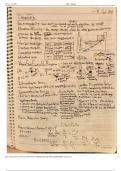
Sensory stimuli
- auditory stimuli
- somatosensory stimuli
- visual stimuli
- rewards (likes, hugs, …) → basal ganglia (dopamine)
- emotional stimuli → amygdala
Dopamine
- originates from the midbrain (VTA and substantia nigra)
- regulates motivation, not pleasure
Prefrontal cortex
- key for the cognitive (goal-directed) control of behavior
- not a unitary region, with distinct functions associated with different
subregions → reciprocal connections (connection goes both ways) with
much of the rest of the cortex (parietal, temporal, occipital, premotor)
- does not act in isolation to bias higher-order cognition, but interacts with (dopamine
in) the basal ganglia (BG)
- takes up about 30% of the total brain volume in humans (smaller in animals)
- PFC can orchestrate perception so that we do not observe irrelevant stimuli
(inhibitory control)
- can help us inhibit our responses to irrelevant sensory stimuli (Stroop
experiment → kleuren uitgeschreven in andere kleur) → words that have
an emotional valence have a longer/slower reaction time than neutral
words because emotional signals activate the amygdala and distract us
(inhibitory control taxed/belast particularly strongly when stimuli are
salient/opvallend)
- bilateral lesions of frontal cortex lead to stimulus-driven behavior instead of goal-
driven behavior in monkeys (study by Bianchi)
- PFC selects, protects, and maintains representation of task-relevant information, also
when it is no longer present.
- PFC does not subserve a unitary function: More dorsal and lateral parts are
implicated in the selection, protection, and maintenance of higher-order abstract
representations/More ventral and medial parts are implicated in value-based
selection and adaptation of actions
stimulus-driven behavior: eg utilization behavior: where you put glasses on because they are
glasses even though you already have glasses on so you don’t need them to see better
Lesions in humans
- Bilateral: frontal lobotomy, severe loss of initiative and goal-oriented
behavior → couch potato syndrome
- unilateral: lead to relatively mild deficits (behavior remains relatively normal, mild
working memory problems, inflexibility (goal neglect))
, - lateral PFC is the primary region for the interaction between current (WM) and
stored information (long-term memory (LTM))
- working memory (WM) is critical for non stimulus-driven behavior
- sustained delay-period activity seen in human DLPFC → if PFC is cooled in
monkeys they perform worse on a delayed response task
- skin conductance increases when people see a negative outcome in a reversal-
learning task
- (spatial) working memory can be tested with a task where they look for
blue boxes in red boxes without returning to already looked at red boxes
→ impaired in people with DLPFC lesion but not with OFC lesion
- OFC lesion lead to disability in making important decisions
Iowa gambling task: reversal-learning task where subjects are asked to choose between
good or bad decks of cards, good decks have small rewards but also small losses while the
bad deck has high rewards but even higher losses, so ultimately the good decks give you
more money, normal people learn this over time and adapt accordingly, (but not if there is a
lesion in the PFC)
- OFC is important for reversal learning: OFC neurons reverse rapidly during
reversal-learning tasks → reversal learning impaired by OFC lesions but
not lateral PFC lesions
- attentional set shift impaired by lateral PFC lesions but not by OFC lesions
Basal ganglia
, - basal ganglia do not directly implement any cognitive or motor program,
but modulate activity in multiple cortical areas, affecting motor
programming, learning, motivation and decision making, and cognitive
control (selection of motor/cognitive programs) using dopamine → This
role of striatal dopamine extends to the flexible gating of cognitive tasks,
maintained in working memory
- BG selectively facilitates (gates) one cortical representation (motor or cognitive
program) while suppressing other representations proportional to their costs and
benefits
Control of emotion
- most-studied emotion is fear
Emotions: triggered by evaluation of an event as relevant to an important goal, experienced
as distinct mental state accompanied by bodily changes, expressions and/or actions
(sweating, muscles tension, …), action tendencies (but: no direct stimulus-response
coupling/instinct)
- appraisal = evaluating the significance of the event
- more than half of the classified mental disorders (DSM-5) are
characterized by emotion dysregulation → anxiety, addictive disorders,
eating disorders, anger disorders, …
Sensory stimuli
- auditory stimuli
- somatosensory stimuli
- visual stimuli
- rewards (likes, hugs, …) → basal ganglia (dopamine)
- emotional stimuli → amygdala
Dopamine
- originates from the midbrain (VTA and substantia nigra)
- regulates motivation, not pleasure
Prefrontal cortex
- key for the cognitive (goal-directed) control of behavior
- not a unitary region, with distinct functions associated with different
subregions → reciprocal connections (connection goes both ways) with
much of the rest of the cortex (parietal, temporal, occipital, premotor)
- does not act in isolation to bias higher-order cognition, but interacts with (dopamine
in) the basal ganglia (BG)
- takes up about 30% of the total brain volume in humans (smaller in animals)
- PFC can orchestrate perception so that we do not observe irrelevant stimuli
(inhibitory control)
- can help us inhibit our responses to irrelevant sensory stimuli (Stroop
experiment → kleuren uitgeschreven in andere kleur) → words that have
an emotional valence have a longer/slower reaction time than neutral
words because emotional signals activate the amygdala and distract us
(inhibitory control taxed/belast particularly strongly when stimuli are
salient/opvallend)
- bilateral lesions of frontal cortex lead to stimulus-driven behavior instead of goal-
driven behavior in monkeys (study by Bianchi)
- PFC selects, protects, and maintains representation of task-relevant information, also
when it is no longer present.
- PFC does not subserve a unitary function: More dorsal and lateral parts are
implicated in the selection, protection, and maintenance of higher-order abstract
representations/More ventral and medial parts are implicated in value-based
selection and adaptation of actions
stimulus-driven behavior: eg utilization behavior: where you put glasses on because they are
glasses even though you already have glasses on so you don’t need them to see better
Lesions in humans
- Bilateral: frontal lobotomy, severe loss of initiative and goal-oriented
behavior → couch potato syndrome
- unilateral: lead to relatively mild deficits (behavior remains relatively normal, mild
working memory problems, inflexibility (goal neglect))
, - lateral PFC is the primary region for the interaction between current (WM) and
stored information (long-term memory (LTM))
- working memory (WM) is critical for non stimulus-driven behavior
- sustained delay-period activity seen in human DLPFC → if PFC is cooled in
monkeys they perform worse on a delayed response task
- skin conductance increases when people see a negative outcome in a reversal-
learning task
- (spatial) working memory can be tested with a task where they look for
blue boxes in red boxes without returning to already looked at red boxes
→ impaired in people with DLPFC lesion but not with OFC lesion
- OFC lesion lead to disability in making important decisions
Iowa gambling task: reversal-learning task where subjects are asked to choose between
good or bad decks of cards, good decks have small rewards but also small losses while the
bad deck has high rewards but even higher losses, so ultimately the good decks give you
more money, normal people learn this over time and adapt accordingly, (but not if there is a
lesion in the PFC)
- OFC is important for reversal learning: OFC neurons reverse rapidly during
reversal-learning tasks → reversal learning impaired by OFC lesions but
not lateral PFC lesions
- attentional set shift impaired by lateral PFC lesions but not by OFC lesions
Basal ganglia
, - basal ganglia do not directly implement any cognitive or motor program,
but modulate activity in multiple cortical areas, affecting motor
programming, learning, motivation and decision making, and cognitive
control (selection of motor/cognitive programs) using dopamine → This
role of striatal dopamine extends to the flexible gating of cognitive tasks,
maintained in working memory
- BG selectively facilitates (gates) one cortical representation (motor or cognitive
program) while suppressing other representations proportional to their costs and
benefits
Control of emotion
- most-studied emotion is fear
Emotions: triggered by evaluation of an event as relevant to an important goal, experienced
as distinct mental state accompanied by bodily changes, expressions and/or actions
(sweating, muscles tension, …), action tendencies (but: no direct stimulus-response
coupling/instinct)
- appraisal = evaluating the significance of the event
- more than half of the classified mental disorders (DSM-5) are
characterized by emotion dysregulation → anxiety, addictive disorders,
eating disorders, anger disorders, …