Crimean War- Key Vocab
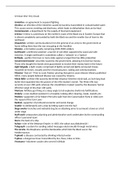
Armistice- an agreement to suspend fighting
Cholera- an infection of the intestine caused by bacteria transmitted in contaminated water.
This causes severe vomiting and diarrhoea, which leads to dehydration that can be fatal
Commissariet- a department for the supply of food and equipment
Crimea- Crimea is a peninsula on the northern coast of the Black sea in Eastern Europe that
is almost completely surrounded by both the Black sea and the smaller Sea of Azov to the
northeast
Dispatches- written communications from the general of an army to the government at
home telling them how the war was going at the frontline
Division- a formation usually comprising 4000-5000 soldiers
Earthwork- a defensive position- a barrier of soil often supported by wood and with
trenches. A single earthwork is sometimes called a ‘redoubt’ or a ‘baston’
Enfilade- gunfire from two or more sides against a target that has little protection
Government bonds- securities issued by the government, allowing it to borrow money.
Those who bought the bonds were guaranteed to receive their money back in the future
Light brigade- a light cavalry comprised of lightly armed and lightly armoured troops
mounted on horses. Usually used for reconnaissance, raiding and communications.
Miasma- ‘Bad air’- Prior to Louis Pasteur proving that germs cause disease (theory published
1861), many people believed disease was caused by miasma.
Minie Rifle- A Minie rifle (used by the British infantry) fired the minie ball, an inch-long lead
bullet that expanded into the groove of the rifle-musket’s barrel. The Minie rifle was
accurate at over 400 yards whereas the smoothbore musket (used by the Russians) had an
effective range of less than 100 yards.
Mortars- Artillery gun firing at a steep angle to lob explosive shells into fortifications
Orderly- a non-medical assistant in a hospital, looking after cleaning, meals, laundry etc.
Peelites- supporters of Sir Robert Peel who split from the Conservative Party in 1846 over
the repeal of the Corn Laws
Radical- supporter of profound economic and social change
Scuttle- to deliberately sink a ship by letting water into the hull
Siege works- trenches and redoubts dug by an attacking army to surround a town or a fort
under siege
Staff work- preparatory planning and administrative work undertaken by the commanding
officer’s personal team
Stern- the back of a ship
Sultan- ruler of the Ottoman Empire. In 1853, the sultan was Abdulmecid I
Telegraph- a system for sending coded messages electronically through metal wires
The straits- the Bosphurus and the Dardanelles which link the Black sea to the
Mediterranean
Typhoid- a disease contracted by drinking infected water
Typhus- a dangerous fever transmitted by lice, fleas, mites or ticks
Yeomanry- Volunteer cavalry who served in Britain
Armistice- an agreement to suspend fighting
Cholera- an infection of the intestine caused by bacteria transmitted in contaminated water.
This causes severe vomiting and diarrhoea, which leads to dehydration that can be fatal
Commissariet- a department for the supply of food and equipment
Crimea- Crimea is a peninsula on the northern coast of the Black sea in Eastern Europe that
is almost completely surrounded by both the Black sea and the smaller Sea of Azov to the
northeast
Dispatches- written communications from the general of an army to the government at
home telling them how the war was going at the frontline
Division- a formation usually comprising 4000-5000 soldiers
Earthwork- a defensive position- a barrier of soil often supported by wood and with
trenches. A single earthwork is sometimes called a ‘redoubt’ or a ‘baston’
Enfilade- gunfire from two or more sides against a target that has little protection
Government bonds- securities issued by the government, allowing it to borrow money.
Those who bought the bonds were guaranteed to receive their money back in the future
Light brigade- a light cavalry comprised of lightly armed and lightly armoured troops
mounted on horses. Usually used for reconnaissance, raiding and communications.
Miasma- ‘Bad air’- Prior to Louis Pasteur proving that germs cause disease (theory published
1861), many people believed disease was caused by miasma.
Minie Rifle- A Minie rifle (used by the British infantry) fired the minie ball, an inch-long lead
bullet that expanded into the groove of the rifle-musket’s barrel. The Minie rifle was
accurate at over 400 yards whereas the smoothbore musket (used by the Russians) had an
effective range of less than 100 yards.
Mortars- Artillery gun firing at a steep angle to lob explosive shells into fortifications
Orderly- a non-medical assistant in a hospital, looking after cleaning, meals, laundry etc.
Peelites- supporters of Sir Robert Peel who split from the Conservative Party in 1846 over
the repeal of the Corn Laws
Radical- supporter of profound economic and social change
Scuttle- to deliberately sink a ship by letting water into the hull
Siege works- trenches and redoubts dug by an attacking army to surround a town or a fort
under siege
Staff work- preparatory planning and administrative work undertaken by the commanding
officer’s personal team
Stern- the back of a ship
Sultan- ruler of the Ottoman Empire. In 1853, the sultan was Abdulmecid I
Telegraph- a system for sending coded messages electronically through metal wires
The straits- the Bosphurus and the Dardanelles which link the Black sea to the
Mediterranean
Typhoid- a disease contracted by drinking infected water
Typhus- a dangerous fever transmitted by lice, fleas, mites or ticks
Yeomanry- Volunteer cavalry who served in Britain