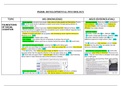
PS2040: DEVELOPMENTAL PSYCHOLOGY
TOPIC A01 (KNOWLEDGE) A02/3 (EVIDENCE+EVAL)
- Social cognition: concerns how people make sense of other people and themselves (Durkin, - Neonatal imitation: Davis et al (2021) conducted a
1995). In the social world. It attempts to explain social action through paying attention to meta-analyses of 26 articles. Found evidence for
FOUNDATIONS motivations, values, etc. neonatal imitation, and it was due to researcher
OF SOCIAL - Neonatal imitation: children have been found to imitate from birth (Meltzoff & Moore, 1977). affiliation that a baby imitated.
COGNITION = Recent evidence to suggest this is not consistently found, however Meltzoff responds that it
may be due to experimental conditions. - Deferred imitation:
- Imitation of tongue protrusion did not predict later-developing social cognitive behaviours = 9 months: imitate after 24hrs. (Meltzoff, 1988)
(Redshaw et al., 2019) = 14 months: imitate after 2 months. (Meltzoff, 1988)
- Deferred imitation: imitation after a delay. = 6 months: deferred imitation after 24hrs w/
- Over imitation: copy actions that are unnecessary to achieve the end goal. additional exposure to target actions. (Barr., 1996)
- Inferred intentions: believe adult has an intention behind the actions (12 & 18-month-olds).
- By 18 months can infer intentions and will imitate
- Joint attention and gaze following: evidence that 3-6months follow gaze. the goal but only when they can explain the odd
= 6 months are more likely to follow gaze when direct eye contact first and when infant-directed behaviour (Buttelman 2007)
speech is used (Senju & Csibra, 2008).
= From 9 months, infant follow eye-gaze longer at objects that are in the direction of someone’s - Joint attention and gaze following: 12-month-olds
eye-gaze rather than the opposite direction of the eye-gaze (Senju et al., 2008). understand gaze follow is referential (Okumura et al.,
=12-month-olds only gaze follow if eyes are open (Brooks & Meltzoff, 2002). Gaze following 2013). They are more likely to anticipate human gaze
allows infant to make inferences about what someone’s interests. than a robot gaze.
- Infant early inferences: six month olds understand who is helpful and who is unhelpful.
= 18-month-olds (but not 14-month-olds) infer desires based on emotional reaction.
, - Social Cognition: concerns how people make sense of other people and themselves (Durkin, Measuring Theory of Mind
1995). = False belief tasks: assessing how a ppt who has no
SOCIAL - Theory of Mind: (Premack & Woodruff, 1978) is the ability to attribute mental states to
COGNITION: knowledge can hold a false belief and act on it.
ourselves and others, serving as one of the foundational elements for social interaction.
THEORY OF MIND ➢ Having a theory of mind is important as it provides the ability to predict and interpret the = Tasks: change in physical location and change in
behavior of others. physical identity.
➢ During infancy and early childhood, children learn the early skills that they’ll need to
develop their theory of mind later on, such as paying attention to people and copying
= Change in physical location, Sally-Anne task: 3yr
them.
➢ The traditional test for theory of mind is a false-belief task, used to assess a child’s olds will not pass this task, say Sally will look in the
understanding that other people can have beliefs about the world which contrast with blue cupboard. 4yr olds will as they understand the
reality.
false belief and will pick red cupboard.
- Role of pretend play: children who participate in more sophisticated social pretend play
demonstrate a greater understanding of others’ false beliefs. = Change in physical idenity: smarties task.
= Preschoolers who participated in joint play (compared to solitary play) performed better on the
appearance/reality task, but not the false beliefs task (because child has to think of other ppl and
not just of objects).
- Mental state talk & pretend play: ppts who understand false beliefs better, demonstrate
stronger social interaction skills. There is more mental state talk during pretend play which can
predict ToM. = Child at 3ys cannot seperate their own beliefs and
- Mental state talk examples: using words that make people reflect on the mental state of others
believe their friend will say pencils because they now
“what does she mean, what do you think will happen, why would they do that?”
- Language: Milligan (2007) assessed the relationship between language ability and ToM know it is.
development. = 5yr olds say smarties.
Social interactions: Siblings
- Research supports that the more siblings a child has, the greater his/her performance on false Language (Milligan et al., 2007)
belief (Ruffman et al., 1998). - Children are given a word and they have to pick
= Older siblings appear to facilitate the false belief understanding of older children, but not that of
younger children (between 2.3 & 3.2yrs). what image on the paper represents that word.
= Having a sibling between 12 months & 12yrs, stimulates development of false belief = We learn about their receptive vocab.
understanding. = Findings show that there is a strong relationship
= ToM rapidly develops earlier with children who have siblings compared to those who don’t.
between early language & ToM understanding.
, Social interactions: Parenting styles Mental states
= (Ruffman et al., 1999) measured false belief in 5 different disciplinary situations. - Different interactions between people to child were
= Four disciplinary categories were found: reprimand response (go to your room), ambiguous assessed and the language used (Brown et al, 1996).
response, general discussion response & how feel response (reflective). They found that parents
who used the how feel response related to false belief understanding.
Social interactions: Peers
- Peers aided moral development. Cognitive disagreement would lead peers to be aware of and
explore differing perspectives on a problem.
- Faux pas & peer relations: higher faux pas understanding with higher peer acceptance scores
between 9-10yrs.
= Lower faux pas understanding was associated with higher peer rejection scores between 10-
11yrs.
Autism & Theory of Mind - Friendship interaction is more stronger than with
- Impairments: social and emotional development, language and communication & imagination. child to mother and child to sibling.
= Sally-Anne task: 85% of typical developing 4yr olds passed the test, 86% of down syndrome & = Children who could direct attention at 40 months
14% autisim children. and assert at 47 months predicted false belief
- At least 20% of autistic children pass the first order FB tasks. Could be due to using other understanding.
stratergies. = Findings were signficant with false beliefs
performance and mental state talk only with friends.
- Roots of ToM failure?
= Joint attention, autistic children fail to recognise eye-region of face as indicating what a person = Mental state talk: (Adrian et al., 2007) assessed
is thinking about, lack spontaneous gaze monitoring & no protodeclarative pointing (pointing, relationship between mental state talk when reading
touching, directing attention). picture book and ToM development. (longitudinal
- Researchers explored ToM development in children w/ hearing impairments. Four groups were over 1yr.)
studied:
= Native signers (parents are deaf), signing deaf from hearing homes (parents learn to sign), oral
deaf (large hearing imapirment but uses hearing aid) & coclear implant.
TOPIC A01 (KNOWLEDGE) A02/3 (EVIDENCE+EVAL)
- Social cognition: concerns how people make sense of other people and themselves (Durkin, - Neonatal imitation: Davis et al (2021) conducted a
1995). In the social world. It attempts to explain social action through paying attention to meta-analyses of 26 articles. Found evidence for
FOUNDATIONS motivations, values, etc. neonatal imitation, and it was due to researcher
OF SOCIAL - Neonatal imitation: children have been found to imitate from birth (Meltzoff & Moore, 1977). affiliation that a baby imitated.
COGNITION = Recent evidence to suggest this is not consistently found, however Meltzoff responds that it
may be due to experimental conditions. - Deferred imitation:
- Imitation of tongue protrusion did not predict later-developing social cognitive behaviours = 9 months: imitate after 24hrs. (Meltzoff, 1988)
(Redshaw et al., 2019) = 14 months: imitate after 2 months. (Meltzoff, 1988)
- Deferred imitation: imitation after a delay. = 6 months: deferred imitation after 24hrs w/
- Over imitation: copy actions that are unnecessary to achieve the end goal. additional exposure to target actions. (Barr., 1996)
- Inferred intentions: believe adult has an intention behind the actions (12 & 18-month-olds).
- By 18 months can infer intentions and will imitate
- Joint attention and gaze following: evidence that 3-6months follow gaze. the goal but only when they can explain the odd
= 6 months are more likely to follow gaze when direct eye contact first and when infant-directed behaviour (Buttelman 2007)
speech is used (Senju & Csibra, 2008).
= From 9 months, infant follow eye-gaze longer at objects that are in the direction of someone’s - Joint attention and gaze following: 12-month-olds
eye-gaze rather than the opposite direction of the eye-gaze (Senju et al., 2008). understand gaze follow is referential (Okumura et al.,
=12-month-olds only gaze follow if eyes are open (Brooks & Meltzoff, 2002). Gaze following 2013). They are more likely to anticipate human gaze
allows infant to make inferences about what someone’s interests. than a robot gaze.
- Infant early inferences: six month olds understand who is helpful and who is unhelpful.
= 18-month-olds (but not 14-month-olds) infer desires based on emotional reaction.
, - Social Cognition: concerns how people make sense of other people and themselves (Durkin, Measuring Theory of Mind
1995). = False belief tasks: assessing how a ppt who has no
SOCIAL - Theory of Mind: (Premack & Woodruff, 1978) is the ability to attribute mental states to
COGNITION: knowledge can hold a false belief and act on it.
ourselves and others, serving as one of the foundational elements for social interaction.
THEORY OF MIND ➢ Having a theory of mind is important as it provides the ability to predict and interpret the = Tasks: change in physical location and change in
behavior of others. physical identity.
➢ During infancy and early childhood, children learn the early skills that they’ll need to
develop their theory of mind later on, such as paying attention to people and copying
= Change in physical location, Sally-Anne task: 3yr
them.
➢ The traditional test for theory of mind is a false-belief task, used to assess a child’s olds will not pass this task, say Sally will look in the
understanding that other people can have beliefs about the world which contrast with blue cupboard. 4yr olds will as they understand the
reality.
false belief and will pick red cupboard.
- Role of pretend play: children who participate in more sophisticated social pretend play
demonstrate a greater understanding of others’ false beliefs. = Change in physical idenity: smarties task.
= Preschoolers who participated in joint play (compared to solitary play) performed better on the
appearance/reality task, but not the false beliefs task (because child has to think of other ppl and
not just of objects).
- Mental state talk & pretend play: ppts who understand false beliefs better, demonstrate
stronger social interaction skills. There is more mental state talk during pretend play which can
predict ToM. = Child at 3ys cannot seperate their own beliefs and
- Mental state talk examples: using words that make people reflect on the mental state of others
believe their friend will say pencils because they now
“what does she mean, what do you think will happen, why would they do that?”
- Language: Milligan (2007) assessed the relationship between language ability and ToM know it is.
development. = 5yr olds say smarties.
Social interactions: Siblings
- Research supports that the more siblings a child has, the greater his/her performance on false Language (Milligan et al., 2007)
belief (Ruffman et al., 1998). - Children are given a word and they have to pick
= Older siblings appear to facilitate the false belief understanding of older children, but not that of
younger children (between 2.3 & 3.2yrs). what image on the paper represents that word.
= Having a sibling between 12 months & 12yrs, stimulates development of false belief = We learn about their receptive vocab.
understanding. = Findings show that there is a strong relationship
= ToM rapidly develops earlier with children who have siblings compared to those who don’t.
between early language & ToM understanding.
, Social interactions: Parenting styles Mental states
= (Ruffman et al., 1999) measured false belief in 5 different disciplinary situations. - Different interactions between people to child were
= Four disciplinary categories were found: reprimand response (go to your room), ambiguous assessed and the language used (Brown et al, 1996).
response, general discussion response & how feel response (reflective). They found that parents
who used the how feel response related to false belief understanding.
Social interactions: Peers
- Peers aided moral development. Cognitive disagreement would lead peers to be aware of and
explore differing perspectives on a problem.
- Faux pas & peer relations: higher faux pas understanding with higher peer acceptance scores
between 9-10yrs.
= Lower faux pas understanding was associated with higher peer rejection scores between 10-
11yrs.
Autism & Theory of Mind - Friendship interaction is more stronger than with
- Impairments: social and emotional development, language and communication & imagination. child to mother and child to sibling.
= Sally-Anne task: 85% of typical developing 4yr olds passed the test, 86% of down syndrome & = Children who could direct attention at 40 months
14% autisim children. and assert at 47 months predicted false belief
- At least 20% of autistic children pass the first order FB tasks. Could be due to using other understanding.
stratergies. = Findings were signficant with false beliefs
performance and mental state talk only with friends.
- Roots of ToM failure?
= Joint attention, autistic children fail to recognise eye-region of face as indicating what a person = Mental state talk: (Adrian et al., 2007) assessed
is thinking about, lack spontaneous gaze monitoring & no protodeclarative pointing (pointing, relationship between mental state talk when reading
touching, directing attention). picture book and ToM development. (longitudinal
- Researchers explored ToM development in children w/ hearing impairments. Four groups were over 1yr.)
studied:
= Native signers (parents are deaf), signing deaf from hearing homes (parents learn to sign), oral
deaf (large hearing imapirment but uses hearing aid) & coclear implant.