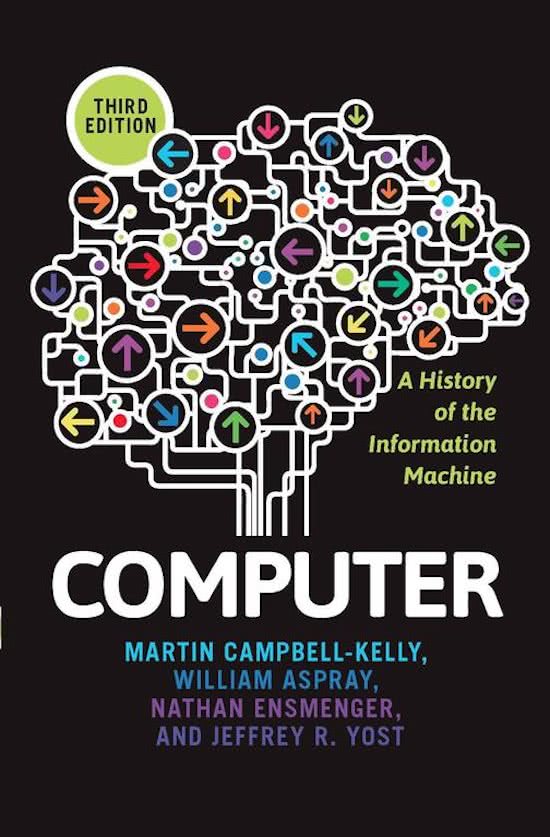
Computer: a history of the information machine
summary
In 1983, Time reported about a personal computer. This was, however, not the first computer:
1950 a calculator was built at the Harvard University for the US Navy, and in 1890 the
punchedcard tabulating system for processing the US Census was invented.
The first computers were large and were one of a kind. The WW2 led to the modern
computer, because they had then a great drive to improve the speed of the calculations.
The industrial revolution led to increasing population and urbanization in the west. Therefore,
the scale of business expanded and resulted in an increase of information collection,
processing and communication needs. Systems were developed for handling this increase in
information. The offices were turned in highly effective and organized systems. Later,
technology came into play. First only for the wealthiest people but later also for the “normal”
people caused by mass production.
The computers of the 1930s were not up to the demands of the military in the WW2. They had
3 shortcomings: human intervention was needed, too slow and they were made for only one
specific purpose. The military had millions and this resulted in storedprogram computers.
Unfortunately, the computers were built too late for the war.
Several groups saw the computer not only as crunching machine but also as data processing
/ accounting machine. The ENIAC builders and IBM were part of these groups.
The basic functional specifications of the computer were set out in a report written by John
von Neumann in 1945, and these specifications are still largely followed today. There are two
types of innovation that followed this concept: the improvement of the components and the
mode of the operation. The five important ones are: highlevel programming languages,
realtime computing, timesharing, networking, and graphically oriented humancomputer
interfaces. While the basic structure of the computer remained unchanged, these new
components and modes of operation revolutionized our human experiences with computers.
The lower cost of computers made it possible to use computers in other environments.
Chapter 1
The word computer meant, in WW2 and Victorian period, a occupation: someone that
computes. The electronic computer is a combination of the human computer and the human
clerk.
, Human computer were first used for the production of mathematical tables. Logarithmic tables
speeded the calculations up just like the trigonometric tables. These were for general
purpose. In the late 18th century there were specialized tables for:
navigational tables for mariners
star tables for astronomers
life insurance tables for actuaries
civil engineering tables for architects
etc...
In 1766 the British government sanctioned the astronomer royal, Nevil Maskelyne, to produce
each year a set of navigational tables to be known as the Nautical Almanac. These provided a
reliable navigation system and therefore was of great importance for the economy. The
calculations were performed twice, independently, by two computers and checked by a third
“comparator.”
Charles Babbage was engaged in the problem of table making and the elimination of errors in
tables. Charles learned about the Frenchtable making project of Gaspard de Prony, and
found it very difficult and error prone to make tables. Therefore, he invented the Difference
machine which was a machine that had adding mechanisms to do the calculations and the
printing part. Unfortunately, Babbage underestimated the financial and technical resources
he would need to build his engine. Asking money for a machine called the Analytical Engine, it
would do any calculation, was the end of Babbage.
The victorian period was the great age of the physical and financial infrastructure investment.
Important information structures of the Victorian period:
Railway Clearing House: tables to check that passenger had paid
telegraph. Was invented to prevent that two trains were on the same track.
By the mid1860s there were more over 75000 miles of telegraph lines in Britain. In 1870
integrated separated systems to make it more efficient. In 1874 a central hub: The central
telegraph office was established, so that every city of importance had a direct line.
The first dataprocessing bureaucracy in the US was the Bureau of the Census. It took about
7 years to process the data that was collected on the grid. To solve this problem Herman
Hollerith developed a machine for census data processing. Later known as the Tabulating
Machine Company and foundation of IBM. For the first time Female labor was used to make
the punched cards.
At the end of the 19th century America had the most advanced office equipment. Reasons for
this is:
America’s office’s started late; they could start fresh and didn’t have to renew the
office.
summary
In 1983, Time reported about a personal computer. This was, however, not the first computer:
1950 a calculator was built at the Harvard University for the US Navy, and in 1890 the
punchedcard tabulating system for processing the US Census was invented.
The first computers were large and were one of a kind. The WW2 led to the modern
computer, because they had then a great drive to improve the speed of the calculations.
The industrial revolution led to increasing population and urbanization in the west. Therefore,
the scale of business expanded and resulted in an increase of information collection,
processing and communication needs. Systems were developed for handling this increase in
information. The offices were turned in highly effective and organized systems. Later,
technology came into play. First only for the wealthiest people but later also for the “normal”
people caused by mass production.
The computers of the 1930s were not up to the demands of the military in the WW2. They had
3 shortcomings: human intervention was needed, too slow and they were made for only one
specific purpose. The military had millions and this resulted in storedprogram computers.
Unfortunately, the computers were built too late for the war.
Several groups saw the computer not only as crunching machine but also as data processing
/ accounting machine. The ENIAC builders and IBM were part of these groups.
The basic functional specifications of the computer were set out in a report written by John
von Neumann in 1945, and these specifications are still largely followed today. There are two
types of innovation that followed this concept: the improvement of the components and the
mode of the operation. The five important ones are: highlevel programming languages,
realtime computing, timesharing, networking, and graphically oriented humancomputer
interfaces. While the basic structure of the computer remained unchanged, these new
components and modes of operation revolutionized our human experiences with computers.
The lower cost of computers made it possible to use computers in other environments.
Chapter 1
The word computer meant, in WW2 and Victorian period, a occupation: someone that
computes. The electronic computer is a combination of the human computer and the human
clerk.
, Human computer were first used for the production of mathematical tables. Logarithmic tables
speeded the calculations up just like the trigonometric tables. These were for general
purpose. In the late 18th century there were specialized tables for:
navigational tables for mariners
star tables for astronomers
life insurance tables for actuaries
civil engineering tables for architects
etc...
In 1766 the British government sanctioned the astronomer royal, Nevil Maskelyne, to produce
each year a set of navigational tables to be known as the Nautical Almanac. These provided a
reliable navigation system and therefore was of great importance for the economy. The
calculations were performed twice, independently, by two computers and checked by a third
“comparator.”
Charles Babbage was engaged in the problem of table making and the elimination of errors in
tables. Charles learned about the Frenchtable making project of Gaspard de Prony, and
found it very difficult and error prone to make tables. Therefore, he invented the Difference
machine which was a machine that had adding mechanisms to do the calculations and the
printing part. Unfortunately, Babbage underestimated the financial and technical resources
he would need to build his engine. Asking money for a machine called the Analytical Engine, it
would do any calculation, was the end of Babbage.
The victorian period was the great age of the physical and financial infrastructure investment.
Important information structures of the Victorian period:
Railway Clearing House: tables to check that passenger had paid
telegraph. Was invented to prevent that two trains were on the same track.
By the mid1860s there were more over 75000 miles of telegraph lines in Britain. In 1870
integrated separated systems to make it more efficient. In 1874 a central hub: The central
telegraph office was established, so that every city of importance had a direct line.
The first dataprocessing bureaucracy in the US was the Bureau of the Census. It took about
7 years to process the data that was collected on the grid. To solve this problem Herman
Hollerith developed a machine for census data processing. Later known as the Tabulating
Machine Company and foundation of IBM. For the first time Female labor was used to make
the punched cards.
At the end of the 19th century America had the most advanced office equipment. Reasons for
this is:
America’s office’s started late; they could start fresh and didn’t have to renew the
office.