

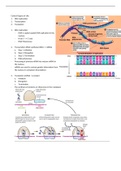
Central Dogma of Life:
1. DNA replication
2. Transcription
3. Translation
1. DNA replication
- DNA is copied copied DNA replication in the
nucleus
- From 5’ → 3’ end
- DNA Polymerase
2. Transcription (RNA synthesis) (DNA → mRNA)
a. Step 1: initiation
b. Step 2: Elongation
c. Step 3: Termination
d. RNA polymerase
- Processing of primary mRNA into mature mRNA in
the nucleus
- mRNAs are used to convey genetic information from
the nucleus to cytoplasm (translation).
3. Translation (mRNA → protein)
a. Initiation
b. Elongation
c. Termination
- The synthesis of proteins on ribosomes in the cytoplasm
, - All organisms must regulate which genes are expressed at any given time
- Genes are turned on and off in response to signals from their external and internal environments
- In multicellular organisms, all cells contain an identical genome
- Differential gene expression is what makes a nerve cell different from a muscle cell. Regulation of gene expression
is essential for cell specialisation and ‘proper’ cell function
Key stages at which gene expression may be regulated include:
Regulation of Gene Expression: Chromatin
- Chromatin is a complex of equal parts of DNA and proteins that forms chromosomes
- The nucleosome (beads) is the fundamental subunit of chromatin
- 8 protein molecules (histones)
- Positively charged AAs bind to negatively charged DNA
- Chromatin could be heterochromatin or euchromatin
1. DNA replication
2. Transcription
3. Translation
1. DNA replication
- DNA is copied copied DNA replication in the
nucleus
- From 5’ → 3’ end
- DNA Polymerase
2. Transcription (RNA synthesis) (DNA → mRNA)
a. Step 1: initiation
b. Step 2: Elongation
c. Step 3: Termination
d. RNA polymerase
- Processing of primary mRNA into mature mRNA in
the nucleus
- mRNAs are used to convey genetic information from
the nucleus to cytoplasm (translation).
3. Translation (mRNA → protein)
a. Initiation
b. Elongation
c. Termination
- The synthesis of proteins on ribosomes in the cytoplasm
, - All organisms must regulate which genes are expressed at any given time
- Genes are turned on and off in response to signals from their external and internal environments
- In multicellular organisms, all cells contain an identical genome
- Differential gene expression is what makes a nerve cell different from a muscle cell. Regulation of gene expression
is essential for cell specialisation and ‘proper’ cell function
Key stages at which gene expression may be regulated include:
Regulation of Gene Expression: Chromatin
- Chromatin is a complex of equal parts of DNA and proteins that forms chromosomes
- The nucleosome (beads) is the fundamental subunit of chromatin
- 8 protein molecules (histones)
- Positively charged AAs bind to negatively charged DNA
- Chromatin could be heterochromatin or euchromatin


