
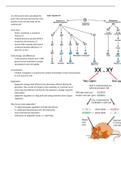
As cells become more specialised the
genes they will need also become more
specific to the cell and many can be
switched off.
Gene dose:
- Down’s syndrome is caused by
trisomy 21
- Amyloid precursor protein (APP) is
located on chromosome 21
- Around half of people with down’s
syndrome develop Alzheimer’s in
their 50’s or 60’s
Gene dosage: sex differences
- X chromosome contains over 1,000
genes that are essential for proper
development and cell viability
X-inactivation:
- X-linked variegation is caused by the random inactivation of one X chromosome
in each precursor cell.
Epigenetics:
- Epigenetic changes that influence the phenotype without altering the
genotype. They consist of changes in the properties of a cell that can in
some cases be inherited, but that do not represent a change in genetic
information.
- Epigenetic regulation is a long term and energy intensive form of gene
regulation.
Why do we study epigenetics?
- To understand gene regulation in health and disease
- To understand development and cell programing
- Gene environment interaction
- Inheritance of epigenetic marks, i.e. imprinting.
, Levels of specific gene products in a tissue can be regulated at different points of their production and persist within
the system for different lengths of time. The right genes, at the right time, in the right place need to be switched on.
Transcription:
As RNA polymerase moves along the DNA, it untwists the double helix, 10 to 20 bases at a time. Transcription
progresses at a rate of 40 nucleotides per second in eukaryotes. Nucleotides are added to the 3 ′ end of the growing
RNA molecule. A gene can be transcribed simultaneously by several RNA polymerases
genes they will need also become more
specific to the cell and many can be
switched off.
Gene dose:
- Down’s syndrome is caused by
trisomy 21
- Amyloid precursor protein (APP) is
located on chromosome 21
- Around half of people with down’s
syndrome develop Alzheimer’s in
their 50’s or 60’s
Gene dosage: sex differences
- X chromosome contains over 1,000
genes that are essential for proper
development and cell viability
X-inactivation:
- X-linked variegation is caused by the random inactivation of one X chromosome
in each precursor cell.
Epigenetics:
- Epigenetic changes that influence the phenotype without altering the
genotype. They consist of changes in the properties of a cell that can in
some cases be inherited, but that do not represent a change in genetic
information.
- Epigenetic regulation is a long term and energy intensive form of gene
regulation.
Why do we study epigenetics?
- To understand gene regulation in health and disease
- To understand development and cell programing
- Gene environment interaction
- Inheritance of epigenetic marks, i.e. imprinting.
, Levels of specific gene products in a tissue can be regulated at different points of their production and persist within
the system for different lengths of time. The right genes, at the right time, in the right place need to be switched on.
Transcription:
As RNA polymerase moves along the DNA, it untwists the double helix, 10 to 20 bases at a time. Transcription
progresses at a rate of 40 nucleotides per second in eukaryotes. Nucleotides are added to the 3 ′ end of the growing
RNA molecule. A gene can be transcribed simultaneously by several RNA polymerases


