SAUNDERS ATI PHARMACOLOGY STUDY GUIDE
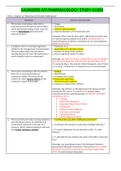
SAUNDERS ATI PHARMACOLOGY STUDY GUIDE Week 1: Chapter 35 “Maternity and Newborn Medications” Questions Answers and Rationales 1. The nurse is monitoring a client who is receiving oxytocin (Pitocin) to induce labor. Which assessment finding would cause the nurse to immediately discontinue the oxytocin infusion? 1. Fatigue 2. Drowsiness 3. Uterine hyperstimulation 4. Early decelerations of the fetal heart rate Rationale: Often used to induce labor. High doses are often used for uterine hyperstimulation & C/S births. ADVERSE EFFECTS: Hyperstimulation of uterine contractions & non-reassuring fetal HR DISCONTINUE 2. A pregnant client is receiving magnesium sulfate for the management of preeclampsia. The nurse determines that the client is experiencing toxicity from the medication if which finding is noted on assessment? 1. Proteinuria of 3 + 2. Respirations of 10 breaths/ minute 3. Presence of deep tendon reflexes 4. Serum magnesium level of 6 mEq/ L Rationale: Mg TOXICITY RESP. DEPRESSION, LOSS OF TENDON REFLEXES & SUDDEN DECLINE IN FETAL HR, MATERNAL HR, & BP caused by Mg tx. Must remain within therapeutic serum levels 4–7.5 mEq/L. Proteinuria 3+ is expected in a pt w/ preeclampsia. 3. The nurse is monitoring a client in preterm labor who is receiving intravenous magnesium sulfate. The nurse should monitor for which adverse effects of this medication? Select all that apply. 1. Flushing 2. Hypertension 3. Increased urine output 4. Depressed respirations 5. Extreme muscle weakness 6. Hyperactive deep tendon reflexes Rationale: Mg sulfate is a CNS depressant that relaxes smooth muscles like the uterus. It’s used to STOP preterm labor contractions and for preeclampsia pts. to PREVENT SEIZURES. ADVERSE EFFECTS: • Flushing • Depressed respirations • Depressed deep tendon reflexes • Hypotension • Extreme muscle weakness • Decreased urine output • Pulmonary Edema • Elevated Mg serum levels 4. The nurse instructor asks a nursing student to describe the procedure for administering erythromycin ointment to the eyes of a newborn. Which student statement indicates that further teaching is needed? 1. “I will flush the eyes after instilling the ointment?” 2. “I will clean the newborn’s eyes before instilling ointment.” 3. “I need to administer the eye ointment within 1 hr. after delivery.” 4. “I will instill the eye ointment into each of the NB’s conjunctiva sacs.” Rationale: Eye prophylaxis protects the NB against Neisseria gonorrhea & Chlamydia trachomatis. The eyes are NOT FLUSHED AFTER INSTILLATION of med because the flush would WASH AWAY the administered medication. 5. A client in preterm labor (31 weeks) who is dilated to 4 cm has been started on magnesium sulfate and contractions have stopped. If the client’s labor can be inhibited for the next 48 hours, the nurse anticipates a prescription for which medication? 1. Nalbuphine (Nubain) 2. Betamethasone (Celestone) 3. Rho(D) immune globulin (RhoGAM) 4. Dinoprostone (Cervidil vaginal insert) Rationale: Betamethasone, a glucocorticoid increases the production of surfactant to stimulate fetal lung maturation. It is administered to clients in preterm labor at 28 to 32 weeks of gestation if the labor can be inhibited for 48 hours. Nalbuphine (Nubain) is an opioid analgesic. Rho(D) immune globulin (RhoGAM) is given to Rh-negative clients to prevent immunological condition aka Rh disease (hemolytic disease of NB); it takes out the + cells that were transported from maternal blood stream fetal circulation. Dinoprostone (Cervidil vaginal insert) is a prostaglandin given to ripen and soften the cervix and to stimulate uterine contractions. 6. Methylergonovine (Methergine) is prescribed for a woman to treat postpartum hemorrhage. Before administration of methylergonovine, what is the priority nursing assessment? 1. Uterine tone 2. Blood pressure ABC!!! 3. Amount of lochia 4. Deep tendon reflexes Rationale: Methylergonovine is an ERGOT ALKALOID prevents or controls postpartum hemorrhage by contracting the uterus. This med continuous uterine contractions and can elevate BP CHECK BP report to MD if HTN is present 7. The nurse is preparing to administer beractant (Survanta) to a premature infant who has respiratory distress syndrome. The nurse plans to administer the medication by which route? 1. Intradermal 2. Intratracheal 3. Subcutaneous 4. Intramuscular Rationale: Respiratory distress syndrome is a serious lung disorder caused by immaturity and the inability to produce surfactant hypoxia and acidosis. It is common in premature infants and may be due to lung immaturity as a result of surfactant deficiency. The mainstay of tx=exogenous surfactant, which is administered by the intratracheal route. * Note relationship that question states “respiratory distress syndrome” Intratracheal 8. An opioid analgesic is administered to a client in labor. The nurse assigned to care for the client ensures that which medication is readily available if respiratory depression occurs? 1. Naloxone Antidote! 2. Morphine sulfate 3. Betamethasone (Celestone) 4. Meperidine hydrochloride (Demerol) 9. Rho(D) immune globulin (RhoGAM) is prescribed for a client after delivery and the nurse provides information to the client about the purpose of the medication. The nurse determines that the woman understands the purpose if the woman states that it will protect her next baby from which condition? 1. Having Rh-positive blood 2. Developing a rubella infection 3. Developing physiological jaundice 4. Being affected by Rh incompatibility Rationale: Rh incompatibility can occur when an Rh-negative mother becomes sensitized to Rh antigen. Sensitization may occur when an Rh-negative woman becomes pregnant with a fetus who is positive maternal circulation mother’s immune system to form antibodies against Rh+ blood. This medication prevents mothers from developing antibodies against Rh+ blood by providing passive antibody protection against Rh antigen. 10. Methylergonovine (Methergine) is prescribed for a client with postpartum hemorrhage. Before administering the medication, the nurse contacts the health care provider who prescribed the medication if which condition is documented in the client’s medical history? 1. Hypotension 2. Hypothyroidism 3. Diabetes mellitus 4. Peripheral vascular disease Rationale: Ergot alkaloids are contraindicated in clients with significant cardiovascular disease, peripheral vascular disease, hypertension, preeclampsia, or eclampsia. The vasoconstrictive effects of the ergot alkaloids worsen these conditions. Chapter 49: “Pediatric Med. Administration and Calculations” Questions Answers and Rationales 1. The nurse is providing medication instructions to a parent. Which statement by the parent indicates a need for further instruction? 1. “I should cuddle my child after giving the medication.” 2. “I can give my child a frozen juice bar after he swallows the medication.” 3. “I should mix the medication in the baby food and give it when I feed my child.” 4. “If my child does not like the taste of the medicine, I should encourage him to pinch his nose and drink the medication through a straw.” Rationale: It may give an unpleasant taste to the food, and the child may refuse to accept the same food in the future. In addition, the child may not consume the entire serving and would not receive the required medication dosage. 2. A health care provider’s prescription reads “ampicillin sodium 125 mg IV every 6 hours.” The medication label reads “1 g and reconstitute with 7.4 mL of bacteriostatic water.” The nurse prepares to draw up how many mL to administer one dose? 1. 1.1 mL 2. 0.54 mL 3. 7.425 mL 4. 0.925 mL Rationale: 1 g= 1000 mg 3. A pediatric client with ventricular septal defect repair is placed on a maintenance dosage of digoxin (Lanoxin). The dosage is 0.07 mg/ kg/ day, and the client’s weight is 7.2 kg. The health care provider (HCP) prescribes the digoxin to be given twice daily. The nurse prepares how much digoxin to administer to the client at each dose? 1. 0.5 mg 2. 2.5 mg 3. 0.25 mg 4. 0.37 mg Rationale: 4. Sulfisoxazole (Gantrisin), 1 g orally four times daily, is prescribed for an adolescent with a urinary tract infection. The medication label reads “500-mg tablets.” The nurse has determined that the dosage prescribed is safe. The nurse administers how many tablets per dose to the adolescent? 1. 1⁄2 tablet 2. 1 tablet 3. 2 tablets 4. 3 tablets Rationale: 5. Penicillin G procaine (Wycillin), 1,000,000 units IM (intramuscularly), is prescribed for a child with an infection. The medication label reads “1,200,000 units per 2 mL.” The nurse has determined that the dose prescribed is safe. The nurse administers how many milliliters per dose to the child? 1. 0.8 mL 2. 1.2 mL 3. 1.44 mL 4. 1.66 mL Rationale: 6. The nurse prepares to administer an intramuscular injection to a 4-month-old infant. The nurse selects which best site to administer the injection? 1. Ventrogluteal 2. Dorsal gluteal 3. Rectus femoris 4. Vastus lateralis Rationale: The vastus lateralis is the ONLY SAFE muscle group to use for IM in a 4-month old infant. The other routes are unsafe. 7. Atropine sulfate, 0.6 mg intramuscularly, is prescribed for a child preoperatively. The nurse has determined that the dose prescribed is safe and prepares to administer how many milliliters to the child? Fill in the blank (refer to figure). Answer: 1.5mL
Written for
- Institution
- SAUNDERS ATI PHARMACOLOGY STUDY GUIDE
- Module
- SAUNDERS ATI PHARMACOLOGY STUDY GUIDE
Document information
- Uploaded on
- January 18, 2022
- Number of pages
- 28
- Written in
- 2022/2023
- Type
- Exam (elaborations)
- Contains
- Questions & answers
Subjects
-
saunders ati pharmacology study guide
-
week 1 chapter 35 “maternity and newborn medications” questions answers and rationales 1 the nurse is monitoring a client who is receiving oxytocin pitocin to

Also available in package deal