

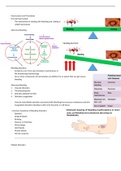
Haemostasis and Thrombosis
Normal Haemostasis
- The mechanism for dealing with bleeding and clotting is
called haemostasis
Abnormal bleeding
Bleeding disorders:
- Symptoms vary from easy bruising to spontaneous or
life-threatening haemorrhage
- Occur when components of haemostasis are deficient to an extent that you get excess
bleeding
Abnormal bleeding
1. Vascular disorders
2. Thrombocytopenia
3. Defective platelet function
4. Defective coagulation
- Vascular and platelet disorders associated with bleeding from mucous membranes and skin
- Coagulation disorders bleeding is often into the joints or soft tissue
Common Symptoms of Bleeding Disorders:
- Epistaxis
- Gingival bleeds
- Bruising
- Purpura or Petechiae
- Menorrhagia
- Joint bleeds
- Muscle bleeds
- Chronic anaemia
Platelet Disorders
, Bleeding Disorders associated with platelets - Platelet bleeding disorders can be:
1. Quantitative (reduced number) ,(<150 x 109/L)
a. thrombocytopenia
2. Qualitative (reduced function)
a. Acquired
b. Inherited (rare)
Thrombocytopenia
- Most common platelet disorder
- Most commonly acquired
- Reduced production (more severe) or increased destruction
- Characterised by:
- Spontaneous skin purpura
- Mucosal haemorrhage and prolonged bleeding after trauma
Acquired Platelet Dysfunction – Aspirin treatment
- Aspirin can be used in the prevention of atherothrombosis
- Aspirin permanently inactivates the cyclooxygenase (COX)
- COX-1 catalyses the conversion of arachidonic acid to
prostaglandin H2
- First committed step in the biosynthesis of thromboxane A2
- Thromboxane A2 triggers reactions that lead to platelet
activation and aggregation
- These effects last for the life of the anucleate platelet,
approximately 7 to 10 days.
Inherited Platelet Disorders
- Inherited platelet disorders are rare
- They can affect various aspects of platelet function including
platelet adhesion, secretion and aggregation
Historic Test – Bleeding time
- The bleeding time is operator dependent, poorly reproducible and neither objective or sensitive
Normal Haemostasis
- The mechanism for dealing with bleeding and clotting is
called haemostasis
Abnormal bleeding
Bleeding disorders:
- Symptoms vary from easy bruising to spontaneous or
life-threatening haemorrhage
- Occur when components of haemostasis are deficient to an extent that you get excess
bleeding
Abnormal bleeding
1. Vascular disorders
2. Thrombocytopenia
3. Defective platelet function
4. Defective coagulation
- Vascular and platelet disorders associated with bleeding from mucous membranes and skin
- Coagulation disorders bleeding is often into the joints or soft tissue
Common Symptoms of Bleeding Disorders:
- Epistaxis
- Gingival bleeds
- Bruising
- Purpura or Petechiae
- Menorrhagia
- Joint bleeds
- Muscle bleeds
- Chronic anaemia
Platelet Disorders
, Bleeding Disorders associated with platelets - Platelet bleeding disorders can be:
1. Quantitative (reduced number) ,(<150 x 109/L)
a. thrombocytopenia
2. Qualitative (reduced function)
a. Acquired
b. Inherited (rare)
Thrombocytopenia
- Most common platelet disorder
- Most commonly acquired
- Reduced production (more severe) or increased destruction
- Characterised by:
- Spontaneous skin purpura
- Mucosal haemorrhage and prolonged bleeding after trauma
Acquired Platelet Dysfunction – Aspirin treatment
- Aspirin can be used in the prevention of atherothrombosis
- Aspirin permanently inactivates the cyclooxygenase (COX)
- COX-1 catalyses the conversion of arachidonic acid to
prostaglandin H2
- First committed step in the biosynthesis of thromboxane A2
- Thromboxane A2 triggers reactions that lead to platelet
activation and aggregation
- These effects last for the life of the anucleate platelet,
approximately 7 to 10 days.
Inherited Platelet Disorders
- Inherited platelet disorders are rare
- They can affect various aspects of platelet function including
platelet adhesion, secretion and aggregation
Historic Test – Bleeding time
- The bleeding time is operator dependent, poorly reproducible and neither objective or sensitive


