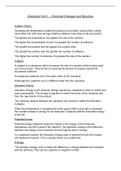
Chemistry Unit 1 – Chemical Changes and Structure
Collison Theory
Increasing the temperature makes the particles move faster making them collide
more often and with more energy (making collisions more likely to be successful).
The greater the temperature, the greater the rate of the reaction.
The higher the concentration of acid, the greater the number of collisions.
The smaller the particle size the greater the surface area.
The greater the surface area the greater the number of collisions.
The higher the number of collisions, the greater the rate of the reaction.
Catalyst
A catalyst is a substance which increases the rate of a reaction without being used
up in the process. They do this by reducing the amount of energy required for
successful collisions.
Homogenous catalysts are in the same state as the reactants.
Heterogenous catalysts are in a different state from the reactants.
Activation Energy
Activation energy is the minimum energy required by reactants in order to collide and
react successfully. This energy is required to break the bonds of the reactants and
form the new bonds in the product.
The molecule halfway between the reactants and product is called the Activated
Complex.
When the temperature is increased the entire graph shifts to the right to represent
the overall increase in energy for all molecules. Catalysts shift the Activation energy
to the left.
Potential Energy
Potential energy diagrams show the change in the energy of the molecules
themselves over the course of the reaction. The activation energy is the difference
between the energy of the reactants and the highest point in energy.
In a catalysed reaction the Activation energy peak is lowered for both the forward
and backward reaction. This is usually shown as a dotted line.
Enthalpy
The enthalpy change (∆H) is simply the difference in energy between the reactants
and the products. This can be a positive or negative number.
Collison Theory
Increasing the temperature makes the particles move faster making them collide
more often and with more energy (making collisions more likely to be successful).
The greater the temperature, the greater the rate of the reaction.
The higher the concentration of acid, the greater the number of collisions.
The smaller the particle size the greater the surface area.
The greater the surface area the greater the number of collisions.
The higher the number of collisions, the greater the rate of the reaction.
Catalyst
A catalyst is a substance which increases the rate of a reaction without being used
up in the process. They do this by reducing the amount of energy required for
successful collisions.
Homogenous catalysts are in the same state as the reactants.
Heterogenous catalysts are in a different state from the reactants.
Activation Energy
Activation energy is the minimum energy required by reactants in order to collide and
react successfully. This energy is required to break the bonds of the reactants and
form the new bonds in the product.
The molecule halfway between the reactants and product is called the Activated
Complex.
When the temperature is increased the entire graph shifts to the right to represent
the overall increase in energy for all molecules. Catalysts shift the Activation energy
to the left.
Potential Energy
Potential energy diagrams show the change in the energy of the molecules
themselves over the course of the reaction. The activation energy is the difference
between the energy of the reactants and the highest point in energy.
In a catalysed reaction the Activation energy peak is lowered for both the forward
and backward reaction. This is usually shown as a dotted line.
Enthalpy
The enthalpy change (∆H) is simply the difference in energy between the reactants
and the products. This can be a positive or negative number.