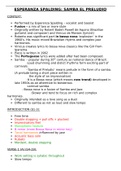
ESPERANZA SPALDING: SAMBA EL PRELUDIO
CONTEXT:
Performed by Esperenza Spalding – vocalist and bassist
Fusion – a mix of two or more style
Originally written by Robert Baden Powell de Aquino (Brazilian
guitarist and composer) and Vinicus de Moraes (lyricist)
Roberto was significant part in bossa nova ‘explosion’ in the
1960’s. His music mixed Brazialian rhytms and complex jazz
harmonies.
Vinicus creates lyrics to bossa nova classics like the Girl from
Ipanema.
Piece is written in 1962
The Portuguese lyrics were added after had been composed.
Samba: – popular during 20th century as national dance of Brazil.
-Loud drumming and distict rhythms form exciting part of
carnivals.
-‘Samba el Preludio’ means prelude in the form of a samba.
(A prelude being a short piece written in
the style of an improvisation)
-It is a Bossa nova (which means new trend) developed in
late 1950s as an alterntive to boisterous
carnival samba.
- Bossa nova is a fusion of Samba and Jazz
-Slower and tend to focus on rich and complex
harmonies.
Originally intended as a love song as a duet
Different to samba as not as loud and slow tempo
INTRODUCTION (b1-3):
Free time
Double stopping + pull offs + plucked
Improvisatory feel
Monophonic texture
B minor (most Bossa Nova in minor key)
Tonal harmonies influenced by jazz
Acoustic bass solo
Rubato
Mordent, double stopping
VERSE 1 (A) (b4-19):
Work setting is syllabic throughout
Slow tempo
, Mostly homophonic but sometimes bass in melodic enough to be
melody itself (counterpoint)
Bass is active and virtuosic
Rapid semi quaver passage
Large interval leaps
Low range for female
Ends with chord V
Melody repeated with different ending and developed rhythmically
Rubato used throughout expressive
Rising arpeggios shape occasionally 7th leaps
Downwards sequence by semitone at start of each phrase
Triplets
BREAK/ LINK (b19-22):
Faster tempo (sounds like 2/2)
Bass sets bossa nova groove 4 bars before guitar joins and uses
syncopation
VERSE 2 (B) (b23-54):
16 bars long
Mainly conjunct
Note values doubled
Acoustic guitar joins the accompaniment mix of plucked chords and
small melodic passages
Syncopation
Chromatic chord
Sequence 4th higher
Jazzy flattened 5th idea
Diminished 7th and chromatic movement in bass
Cross rhythms between voice and bass
Guitar flourishes
Values doubled
Dissonance perfect cadence
INSTRUMENTAL (b55-87):
Guitar solo over 2 sets of 16 bar chord sequence of verse 2
Overdubbed however when live would do simpler solo
Bass still plays accompaniment
VERSE 3 voice and bass duet (b88-104):
Repeat of 3rd stanza 16 bars long
Polyphonic texture ( more sparse) (A in bass B in voice)
s with line = sengo repeat from this sign
CONTEXT:
Performed by Esperenza Spalding – vocalist and bassist
Fusion – a mix of two or more style
Originally written by Robert Baden Powell de Aquino (Brazilian
guitarist and composer) and Vinicus de Moraes (lyricist)
Roberto was significant part in bossa nova ‘explosion’ in the
1960’s. His music mixed Brazialian rhytms and complex jazz
harmonies.
Vinicus creates lyrics to bossa nova classics like the Girl from
Ipanema.
Piece is written in 1962
The Portuguese lyrics were added after had been composed.
Samba: – popular during 20th century as national dance of Brazil.
-Loud drumming and distict rhythms form exciting part of
carnivals.
-‘Samba el Preludio’ means prelude in the form of a samba.
(A prelude being a short piece written in
the style of an improvisation)
-It is a Bossa nova (which means new trend) developed in
late 1950s as an alterntive to boisterous
carnival samba.
- Bossa nova is a fusion of Samba and Jazz
-Slower and tend to focus on rich and complex
harmonies.
Originally intended as a love song as a duet
Different to samba as not as loud and slow tempo
INTRODUCTION (b1-3):
Free time
Double stopping + pull offs + plucked
Improvisatory feel
Monophonic texture
B minor (most Bossa Nova in minor key)
Tonal harmonies influenced by jazz
Acoustic bass solo
Rubato
Mordent, double stopping
VERSE 1 (A) (b4-19):
Work setting is syllabic throughout
Slow tempo
, Mostly homophonic but sometimes bass in melodic enough to be
melody itself (counterpoint)
Bass is active and virtuosic
Rapid semi quaver passage
Large interval leaps
Low range for female
Ends with chord V
Melody repeated with different ending and developed rhythmically
Rubato used throughout expressive
Rising arpeggios shape occasionally 7th leaps
Downwards sequence by semitone at start of each phrase
Triplets
BREAK/ LINK (b19-22):
Faster tempo (sounds like 2/2)
Bass sets bossa nova groove 4 bars before guitar joins and uses
syncopation
VERSE 2 (B) (b23-54):
16 bars long
Mainly conjunct
Note values doubled
Acoustic guitar joins the accompaniment mix of plucked chords and
small melodic passages
Syncopation
Chromatic chord
Sequence 4th higher
Jazzy flattened 5th idea
Diminished 7th and chromatic movement in bass
Cross rhythms between voice and bass
Guitar flourishes
Values doubled
Dissonance perfect cadence
INSTRUMENTAL (b55-87):
Guitar solo over 2 sets of 16 bar chord sequence of verse 2
Overdubbed however when live would do simpler solo
Bass still plays accompaniment
VERSE 3 voice and bass duet (b88-104):
Repeat of 3rd stanza 16 bars long
Polyphonic texture ( more sparse) (A in bass B in voice)
s with line = sengo repeat from this sign