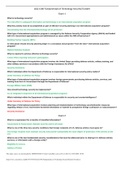
Test Bank for Economics for Managers 2nd Edition Part 1 ( NEWEST)
Test Bank for Economics for Managers 2nd Edition Which of the following statements is correct? 1. A) By and large, managerial decisions are not affected by either microeconomic or macroeconomic forces. 2. B) Managerial decisions are affected primarily by macroeconomic forces. 3. C) Managerial decisions are affected by both microeconomic and macroeconomic forces. 4. D) Managerial decisions are affected primarily by microeconomic forces. Walmartʹs decision in 1994 to continue operating stores in specific cities in Mexico when other firms were pulling out would be best classified as: 1. A) a microeconomic decision. 2. B) a macroeconomic decision. 3. C) both a microeconomic and a macroeconomic decision. 4. D) neither a microeconomic nor a macroeconomic decision. Which of the following would be considered an example of a macroeconomic problem? 1. A) Should Microsoft reduce the price of its Windows operating system? 2. B) Should JP Morgan Chase increase the interest rate it charges its credit card customers? 3. C) Should Mitsubishi eliminate one of its production shifts? 4. D) Should the federal government extend the eligibility period for unemployment benefits? Walmartʹs entry into the market in Mexico had the effect of: 1. A) reducing competition and raising the prices of many of the goods it sells. 2. B) increasing competition and raising the prices of many of the goods it sells. 3. C) increasing competition and lowering the prices of many of the goods it sells. 4. D) reducing competition and lowering the prices of many of the goods it sells. Which of the following statements is false? 1. A) While managers must understand how output prices are determined, determination of input prices is irrelevant because it is beyond the managerʹs control. 2. B) Price determination is the key element in any market system. 3. C) Input prices influence a firmʹs costs of production. 4. D) Output prices influence a firmʹs revenues. All else constant, the choice of whether to use a labor-intensive production process or a capital-intensive one is depends on: 1. A) the absolute prices of capital and labor. 2. B) whether the economy is growing or shrinking. 3. C) the relative prices of capital labor. 4. D) the type of market in which the firm operates. Which of the following is not a characteristic of a perfectly competitive market? 1. A) Limited information is available to all market participants. 2. B) Ease of entry into the market. 3. C) Outputs of the firms are perfect substitutes for one another. 4. D) Large number of firms in the industry. Firms are considered to be price searchers, as opposed to price takers, in all of the following market types except: 1. A) monopoly. 2. B) perfect competition. 3. C) oligopoly. 4. D) monopolistic competition. Which of the following conditions ensures that excess profits cannot persist in a perfectly competitive market over the long run? 1. A) Large number of firms in the industry. 2. B) Complete information is available to all market participants. 3. C) Outputs of the firms are perfect substitutes for one another. 4. D) Ease of entry into the market. Which of the following statements is correct? 1. A) All else constant, a monopoly firm has more market power than a monopolistically competitive firm. 2. B) The fact that the firms in an oligopoly are mutually interdependent means that individual firms do not have any market power. 3. C) The amount of market power a firm possesses is unrelated to the type of market in which it operates. 4. D) So long as a firm is sufficiently large, it will have some amount of market power, regardless of the type of market in which it operates. The market structure that is characterized by a small number of large firms that have some market power is called: 1. A) oligopoly. 2. B) monopoly. 3. C) perfect competition. 4. D) monopolistic competition. Which of the following market structures is most similar to perfect competition? 1. A) Monopolistic competition. 2. B) Monopsony. 3. C) Monopoly. 4. D) Oligopoly. The key characteristic of an oligopolistic market is: 1. A) mutual interdependence among firms in the market. 2. B) production of a homogeneous product. 3. C) the absence of market power by any one firm. 4. D) ease of entry into, and exit out of, the market. Which of the following statements about monopoly is false? 1. A) Because there is a single firm serving the entire market, the monopolist can charge whatever price it wants to for its output. 2. B) A single firm serves the market. 3. C) There are usually significant barriers to entry. 4. D) There are no close substitutes for the monopolistʹs output. The assumed goal of the firms that operate in each of the four market structures discussed in the text is to maximize: 1. A) profits. 2. B) revenue. 3. C) price. 4. D) sales. Which of the following statements about the circular flow model is false? 1. A) Households supply resources to the business sector. 2. B) Business firms buy goods and services from the household sector. 3. C) Businesses supply goods and services to the household sector. 4. D) Consumers earn income by selling resources they own to businesses. Which of the following statements is false? In the circular flow model: 1. A) factor payments are made to business firms. 2. B) consumption expenditures are made by households. 3. C) the funds needed to finance investment spending come from the saving of households. 4. D) GDP can be measured either by the income received or by the expenditures made. Within the circular flow model, which of the following is not represented as a flow of funds into firms? 1. A) Government purchases. 2. B) Consumption spending. 3. C) Foreign purchases of goods and services. 4. D) Income payments. The major categories of expenditures in the economy are: 1. A) consumption, gross investment, and government purchases. 2. B) consumption, fixed investment, government purchases, and net imports.
Written for
- Institution
- Axia University Of Phoenix
- Module
- ECONOMICS BEA683
Document information
- Uploaded on
- January 6, 2022
- Number of pages
- 347
- Written in
- 2021/2022
- Type
- Exam (elaborations)
- Contains
- Questions & answers
Subjects
-
test bank for economics for managers 2nd edition part 1