Minor – Positive Behavior Change in The Digital Age Literature Summaries
Literature Week 1 – Week 1 is the introduction week\
Literature Week 2
The Behavior Change Wheel: A New Method for Characterizing and Designing
Behavior Change Interventions
COM-B System: capability, opportunity, and
motivation.
The process of designing behavior change
interventions usually involves first of all
determining the broad approach that will be
adopted and then working on the specifics of
the intervention design.
In order to identify the type or types of
intervention that are likely to be effective, it is
important to canvass the full range of options
available and use a rational system for
selecting from among them.
This requires a system for characterizing
interventions that covers all possible
intervention types together with a system for
matching these features to the behavioral
target, the target population, and the context in
which the intervention will be delivered.
Two systems by which human behavior can be
influenced.
1. The reflective
2. The automatic
Goals
Framework for characterizing interventions should be comprehensive: it should apply to
every intervention that has been or could be developed.
The framework needs to be coherent in that its categories are all exemplars of the same type
of entity and have a broadly similar level of specificity. Thus, categories should be from a
super-ordinate entity and the framework should not include some categories that are very
broad and others very specific.
COM-B
Capability: the individual’s psychological and physical capacity
to engage in the activity concerned. It includes having the
necessary knowledge and skills.
o Physical capabilities
o Psychological capabilities
Motivation: all those brain processes that energize and direct
behaviour, not just goals and conscious decision-making. It
includes habitual processes, emotional responding, as well as
analytical decision-making.
o Reflective processes: involving evaluations and plans
o Automatic processes: involving emotions and impulses that arise from associative
learning and or innate dispositions.
Opportunity: all the factors that lie outside the individual that make the behaviour possible
or prompt it.
, o Physical opportunity afforded by the environment.
o Social opportunity afforded by the cultural milieu that dictates the way that we think
about things.
Important: COM-B
With one behavioral target the only barrier might be capability, while for another it may be
enough to provide or restrict opportunities, while for yet another changes to capability,
motivation, and opportunity may be required.
Links Between Behavior Change Techniques (BCT) and Mechanisms of Action (MoA)
Purpose: To elicit expert consensus on links between BCTs and MoAs.
o The aim of the current study is to develop an overview of the mechanisms through
which BCTs might alter behavior.
Results: BCTs had a definite link to one or more MoAs. MoAs had a definite link to one or
more BCTs.
The BCTs produce a change in behavior by acting upon a process (e.g., a psychological,
physical, or social process) which changes as a result of the active ingredient, this change is
what catalyzes a change in behavior.
MoAs: processes which influence behavior.
Round 1
The aim of Round 1 was to establish an initial level of consensus among experts for each
BCT × MoA link.
Question: “Does the Behaviour Change Technique [e.g., Goal Setting] change behavior
through the MoA [e.g., beliefs about one’s ability to successfully carry out a behavior (Beliefs
about Capabilities)]?”
Results: At least 50 per cent of experts agreed that 83 BCT × MoA links (5 per cent) were
“definite” links, 147 (9 per cent) were “possibly” links, 53 (3 per cent) were “possibly” not
links, and 296 (19 per cent) were “definitely” not links.
Round 2
The aim of Round 2 was to facilitate a discussion of experts’ ratings of BCT × MoA links,
particularly for the links that elicited high levels of disagreement and/or uncertainty among
each of the five groups of experts in Round 1.
Results: The 10 links rated “Don’t Know/ Uncertain” by the largest percentage of experts in
their group, the 10 for which a nearly equal percentage of experts rated “Definitely No” and
“Definitely Yes,” and two links which were discussed by all five groups, which were the most
uncertain and disagreed links across all experts.
Round 3
The aim of Round 3 was to establish a final understanding of experts’ views on the BCT ×
MoA links.
Experts were invited to rate links between the BCTs and MoAs that they had rated in Round
1.
Question, “When [BCT] works, does it work through changing (MoA definition (MoA
label)?”
Results: Of the 1,586 possible links (61 BCTs × 26 MoAs), consensus
was reached for 90 BCT × MoA links as “definite” links and 464 as
“definitely not” links.
Designing Interventions to Change Eating Behaviors
, Using theory in intervention design has a number of benefits: it can provide a framework to
facilitate the accumulation of evidence, summarising what is known; it can permit
communication across research groups.
Theory can be used as a starting point for intervention design to identify what needs to shift in
order for behavior to change.
Designing interventions using the Behaviour Change Wheel
1. Understand the behavior
o Define the problem in behavioural terms.
o There are two components to this: (i) who is performing the behaviour and (ii) what
the behavior is.
o Select a target behaviour.
o Intervention designers are encouraged to begin by generating a list of all the potential
behaviours that may be relevant to the problem they are trying to solve.
Consider each behaviour in terms of: the impact of changing the behaviour
(what difference will it make?) the likelihood of changing the behaviour (to
what extent can the behavior be easily changed?) and any spillover effect
(will changing the behaviour positively or negatively influence other
behaviors?).
o Be specific.
o Using the COM-B model and/or TDF intervention designers can make a behavioral
diagnosis of what needs to shift in order for the desired behavior to occur.
2. Identify intervention options
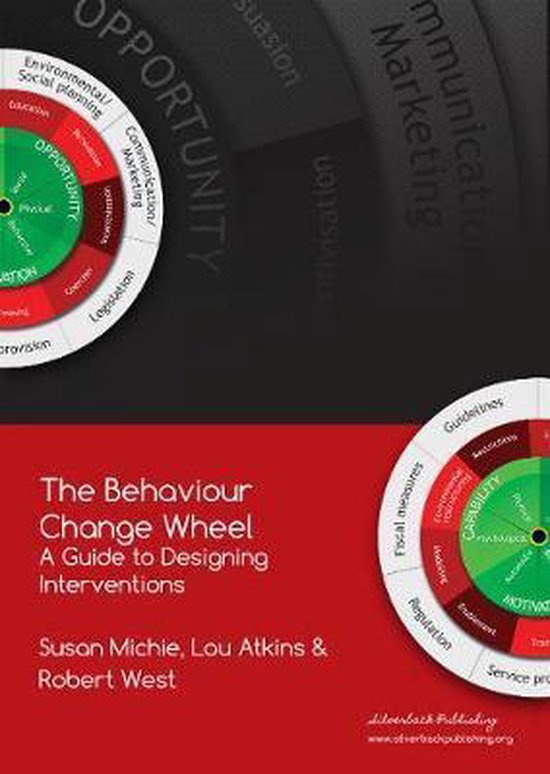
o The BCW is composed of the COM-B model at the hub of the wheel, nine
intervention functions form the inner ring and seven policy categories form the outer
ring of the wheel.
o Identify intervention functions.
Intervention functions: broad categories of means by which an intervention
can change behaviour.
o There are several functions that could potentially bring about a shift in reflective
motivation. These are education, persuasion, incentivisation or coercion.
o Affordability, practicality, effectiveness and cost-effectiveness, acceptability, side-
effects and safety, equity (does the intervention advantage some groups over others?)
3. Identify implementation options
o Decide on a BCT.
o BCT: ‘active ingredients’ in an intervention designed to bring about change (e.g.,
goal setting (behavior) and self-monitoring of behavior)
4. Implementation
o Implementing an intervention to change behaviour in a particular group is likely to
depend on changing behaviour of those delivering the intervention.
The COM-B Model of Behavior
COM-B Model
The COM-B model proposes that there are three components to any behaviour
(B): Capability (C), Opportunity (O) and Motivation (M). By changing both perceived
capabilities and opportunities, we can influence a person’s motivation for executing a
particular behaviour and therefore encourage behaviour change.
One or more of its components must be changed in order to facilitate effective and long-
standing behaviour change. By changing both perceived capabilities and opportunities, we
can influence a person’s motivation for executing a particular behaviour and therefore
encourage behaviour change.
Literature Week 1 – Week 1 is the introduction week\
Literature Week 2
The Behavior Change Wheel: A New Method for Characterizing and Designing
Behavior Change Interventions
COM-B System: capability, opportunity, and
motivation.
The process of designing behavior change
interventions usually involves first of all
determining the broad approach that will be
adopted and then working on the specifics of
the intervention design.
In order to identify the type or types of
intervention that are likely to be effective, it is
important to canvass the full range of options
available and use a rational system for
selecting from among them.
This requires a system for characterizing
interventions that covers all possible
intervention types together with a system for
matching these features to the behavioral
target, the target population, and the context in
which the intervention will be delivered.
Two systems by which human behavior can be
influenced.
1. The reflective
2. The automatic
Goals
Framework for characterizing interventions should be comprehensive: it should apply to
every intervention that has been or could be developed.
The framework needs to be coherent in that its categories are all exemplars of the same type
of entity and have a broadly similar level of specificity. Thus, categories should be from a
super-ordinate entity and the framework should not include some categories that are very
broad and others very specific.
COM-B
Capability: the individual’s psychological and physical capacity
to engage in the activity concerned. It includes having the
necessary knowledge and skills.
o Physical capabilities
o Psychological capabilities
Motivation: all those brain processes that energize and direct
behaviour, not just goals and conscious decision-making. It
includes habitual processes, emotional responding, as well as
analytical decision-making.
o Reflective processes: involving evaluations and plans
o Automatic processes: involving emotions and impulses that arise from associative
learning and or innate dispositions.
Opportunity: all the factors that lie outside the individual that make the behaviour possible
or prompt it.
, o Physical opportunity afforded by the environment.
o Social opportunity afforded by the cultural milieu that dictates the way that we think
about things.
Important: COM-B
With one behavioral target the only barrier might be capability, while for another it may be
enough to provide or restrict opportunities, while for yet another changes to capability,
motivation, and opportunity may be required.
Links Between Behavior Change Techniques (BCT) and Mechanisms of Action (MoA)
Purpose: To elicit expert consensus on links between BCTs and MoAs.
o The aim of the current study is to develop an overview of the mechanisms through
which BCTs might alter behavior.
Results: BCTs had a definite link to one or more MoAs. MoAs had a definite link to one or
more BCTs.
The BCTs produce a change in behavior by acting upon a process (e.g., a psychological,
physical, or social process) which changes as a result of the active ingredient, this change is
what catalyzes a change in behavior.
MoAs: processes which influence behavior.
Round 1
The aim of Round 1 was to establish an initial level of consensus among experts for each
BCT × MoA link.
Question: “Does the Behaviour Change Technique [e.g., Goal Setting] change behavior
through the MoA [e.g., beliefs about one’s ability to successfully carry out a behavior (Beliefs
about Capabilities)]?”
Results: At least 50 per cent of experts agreed that 83 BCT × MoA links (5 per cent) were
“definite” links, 147 (9 per cent) were “possibly” links, 53 (3 per cent) were “possibly” not
links, and 296 (19 per cent) were “definitely” not links.
Round 2
The aim of Round 2 was to facilitate a discussion of experts’ ratings of BCT × MoA links,
particularly for the links that elicited high levels of disagreement and/or uncertainty among
each of the five groups of experts in Round 1.
Results: The 10 links rated “Don’t Know/ Uncertain” by the largest percentage of experts in
their group, the 10 for which a nearly equal percentage of experts rated “Definitely No” and
“Definitely Yes,” and two links which were discussed by all five groups, which were the most
uncertain and disagreed links across all experts.
Round 3
The aim of Round 3 was to establish a final understanding of experts’ views on the BCT ×
MoA links.
Experts were invited to rate links between the BCTs and MoAs that they had rated in Round
1.
Question, “When [BCT] works, does it work through changing (MoA definition (MoA
label)?”
Results: Of the 1,586 possible links (61 BCTs × 26 MoAs), consensus
was reached for 90 BCT × MoA links as “definite” links and 464 as
“definitely not” links.
Designing Interventions to Change Eating Behaviors
, Using theory in intervention design has a number of benefits: it can provide a framework to
facilitate the accumulation of evidence, summarising what is known; it can permit
communication across research groups.
Theory can be used as a starting point for intervention design to identify what needs to shift in
order for behavior to change.
Designing interventions using the Behaviour Change Wheel
1. Understand the behavior
o Define the problem in behavioural terms.
o There are two components to this: (i) who is performing the behaviour and (ii) what
the behavior is.
o Select a target behaviour.
o Intervention designers are encouraged to begin by generating a list of all the potential
behaviours that may be relevant to the problem they are trying to solve.
Consider each behaviour in terms of: the impact of changing the behaviour
(what difference will it make?) the likelihood of changing the behaviour (to
what extent can the behavior be easily changed?) and any spillover effect
(will changing the behaviour positively or negatively influence other
behaviors?).
o Be specific.
o Using the COM-B model and/or TDF intervention designers can make a behavioral
diagnosis of what needs to shift in order for the desired behavior to occur.
2. Identify intervention options
o The BCW is composed of the COM-B model at the hub of the wheel, nine
intervention functions form the inner ring and seven policy categories form the outer
ring of the wheel.
o Identify intervention functions.
Intervention functions: broad categories of means by which an intervention
can change behaviour.
o There are several functions that could potentially bring about a shift in reflective
motivation. These are education, persuasion, incentivisation or coercion.
o Affordability, practicality, effectiveness and cost-effectiveness, acceptability, side-
effects and safety, equity (does the intervention advantage some groups over others?)
3. Identify implementation options
o Decide on a BCT.
o BCT: ‘active ingredients’ in an intervention designed to bring about change (e.g.,
goal setting (behavior) and self-monitoring of behavior)
4. Implementation
o Implementing an intervention to change behaviour in a particular group is likely to
depend on changing behaviour of those delivering the intervention.
The COM-B Model of Behavior
COM-B Model
The COM-B model proposes that there are three components to any behaviour
(B): Capability (C), Opportunity (O) and Motivation (M). By changing both perceived
capabilities and opportunities, we can influence a person’s motivation for executing a
particular behaviour and therefore encourage behaviour change.
One or more of its components must be changed in order to facilitate effective and long-
standing behaviour change. By changing both perceived capabilities and opportunities, we
can influence a person’s motivation for executing a particular behaviour and therefore
encourage behaviour change.