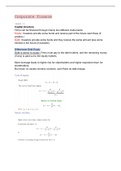
Corporate finance
(week 1)
Capital structure
Firms can be financed through mainly two different instruments:
Equity: Investors provide some funds and receive part of the future cash flows (if
positive.)
Debt: Investors provide some funds and they receive the same amount plus some
interest in the future (if possible)
Differences Debt Equity
Debt is senior to equity: Firms must pay to the debt holders, and the remaining money
(if any) is paid out to the equity holders.
More leverage leads to higher risk for shareholders and higher expected return for
shareholders.
But return on assets remains constant, cash flows do not change.
,Two capital structure fallacies
1. More leverage increases EPS, then stock price should increase.
2. Issuing capital increases the number of shares, therefore share price should
decrease
BOTH NOT TRUE
Modigliani - Miller → share price is the same!
(week 2)
Interest tax shield
The interest tax deduction;
Firms pay taxes according to the profits they earn.
Profits = Earnings - operating costs - interest payments
Therefore debt reduces taxes paid by firms.
Interest tax shield (ITS) = Corporate tax rate (Tc) x Interest payments
Valuing the tax shield
According to the law of one price
To compute the increase in value due to leverage, PV(ITS), we need to make
assumptions about future interest payments.
PV(ITS) can be computed under 3 assumptions
1. Certain payments (no risk)
Nominal amount = 2000
, Maturity = 10 years
Interest rate = 5%
Corporate tax = 35%
ITSt = Tc x Int.pay = 0.35 x (0.05 x 2000) = 35
2. Constant debt
Suppose a firm borrows debt D and keeps the same level of debt permanently.
Corporate tax = Tc
Risk-free rate = rf
3. Constant debt-to-equity ratio
Interest payment = rd x D
Tax saving = Tc x rd x D
→ Total cost = (1-Tc) x rd x D
The actual cost per unit of debt is (1-Tc) x rd
Share price with recap
, How to compute the recap price
There are three possibilities:
1. The share price after the recap is higher than the recap price
P> Precap → Shareholders would not sell during the recap.
2. The share price after the recap is lower than the recap price.
P< Precap → No one would keep their shares.
3. The share price after the recap is equal to the recap price.
P = Precap → Shareholders are indifferent between selling or not.
Personal taxes
Interest payments received from debt are taxed as income.
Equity investors also must pay taxes on dividends and capital gains.
In the case of equity, this system implies double taxation.
Effective tax advantage debt (T*c) = (debt - equity)/ debt
Growth and debt
In a tax-optimal capital structure debt will depend on current EBIT
The value of equity depends on all future cash flows.
As a result, the optimal debt-to-value ratio will be lower for high-growth firms.
How to compute the optimal debt
Consider a firm whose EBIT can be :
5 million with probability ½
10 million with probability ½
Investors are subject to the following taxes:
Corporate tax: 35%
Equity income tax: 15%
Interest income tax: 35%
(week 1)
Capital structure
Firms can be financed through mainly two different instruments:
Equity: Investors provide some funds and receive part of the future cash flows (if
positive.)
Debt: Investors provide some funds and they receive the same amount plus some
interest in the future (if possible)
Differences Debt Equity
Debt is senior to equity: Firms must pay to the debt holders, and the remaining money
(if any) is paid out to the equity holders.
More leverage leads to higher risk for shareholders and higher expected return for
shareholders.
But return on assets remains constant, cash flows do not change.
,Two capital structure fallacies
1. More leverage increases EPS, then stock price should increase.
2. Issuing capital increases the number of shares, therefore share price should
decrease
BOTH NOT TRUE
Modigliani - Miller → share price is the same!
(week 2)
Interest tax shield
The interest tax deduction;
Firms pay taxes according to the profits they earn.
Profits = Earnings - operating costs - interest payments
Therefore debt reduces taxes paid by firms.
Interest tax shield (ITS) = Corporate tax rate (Tc) x Interest payments
Valuing the tax shield
According to the law of one price
To compute the increase in value due to leverage, PV(ITS), we need to make
assumptions about future interest payments.
PV(ITS) can be computed under 3 assumptions
1. Certain payments (no risk)
Nominal amount = 2000
, Maturity = 10 years
Interest rate = 5%
Corporate tax = 35%
ITSt = Tc x Int.pay = 0.35 x (0.05 x 2000) = 35
2. Constant debt
Suppose a firm borrows debt D and keeps the same level of debt permanently.
Corporate tax = Tc
Risk-free rate = rf
3. Constant debt-to-equity ratio
Interest payment = rd x D
Tax saving = Tc x rd x D
→ Total cost = (1-Tc) x rd x D
The actual cost per unit of debt is (1-Tc) x rd
Share price with recap
, How to compute the recap price
There are three possibilities:
1. The share price after the recap is higher than the recap price
P> Precap → Shareholders would not sell during the recap.
2. The share price after the recap is lower than the recap price.
P< Precap → No one would keep their shares.
3. The share price after the recap is equal to the recap price.
P = Precap → Shareholders are indifferent between selling or not.
Personal taxes
Interest payments received from debt are taxed as income.
Equity investors also must pay taxes on dividends and capital gains.
In the case of equity, this system implies double taxation.
Effective tax advantage debt (T*c) = (debt - equity)/ debt
Growth and debt
In a tax-optimal capital structure debt will depend on current EBIT
The value of equity depends on all future cash flows.
As a result, the optimal debt-to-value ratio will be lower for high-growth firms.
How to compute the optimal debt
Consider a firm whose EBIT can be :
5 million with probability ½
10 million with probability ½
Investors are subject to the following taxes:
Corporate tax: 35%
Equity income tax: 15%
Interest income tax: 35%