BEING A LEADER ASSESSMENT - LEVEL 5
Identify a range of factors that contribute to motivation.
There are a range of models available to outline motivational factors.
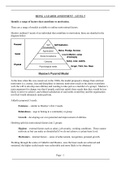
Maslow outlined 5 needs of an individual that contribute to motivation, these are detailed in the
diagram below:
Personal Self Self Realisation
Actualisation
Appreciation Status, Prestige, Success
Social Love & Affection, sense
Social Acceptance of belonging
Certainty Safety, order, stability
Physical
Psychological needs Hunger, Thirst, Sex, Sleep
Maslow’s Pyramid Model
At the time when this was conceived, in the 1940s, the model proposed a change from extrinsic
motivators (i.e. money, fear and discipline) to intrinsic motivators (such as the desire to perform
well, the will to develop ones abilities and wanting to take part as a member of a group). Maslow’s
main argument for change was that if people could not satisfy these needs then they would be less
likely to strive to achieve, and without satisfaction of said needs would they and the organisation
involved would ultimately under perform.
Alderfer proposed 3 needs:
Existence – similar to Maslow’s first 2 needs.
Relatedness – urge to belong to a community or group.
Growth – developing our own potential and improvement of abilities.
Herzberg split his motivational factors into 2 groups:
Hygiene – external factors such as salary, job security, working conditions. These cannot
motivate us but can make us dissatisfied if we do not achieve a certain basic level.
Motivators – internal factors – sense of achievement, recognition, personal growth.
Working through the scales of Alderfer and Maslow, once the basic needs are achieved and
sustained, the higher scaled needs were achievable and more likely to be obtained.
Page - 1
, These needs can be incorporated into my own team management, although the very basic
physiological need is very much out of my own remit, other than to allow sufficient time off, breaks
and rest periods to ensure that they are possible.
Given this, the next two are always considered to be part of ensuring that new staff and existing staff
are kept involved, informed and are able to contribute. Security in the role being performed ensures
that staff are able to concentrate on tasks and objectives and not (for example) contract related
issues. Contracts have presented problems within the Unit, however, these issues affected members
of staff who had already achieved the higher levels of the scales mentioned (Maslow) and due to
their professionalism and dedication to the objectives of the Unit in general, did not largely affect the
achievement of said aims or indeed lead to the loss of the lower levels of the scales/models.
Ultimately, the performance of the Unit was not adversely affected and the issues were resolved
satisfactorily. This may not have been the case had some of the newer members of the Unit been
experiencing the same issues with their contracts and the situation could have led to the loss of the
lower levels and presented a very significant problem towards the effective operation of the Unit.
Our team, although not serving as a team for more than a year as a whole, are all of long service and
experienced within the organisation, these models therefore need not be applied in the main but can
be monitored to ensure that all levels are being maintained and/or at the very least considered within
Welfare Meetings and general Resources Unit meetings and indeed, within thee general day to day
running of the Unit.
Sources:
Management Masterclass - A Practical Guide to the New Realities of Business 1996 – Neil Glass
How to be an Even Better Manager – 6th Edition – Michael Armstrong
Page - 2
Identify a range of factors that contribute to motivation.
There are a range of models available to outline motivational factors.
Maslow outlined 5 needs of an individual that contribute to motivation, these are detailed in the
diagram below:
Personal Self Self Realisation
Actualisation
Appreciation Status, Prestige, Success
Social Love & Affection, sense
Social Acceptance of belonging
Certainty Safety, order, stability
Physical
Psychological needs Hunger, Thirst, Sex, Sleep
Maslow’s Pyramid Model
At the time when this was conceived, in the 1940s, the model proposed a change from extrinsic
motivators (i.e. money, fear and discipline) to intrinsic motivators (such as the desire to perform
well, the will to develop ones abilities and wanting to take part as a member of a group). Maslow’s
main argument for change was that if people could not satisfy these needs then they would be less
likely to strive to achieve, and without satisfaction of said needs would they and the organisation
involved would ultimately under perform.
Alderfer proposed 3 needs:
Existence – similar to Maslow’s first 2 needs.
Relatedness – urge to belong to a community or group.
Growth – developing our own potential and improvement of abilities.
Herzberg split his motivational factors into 2 groups:
Hygiene – external factors such as salary, job security, working conditions. These cannot
motivate us but can make us dissatisfied if we do not achieve a certain basic level.
Motivators – internal factors – sense of achievement, recognition, personal growth.
Working through the scales of Alderfer and Maslow, once the basic needs are achieved and
sustained, the higher scaled needs were achievable and more likely to be obtained.
Page - 1
, These needs can be incorporated into my own team management, although the very basic
physiological need is very much out of my own remit, other than to allow sufficient time off, breaks
and rest periods to ensure that they are possible.
Given this, the next two are always considered to be part of ensuring that new staff and existing staff
are kept involved, informed and are able to contribute. Security in the role being performed ensures
that staff are able to concentrate on tasks and objectives and not (for example) contract related
issues. Contracts have presented problems within the Unit, however, these issues affected members
of staff who had already achieved the higher levels of the scales mentioned (Maslow) and due to
their professionalism and dedication to the objectives of the Unit in general, did not largely affect the
achievement of said aims or indeed lead to the loss of the lower levels of the scales/models.
Ultimately, the performance of the Unit was not adversely affected and the issues were resolved
satisfactorily. This may not have been the case had some of the newer members of the Unit been
experiencing the same issues with their contracts and the situation could have led to the loss of the
lower levels and presented a very significant problem towards the effective operation of the Unit.
Our team, although not serving as a team for more than a year as a whole, are all of long service and
experienced within the organisation, these models therefore need not be applied in the main but can
be monitored to ensure that all levels are being maintained and/or at the very least considered within
Welfare Meetings and general Resources Unit meetings and indeed, within thee general day to day
running of the Unit.
Sources:
Management Masterclass - A Practical Guide to the New Realities of Business 1996 – Neil Glass
How to be an Even Better Manager – 6th Edition – Michael Armstrong
Page - 2