PROJECT MANAGEMENT ASSESSMENT
LEVEL 5
Define a “Project”.
A project is a process for the planning, supervision and control of any activity or set of activities that
leads to a defined outcome at a predetermined time and in accordance with specified performance or
quality standards at a budgeted cost.
During the Aquarius Projects in North Wales Police, I was the Project Assistant to the Duty
Management sub-project. This system is now the main Resource Management Tool in use
throughout the Resources Units of the Force.
Detail the key principles involved in effective project management, providing an example of a
suitable project management methodology.
The key principles to Project Management can be found within the Berenschot Project Management
Model. This model involves 4 main methodologies:
The Life Cycle – All stages of the project from start to finish.
The Project Hierarchy – Sub-Projects, management structures and reporting structures.
The Project Fundamentals – What needs to be achieved to complete the project.
The Management Cycle – The Deming Cycle (Plan, Do, Check, Act) continuous
improvement cycle.
The first three dimensions are necessary in order to define, start up and carry out the project, while
the fourth, the management cycle ensures the controlled execution of the whole project. This is
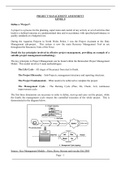
demonstrated in the diagram below:
2. Project Hierarchy
Project
Sub-Project
Sub-Project Sub-Project
1. Life Cycle
Definition Design Execution GOAL!! After-care
Pre-process phase
3. Project
Fundamentals Act Plan
-…. Initial Plan Results
-….
-…. Check Do
4. Management Cycle (ongoing)
Source: Key Management Models – Have, Have, Stevens and van der Elst 2003
Page - 1
, What is a Gantt Chart and how should it contribute to effective project management?
A gantt chart is a graphically representative timeline that details objective subjects and achievement
dates. The chart will contain timelines for all parts of the project from development, through testing
to rollout and aftercare.
The gantt chart enables the Project Manager and Assistants to set goals and aims for achieving each
part of the final objective, in the order that they need to be achieved and within the timescales set for
completion. Being a visual aid, with all time scaled and objective information upon in, makes the
chart a quick reference point for a detailed overview on project progress for Project Managers,
Executive Programme Board members and the stakeholders. This viewing will allow the Project
Manager an easy sighting of how progression in different areas may be continuing and whether
funding or resources need to be re-allocated to suit those objectives behind schedule for example.
Included on the following pages is a copy of my own Resources Unit Future Planning Strategy,
which I have introduced to keep members of my team up to date with our Unit developments, future
plans and status on current process and system rollout. This is maintained throughout each year and
updated following Resources Unit monthly meetings.
Source: Lee Burt – Duty Management Project Assistant 2003
Page - 2
LEVEL 5
Define a “Project”.
A project is a process for the planning, supervision and control of any activity or set of activities that
leads to a defined outcome at a predetermined time and in accordance with specified performance or
quality standards at a budgeted cost.
During the Aquarius Projects in North Wales Police, I was the Project Assistant to the Duty
Management sub-project. This system is now the main Resource Management Tool in use
throughout the Resources Units of the Force.
Detail the key principles involved in effective project management, providing an example of a
suitable project management methodology.
The key principles to Project Management can be found within the Berenschot Project Management
Model. This model involves 4 main methodologies:
The Life Cycle – All stages of the project from start to finish.
The Project Hierarchy – Sub-Projects, management structures and reporting structures.
The Project Fundamentals – What needs to be achieved to complete the project.
The Management Cycle – The Deming Cycle (Plan, Do, Check, Act) continuous
improvement cycle.
The first three dimensions are necessary in order to define, start up and carry out the project, while
the fourth, the management cycle ensures the controlled execution of the whole project. This is
demonstrated in the diagram below:
2. Project Hierarchy
Project
Sub-Project
Sub-Project Sub-Project
1. Life Cycle
Definition Design Execution GOAL!! After-care
Pre-process phase
3. Project
Fundamentals Act Plan
-…. Initial Plan Results
-….
-…. Check Do
4. Management Cycle (ongoing)
Source: Key Management Models – Have, Have, Stevens and van der Elst 2003
Page - 1
, What is a Gantt Chart and how should it contribute to effective project management?
A gantt chart is a graphically representative timeline that details objective subjects and achievement
dates. The chart will contain timelines for all parts of the project from development, through testing
to rollout and aftercare.
The gantt chart enables the Project Manager and Assistants to set goals and aims for achieving each
part of the final objective, in the order that they need to be achieved and within the timescales set for
completion. Being a visual aid, with all time scaled and objective information upon in, makes the
chart a quick reference point for a detailed overview on project progress for Project Managers,
Executive Programme Board members and the stakeholders. This viewing will allow the Project
Manager an easy sighting of how progression in different areas may be continuing and whether
funding or resources need to be re-allocated to suit those objectives behind schedule for example.
Included on the following pages is a copy of my own Resources Unit Future Planning Strategy,
which I have introduced to keep members of my team up to date with our Unit developments, future
plans and status on current process and system rollout. This is maintained throughout each year and
updated following Resources Unit monthly meetings.
Source: Lee Burt – Duty Management Project Assistant 2003
Page - 2