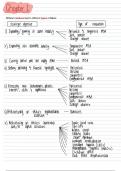
Advanced energetics consolidation notes
Standard lattice enthalpy = the enthalpy change when 1 mole of an ionic substance is formed from its gaseous ions
under standard conditions.
• We need to remember that lattice enthalpy is always exothermic.
First electron affinity = the enthalpy change when 1 mole of gaseous atoms each acquire an electron to form 1 mole
of gaseous anions.
First ionisation energy = the enthalpy change when 1 mole of gaseous atoms lose an electron to form one mole of
gaseous cations.
Enthalpy change of atomisation = the enthalpy change when 1 mole of an element in its standard state is atomised
to produce 1 mole of gaseous atoms.
Enthalpy change of solution = the enthalpy change when 1 mole of a solute dissolves in a solvent.
Enthalpy change of hydration = the enthalpy change when 1 mole of gaseous ions dissolve in water to form one
mole of aqueous ions.
Enthalpy of formation = the enthalpy change when 1 mole of a compound is formed from its elements in their
standard states.
Factors affecting lattice enthalpy
Ionic charge Ionic radius
• The higher the ionic charge, the more energy • The smaller the ionic radius, the more
released when the lattice forms. exothermic the reaction.
• Therefore, the electrostatic attraction between • As ionic radius decreases, electrostatic
ions is greater when the charge is greater. attraction between ions increases… so more
• So, more energy is needed to break this energy needed to break the lattice.
attraction and more energy released when the
compound forms.
Born-Haber cycles (lattice enthalpy) How to interpret Born-Haber cycles?
1) This is the enthalpy of formation of Sodium chloride.
2) This is the enthalpy of atomisation of chlorine
3) This is the enthalpy of atomisation of sodium
4) This is the ionisation energy for sodium
5) This is the electron affinity for chlorine
6) This is the lattice enthalpy of sodium chloride
Lattice enthalpy = (atomisation + ionisation + electron affinity) – enthalpy
of formation.
For group 2 elements, it is a bit different as you
must ionise the group 2 element twice… and if
bonding with a group 7, you need to multiple the
electron affinity and atomisation of this by 2.
Standard lattice enthalpy = the enthalpy change when 1 mole of an ionic substance is formed from its gaseous ions
under standard conditions.
• We need to remember that lattice enthalpy is always exothermic.
First electron affinity = the enthalpy change when 1 mole of gaseous atoms each acquire an electron to form 1 mole
of gaseous anions.
First ionisation energy = the enthalpy change when 1 mole of gaseous atoms lose an electron to form one mole of
gaseous cations.
Enthalpy change of atomisation = the enthalpy change when 1 mole of an element in its standard state is atomised
to produce 1 mole of gaseous atoms.
Enthalpy change of solution = the enthalpy change when 1 mole of a solute dissolves in a solvent.
Enthalpy change of hydration = the enthalpy change when 1 mole of gaseous ions dissolve in water to form one
mole of aqueous ions.
Enthalpy of formation = the enthalpy change when 1 mole of a compound is formed from its elements in their
standard states.
Factors affecting lattice enthalpy
Ionic charge Ionic radius
• The higher the ionic charge, the more energy • The smaller the ionic radius, the more
released when the lattice forms. exothermic the reaction.
• Therefore, the electrostatic attraction between • As ionic radius decreases, electrostatic
ions is greater when the charge is greater. attraction between ions increases… so more
• So, more energy is needed to break this energy needed to break the lattice.
attraction and more energy released when the
compound forms.
Born-Haber cycles (lattice enthalpy) How to interpret Born-Haber cycles?
1) This is the enthalpy of formation of Sodium chloride.
2) This is the enthalpy of atomisation of chlorine
3) This is the enthalpy of atomisation of sodium
4) This is the ionisation energy for sodium
5) This is the electron affinity for chlorine
6) This is the lattice enthalpy of sodium chloride
Lattice enthalpy = (atomisation + ionisation + electron affinity) – enthalpy
of formation.
For group 2 elements, it is a bit different as you
must ionise the group 2 element twice… and if
bonding with a group 7, you need to multiple the
electron affinity and atomisation of this by 2.