

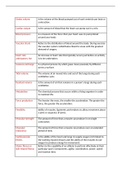
Stroke volume Is the volume of the blood pumped out of each ventricle per beat or
contraction.
Cardiac output Is the amount of blood that the heart can pump out in a min.
Blood pressure Is a measure of the force that your heart uses to pump blood
around your body.
Vascular shunt Refers to the distribution of blood around the body. During exercise
the vascular system redistributes blood to areas with the greatest
demand of oxygen.
Heart rate An increase in heart rate that typically occurs just before an activity
anticipatory rise is to be undertaken.
Gaseous exchange Is a physical process by which gases move passively by diffusion
across a surface.
Tidal volume The volume of air moved into and out of the lungs during each
ventilation cycle.
Residual volume Is the amount of air that remains in a person’s lungs during each
ventilation.
Metabolism The chemical process that occurs within a living organism in order
to maintain life.
Force production The heavier the mass, the smaller the acceleration. The greater the
force, the greater the acceleration.
Flexibility Ability of muscles, ligaments and tendons to allow movement about
a joint or sequence of joints.
Muscular strength The amount of force that a muscle can produce in on single
contraction.
Muscular The amount of force that a muscle can produce over an extended
endurance period of time.
Cardiovascular Is the ability of the heart and lungs to supply oxygen (rich blood to
fitness the working muscles tissues and the ability of the muscles to use
oxygen to produce energy for movement).
Motor fitness or Refers to the capability of an athlete to perform affectively at their
skill related fitness particular sport. Components, agility, coordination, power, speed
and reaction time.
,Aerobic Activity in which large amounts of oxygen are required continually
for an extended period of time.
Anaerobic Activity in which the body’s demand for oxygen is greater then what
is available (absence of oxygen).
VO2 max The maximum amount of oxygen that can be taken in by and be
utilised by the body.
Lactate threshold Is the maximal effort or intensity that an athlete can maintain for an
extended period of time with little or an increased in lactate in the
blood.
Onset of blood Is a point at which blood lactate becomes extensive enough to
lactate suppress performance. If sufficient rest/ recovery between intense
accumulation workout is not achieved there may be severe damage to muscle
(OBLA) cells.
Musculoskeletal response
, Consists of muscles, tendons, ligaments, bones and cartilage. These support your body and enable it
to move. The different parts of your musculoskeletal system operate under the control of the
nervous system to produce voluntary movement. Impulses from the nervous system causes muscles
to contract: when a muscle contracts, it shortens, pulling on the bone to which it is attached. The
skeletal system forms the framework of the body, while muscles form the fleshy part. They facilitate
movement, maintain posture and produce heat.
Short term:
❖ Increase blood supply
❖ Increase in temperature
❖ Increase in metabolic activity- as a result of this increase in metabolic act there is a greater
demand for oxygen met by an increase in blood supply through capillary dilation.
❖ Increase in muscle pliability - making them more pliable (stretchiness of your muscles and
connective tissues) and reduce the risk of injury.
❖ Increased range of movement- the synovial fluid becomes less viscous (thickness) and the
range of movement at the joints increases.
❖ Muscle fibre micro tears- during exercise the muscle are put under stress to the point that
tiny tears occur in the muscle fibres. This micro tears causes swelling in the muscle tissue
which causes pressure on the nerve endings and pain.
Long-term:
Muscles tissue’s response to exercise depends on the yep of training undertaken and the degree of
overload achieved. Muscles strength and size increase with high intensity resistance training, while
muscles endurance increases with repetitive low intensity training.
❖ Hypertrophy
Increases in muscle size and bulk. Hypertrophy are the results of increases in the volume of
contractile proteins within the muscle cells so that they can contract with greater force. In
general, males have a greater potential to achieve increases in muscles bulk and size due to
higher levels of the hormone testosterone.
❖ Increase in tendon strength
Tendons are tough bands of fibrous connective tissues designed to withstand tension. Like
muscles, tendons adapt to the mechanical loading of regular exercise. A general adaptation
is increased strength but different type of training will exert different effects on muscles
tendon complexes.
contraction.
Cardiac output Is the amount of blood that the heart can pump out in a min.
Blood pressure Is a measure of the force that your heart uses to pump blood
around your body.
Vascular shunt Refers to the distribution of blood around the body. During exercise
the vascular system redistributes blood to areas with the greatest
demand of oxygen.
Heart rate An increase in heart rate that typically occurs just before an activity
anticipatory rise is to be undertaken.
Gaseous exchange Is a physical process by which gases move passively by diffusion
across a surface.
Tidal volume The volume of air moved into and out of the lungs during each
ventilation cycle.
Residual volume Is the amount of air that remains in a person’s lungs during each
ventilation.
Metabolism The chemical process that occurs within a living organism in order
to maintain life.
Force production The heavier the mass, the smaller the acceleration. The greater the
force, the greater the acceleration.
Flexibility Ability of muscles, ligaments and tendons to allow movement about
a joint or sequence of joints.
Muscular strength The amount of force that a muscle can produce in on single
contraction.
Muscular The amount of force that a muscle can produce over an extended
endurance period of time.
Cardiovascular Is the ability of the heart and lungs to supply oxygen (rich blood to
fitness the working muscles tissues and the ability of the muscles to use
oxygen to produce energy for movement).
Motor fitness or Refers to the capability of an athlete to perform affectively at their
skill related fitness particular sport. Components, agility, coordination, power, speed
and reaction time.
,Aerobic Activity in which large amounts of oxygen are required continually
for an extended period of time.
Anaerobic Activity in which the body’s demand for oxygen is greater then what
is available (absence of oxygen).
VO2 max The maximum amount of oxygen that can be taken in by and be
utilised by the body.
Lactate threshold Is the maximal effort or intensity that an athlete can maintain for an
extended period of time with little or an increased in lactate in the
blood.
Onset of blood Is a point at which blood lactate becomes extensive enough to
lactate suppress performance. If sufficient rest/ recovery between intense
accumulation workout is not achieved there may be severe damage to muscle
(OBLA) cells.
Musculoskeletal response
, Consists of muscles, tendons, ligaments, bones and cartilage. These support your body and enable it
to move. The different parts of your musculoskeletal system operate under the control of the
nervous system to produce voluntary movement. Impulses from the nervous system causes muscles
to contract: when a muscle contracts, it shortens, pulling on the bone to which it is attached. The
skeletal system forms the framework of the body, while muscles form the fleshy part. They facilitate
movement, maintain posture and produce heat.
Short term:
❖ Increase blood supply
❖ Increase in temperature
❖ Increase in metabolic activity- as a result of this increase in metabolic act there is a greater
demand for oxygen met by an increase in blood supply through capillary dilation.
❖ Increase in muscle pliability - making them more pliable (stretchiness of your muscles and
connective tissues) and reduce the risk of injury.
❖ Increased range of movement- the synovial fluid becomes less viscous (thickness) and the
range of movement at the joints increases.
❖ Muscle fibre micro tears- during exercise the muscle are put under stress to the point that
tiny tears occur in the muscle fibres. This micro tears causes swelling in the muscle tissue
which causes pressure on the nerve endings and pain.
Long-term:
Muscles tissue’s response to exercise depends on the yep of training undertaken and the degree of
overload achieved. Muscles strength and size increase with high intensity resistance training, while
muscles endurance increases with repetitive low intensity training.
❖ Hypertrophy
Increases in muscle size and bulk. Hypertrophy are the results of increases in the volume of
contractile proteins within the muscle cells so that they can contract with greater force. In
general, males have a greater potential to achieve increases in muscles bulk and size due to
higher levels of the hormone testosterone.
❖ Increase in tendon strength
Tendons are tough bands of fibrous connective tissues designed to withstand tension. Like
muscles, tendons adapt to the mechanical loading of regular exercise. A general adaptation
is increased strength but different type of training will exert different effects on muscles
tendon complexes.



