PYC3703 – COGNITIVE PSYCHOLOGY
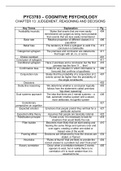
CHAPTER 13: JUDGEMENT, REASONING AND DECISIONS
Key Terms Explanation Pg.
Availability heuristic States that events that are more easily 404
remembered are judged as being more probable
than events that are less easily remembered
Base rate Relative proportion of different classes in a 406
population
Belief bias The tendency to think a syllogism is valid if its 413
conclusion is believable
Categorical syllogism The premises and conclusion are statements 411
that begin with all, no, or some
Choice overload 431
Conclusion of syllogism 411
Conditional syllogism Have 2 premises and a conclusion but the first 416
premise has the form “if … then”
Confirmation bias Holds for any situation in which information is 409
favoured that confirms a hypothesis
Conjunction rule States that the probability of a conjunction of 2 407
events cannot be higher than the probability of
the single constituents
Decisions 402
Deductive reasoning We determine whether a conclusion logically 403
follows from the statements called premises
“top-down reasoning”
Dual systems approach The idea that there are 2 mental systems – a 436
fast, automatic intuitive system and a slower,
more deliberate, thoughtful system
Evolutionary 421
perspective on cognition
Expected emotion Emotions that people predict they will feel for a 427
particular outcome
Expected utility theory Assumes that people are basically rational 423
Falsification principle To test a rule, it is necessary to look for 418
situations that would falsify the rule
Filter bubble Becomes more likely that we start seeing and 410
hearing the same things and opinions over and
over again, creating a rather one-sided or
biased view of the world
Framing effect Decisions are influenced by how the choices are 434
stated, or framed
Heuristics “Rules of thumb” that are likely to provide the 404
correct answer to a problem but aren’t fool-proof
Illusory correlation Occur when a correlation between 2 events 405
appears to exist, but in reality there is no
correlation of it is much weaker than it is
assumed to be
, Incidental emotions Emotions that aren’t caused by having to make 428
a decision
Inductive reasoning Reasoning based on observations, or reaching 402
conclusions from evidence
“bottom-up reasoning”
Law of large numbers States that the larger the number of individuals 408
randomly drawn from a population, the more
representative the resulting group will be of the
entire population
Mental model A specific situation represented in a person’s 414
mind that can be used to help determine the
validity of syllogisms in deductive reasoning
Myopic-misery Suggests that sadness increases impatience 429
hypothesis due to a sense of loss and a need for reward
replacement
Myside bias The tendency for people to generate and 409
evaluate evidence and test their hypotheses in a
way that is biased toward their own opinions and
attitudes
Neuroeconomics Combines research from the fields of 434
psychology, neuroscience and economics to
study how brain activation is related to decisions
that involve potential gains or losses
Opt-in procedure 432
Opt-out procedure 432
Permission schema States that if a person satisfies a specific 420
condition then he or she gets to carry out an
action
Premise Statements 411
Prospect theory Proposes that, in contrast to the utility theory, 427
people’s choices are better predicted by the
values that they assign to gains and losses as
opposed to the values they assign to certain
outcomes
Representativeness States that the probability that A is a member of 406
heuristic class B can be determined by how well the
properties of A resemble the properties we
usually associate with class B
Risk aversion The tendency to avoid taking risks 427
Risk aversion strategy 432
Risk-taking strategy 433
Sadder-but-wiser Suggest that sadness motivates individuals to 429
hypothesis think more analytically and look more carefully
at the implications
Somatic marker Suggests that emotion-related signals may bias 427
hypothesis certain choices, either consciously or
unconsciously
Social exchange theory States that an important aspect of human 421
behaviour is the ability for 2 people to cooperate
CHAPTER 13: JUDGEMENT, REASONING AND DECISIONS
Key Terms Explanation Pg.
Availability heuristic States that events that are more easily 404
remembered are judged as being more probable
than events that are less easily remembered
Base rate Relative proportion of different classes in a 406
population
Belief bias The tendency to think a syllogism is valid if its 413
conclusion is believable
Categorical syllogism The premises and conclusion are statements 411
that begin with all, no, or some
Choice overload 431
Conclusion of syllogism 411
Conditional syllogism Have 2 premises and a conclusion but the first 416
premise has the form “if … then”
Confirmation bias Holds for any situation in which information is 409
favoured that confirms a hypothesis
Conjunction rule States that the probability of a conjunction of 2 407
events cannot be higher than the probability of
the single constituents
Decisions 402
Deductive reasoning We determine whether a conclusion logically 403
follows from the statements called premises
“top-down reasoning”
Dual systems approach The idea that there are 2 mental systems – a 436
fast, automatic intuitive system and a slower,
more deliberate, thoughtful system
Evolutionary 421
perspective on cognition
Expected emotion Emotions that people predict they will feel for a 427
particular outcome
Expected utility theory Assumes that people are basically rational 423
Falsification principle To test a rule, it is necessary to look for 418
situations that would falsify the rule
Filter bubble Becomes more likely that we start seeing and 410
hearing the same things and opinions over and
over again, creating a rather one-sided or
biased view of the world
Framing effect Decisions are influenced by how the choices are 434
stated, or framed
Heuristics “Rules of thumb” that are likely to provide the 404
correct answer to a problem but aren’t fool-proof
Illusory correlation Occur when a correlation between 2 events 405
appears to exist, but in reality there is no
correlation of it is much weaker than it is
assumed to be
, Incidental emotions Emotions that aren’t caused by having to make 428
a decision
Inductive reasoning Reasoning based on observations, or reaching 402
conclusions from evidence
“bottom-up reasoning”
Law of large numbers States that the larger the number of individuals 408
randomly drawn from a population, the more
representative the resulting group will be of the
entire population
Mental model A specific situation represented in a person’s 414
mind that can be used to help determine the
validity of syllogisms in deductive reasoning
Myopic-misery Suggests that sadness increases impatience 429
hypothesis due to a sense of loss and a need for reward
replacement
Myside bias The tendency for people to generate and 409
evaluate evidence and test their hypotheses in a
way that is biased toward their own opinions and
attitudes
Neuroeconomics Combines research from the fields of 434
psychology, neuroscience and economics to
study how brain activation is related to decisions
that involve potential gains or losses
Opt-in procedure 432
Opt-out procedure 432
Permission schema States that if a person satisfies a specific 420
condition then he or she gets to carry out an
action
Premise Statements 411
Prospect theory Proposes that, in contrast to the utility theory, 427
people’s choices are better predicted by the
values that they assign to gains and losses as
opposed to the values they assign to certain
outcomes
Representativeness States that the probability that A is a member of 406
heuristic class B can be determined by how well the
properties of A resemble the properties we
usually associate with class B
Risk aversion The tendency to avoid taking risks 427
Risk aversion strategy 432
Risk-taking strategy 433
Sadder-but-wiser Suggest that sadness motivates individuals to 429
hypothesis think more analytically and look more carefully
at the implications
Somatic marker Suggests that emotion-related signals may bias 427
hypothesis certain choices, either consciously or
unconsciously
Social exchange theory States that an important aspect of human 421
behaviour is the ability for 2 people to cooperate