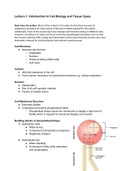
Lecture 1: Introduction to Cell Biology and Tissue Types
Note from the author: Much of the content in the notes for this block is purely for
explanatory purposes as I was unsure of the level of detail required for the exams.
Additionally, much of the course may have changed with lecturers taking on different roles.
However, my advice is to learn and focus on the key physiological processes such as how
the muscle contracts (ATP cycling and transmission at the neuromuscular junction etc), bony
landmarks (relevant for clinical practice) and relevant muscle groups.
Cell Structure
● Structure and function
○ Organelles
○ Nucleus
○ Protein-building (DNA code)
○ Cell cycle
Cytosol
● Jelly-like substance in the cell
● Fluid medium necessary for biochemical reactions e.g. cellular respiration
Nucleus
● Independent
● Site of all cell’s genetic material
● Factory of cellular action
Cell Membrane Structure
● Extremely pliable
● Composed of primarily phospholipid bilayer
○ Phospholipid bilayer allows the membrane to display a high level of
fluidity which is required for structural integrity and function
Building blocks of phospholipid bilayer
1) Hydrophilic head
● Water-loving
● Composed of phosphate and glycerol
● Negatively charged
2) Hydrophobic tail
● Water-repelling
● Composed of fatty acids (saturated
and unsaturated)
,Saturated FAs
● Lack double bonds between the individual carbon atoms
● Solid at room temperature e.g. animal fats
Unsaturated FAs
● There is at least one double bond in the FA chain
● Liquid at room temperature e.g. plant derived
Phospholipid Bilayer
● Phosphate groups are hydrophilic and arrange adjacent to intracellular (ICF)
and extracellular (ECF) fluid
● The hydrophobic (water-repelling) tails make up the inner membrane and
create a hydrophobic or fluid-free environment
● NB: These physicochemical properties enable a fluid membrane structure
Summary of Phospholipid Bilayer
a) Hydrophilic heads situate themselves adjacent to ECF or ICF
● Composed of phosphate and glycerol
● Negatively charged
b) Hydrophobic tails are what make up the innermost part of the membrane
● Create a hydrophobic/fluid-free environment
● Composed of saturated and unsaturated fatty acids
c) Function: these physicochemical properties enable a fluid membrane
structure
● Cell membranes are peppered with a range of cell membrane-associated
proteins
○ These are classified into two different groups
, Cell Membrane-associated Proteins
1) Integral Protein
● Embedded within the membrane
● Run through the entirety of the membrane bilayer
● Examples include:
a) Channel proteins
● Allow the passage of ions through the bilayer
b) Receptor proteins
● Respond to external ligands (cues) to influence cell
signalling
2) Peripheral proteins
● Proteins attached to the external or internal side of the membrane
In order to understand how substances move passively across a cell membrane, it is
necessary to understand concentration gradients and diffusion
● Concentration gradient = a difference in concentration of a substance across
a space
Types of Diffusion
Simple Diffusion
● Molecules and ions will diffuse from where they are more concentrated to
where they are less concentrated until they are equally distributed across that
space
Examples:
● Gases such as oxygen will diffuse from high concentrations to lower
concentrations from outside to inside the cell
Note from the author: Much of the content in the notes for this block is purely for
explanatory purposes as I was unsure of the level of detail required for the exams.
Additionally, much of the course may have changed with lecturers taking on different roles.
However, my advice is to learn and focus on the key physiological processes such as how
the muscle contracts (ATP cycling and transmission at the neuromuscular junction etc), bony
landmarks (relevant for clinical practice) and relevant muscle groups.
Cell Structure
● Structure and function
○ Organelles
○ Nucleus
○ Protein-building (DNA code)
○ Cell cycle
Cytosol
● Jelly-like substance in the cell
● Fluid medium necessary for biochemical reactions e.g. cellular respiration
Nucleus
● Independent
● Site of all cell’s genetic material
● Factory of cellular action
Cell Membrane Structure
● Extremely pliable
● Composed of primarily phospholipid bilayer
○ Phospholipid bilayer allows the membrane to display a high level of
fluidity which is required for structural integrity and function
Building blocks of phospholipid bilayer
1) Hydrophilic head
● Water-loving
● Composed of phosphate and glycerol
● Negatively charged
2) Hydrophobic tail
● Water-repelling
● Composed of fatty acids (saturated
and unsaturated)
,Saturated FAs
● Lack double bonds between the individual carbon atoms
● Solid at room temperature e.g. animal fats
Unsaturated FAs
● There is at least one double bond in the FA chain
● Liquid at room temperature e.g. plant derived
Phospholipid Bilayer
● Phosphate groups are hydrophilic and arrange adjacent to intracellular (ICF)
and extracellular (ECF) fluid
● The hydrophobic (water-repelling) tails make up the inner membrane and
create a hydrophobic or fluid-free environment
● NB: These physicochemical properties enable a fluid membrane structure
Summary of Phospholipid Bilayer
a) Hydrophilic heads situate themselves adjacent to ECF or ICF
● Composed of phosphate and glycerol
● Negatively charged
b) Hydrophobic tails are what make up the innermost part of the membrane
● Create a hydrophobic/fluid-free environment
● Composed of saturated and unsaturated fatty acids
c) Function: these physicochemical properties enable a fluid membrane
structure
● Cell membranes are peppered with a range of cell membrane-associated
proteins
○ These are classified into two different groups
, Cell Membrane-associated Proteins
1) Integral Protein
● Embedded within the membrane
● Run through the entirety of the membrane bilayer
● Examples include:
a) Channel proteins
● Allow the passage of ions through the bilayer
b) Receptor proteins
● Respond to external ligands (cues) to influence cell
signalling
2) Peripheral proteins
● Proteins attached to the external or internal side of the membrane
In order to understand how substances move passively across a cell membrane, it is
necessary to understand concentration gradients and diffusion
● Concentration gradient = a difference in concentration of a substance across
a space
Types of Diffusion
Simple Diffusion
● Molecules and ions will diffuse from where they are more concentrated to
where they are less concentrated until they are equally distributed across that
space
Examples:
● Gases such as oxygen will diffuse from high concentrations to lower
concentrations from outside to inside the cell