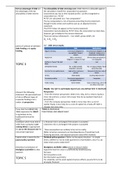
the tax advantage of debt (or Tax allowability of debt servicing costs: Debt interest is allowable against
the advantage of the tax the calculation of profit for corporation tax purposes
allowability of debt interest Corporations pay tax on their taxable profits = profits chargeable to
corporation tax = PCTCT
PCTCT are calculated via a “tax computation”
The tax computation is not a financial accounting income statement -
though it looks similar and could be seen as an adjusted income
statement
The PCTCT does not appear on the income statement
Corporation tax (calculated as PCTCT times the corporation tax rate) does,
however, get included in the income statement
There are various refinements ... loss reliefs, group reliefs, etc.
points of contrast as between SoF - debt versus equity
debt funding and equity
funding;
TOPIC 3
interpret the following Perspective
statement: the perceived level - From the investor perspective: Debt is less risky, Kd is a return; Equity is
of risk in different types of more risk and Ke is a return; Kd is lower than Ke (a standard risk/return
corporate funding is all a association)
matter of perspective - From the company perspective: Debt is more risky, Kd is a cost of
capital; Equity is less risky, Ke is a cost of capital; So a trade-off: debt is
cheaper but more risky.
Prove that the M&M(1958, TOPIC 4 ADDENDUM
1963) expression for WACC TRADITIONAL AND M&M3 WACC
is equivalent to the
traditional formula for
WACC.
conditions which must hold in 1.Financial risk is unchanged if the project is accepted
order that a company’s pre- 2.Business risk is unchanged if the project is accepted
existing WACC is appropriate
for use as the discount rate for These assumptions are unlikely to be met in reality.
new project appraisal [Refer to lecture comments on interdependence of investment and
financing decisions; and adjusted present value (APV) method]
Explain what is meant by the Dividend policy question • Refers to the payout decision – in simple
payout policy question terms, whether or not to make payments to shareholders; and, if so, by
what means and to what level?
theoretical contribution of Modigliani and Miller (1961) (more on lecture slides)
Modigliani and Miller to that Argument that firm value is unaffected by dividend policy
question No taxes
No transactions costs
No information asymmetry
TOPIC 5 For simplicity, and to avoid capital structure effects, assume firms to be
all-equity financed
, factors which may impact Impactors on dividend policy
upon firms’ payout policies in A. Amount of reserves distributable to shareholders – as determined by
practice reference to regulation
B. Contractual limitations – restrictive loan covenants – need first to
service debt in full
C. Liquidity
D. Taxation
– corporate taxation position (UK historic)
– taxation position of dividend recipients • income tax position
E. Clientele theory / effect
TOPIC 5 – equity investors are aware of the manifestation of the dividend policy of
firms (e.g., their dividend payout ratios)
– investor preferences include considerations of income need, tax
position, etc.
– therefore, choose a firm in which to invest based, inter alia, on this
– no particular dividend policy implied to be intrinsically superior
F. Earnings stability / signalling
– “information content of dividends”
• information asymmetry, therefore signalling opportunity
• dividend rate increase is potentially costly
• also, by same arguments, signalling impact of rights issues and bonus
issues
– information-disclosure package of “high dividend + new equity
financing” tends to be superior to the obvious alternative … but this is
merely a matter of perception
– availability of +ve NPV projects … growth, life-cycle
G. Agency theory
– E.g., retaining cash leaves more scope for management to pursue their
self interest
– But retaining cash to invest in suitable +ve NPV projects is in the
interests of shareholders
– So, positive dividend policy can reduce agency costs
H. Nature of firm
– E.g. “family” firm … special regard to personal circumstances of owners
Explain the meaning and Securitization
purposes of the following: – Authorised issuance of participation certificates (or ‘pass-throughs’) –
securitization, and Mortgage-backed bond securities (“MBS”) • Mortgages are placed in a
collateralized mortgage pool/SPV, and participation certificates are issued to finance these assets
obligations – A bank provides a mortgage loan (debt) to, e.g., an individual home
owner, to enable them to purchase a house • Not market-tradeable in the
UK – Participation certificates are tradeable debt – So securitization opens
TOPIC 7 up wider participation (investment/funding) opportunities in the
mortgage market • Householder pays the mortgage interest and
repayments into the pool, and these cash-flows cover obligations to pay
the participation certificate investors – Often the profile of participation
certificate redemption is linked to the profile of mortgage redemptions –
… and early repayment of mortgages can be unpopular with P-C investors
Collateralized mortgage obligations (CMOs)
• Mortgage repayments consists of interest and principal • Under CMO,
mortgage pool’s interest and principal payments are allocated between
investors in the pool in relation to their attitude to prepayment risk • Pool
is split up into tranches, that have different priority claims on the interest
and principal. • All tranches earn the same rate of interest, • All principal
repayments are funnelled to tranche A (both scheduled and prepaid) until
A has been retired • When A has matured, the B tranche receives the
interest and principal repayments until it matures • So prepayment risk is
borne by A in the first instance, B next and then C • So holder of tranche C
faces little prepayment risk • So will participation certificate in A sell for
more or less than C?
the advantage of the tax the calculation of profit for corporation tax purposes
allowability of debt interest Corporations pay tax on their taxable profits = profits chargeable to
corporation tax = PCTCT
PCTCT are calculated via a “tax computation”
The tax computation is not a financial accounting income statement -
though it looks similar and could be seen as an adjusted income
statement
The PCTCT does not appear on the income statement
Corporation tax (calculated as PCTCT times the corporation tax rate) does,
however, get included in the income statement
There are various refinements ... loss reliefs, group reliefs, etc.
points of contrast as between SoF - debt versus equity
debt funding and equity
funding;
TOPIC 3
interpret the following Perspective
statement: the perceived level - From the investor perspective: Debt is less risky, Kd is a return; Equity is
of risk in different types of more risk and Ke is a return; Kd is lower than Ke (a standard risk/return
corporate funding is all a association)
matter of perspective - From the company perspective: Debt is more risky, Kd is a cost of
capital; Equity is less risky, Ke is a cost of capital; So a trade-off: debt is
cheaper but more risky.
Prove that the M&M(1958, TOPIC 4 ADDENDUM
1963) expression for WACC TRADITIONAL AND M&M3 WACC
is equivalent to the
traditional formula for
WACC.
conditions which must hold in 1.Financial risk is unchanged if the project is accepted
order that a company’s pre- 2.Business risk is unchanged if the project is accepted
existing WACC is appropriate
for use as the discount rate for These assumptions are unlikely to be met in reality.
new project appraisal [Refer to lecture comments on interdependence of investment and
financing decisions; and adjusted present value (APV) method]
Explain what is meant by the Dividend policy question • Refers to the payout decision – in simple
payout policy question terms, whether or not to make payments to shareholders; and, if so, by
what means and to what level?
theoretical contribution of Modigliani and Miller (1961) (more on lecture slides)
Modigliani and Miller to that Argument that firm value is unaffected by dividend policy
question No taxes
No transactions costs
No information asymmetry
TOPIC 5 For simplicity, and to avoid capital structure effects, assume firms to be
all-equity financed
, factors which may impact Impactors on dividend policy
upon firms’ payout policies in A. Amount of reserves distributable to shareholders – as determined by
practice reference to regulation
B. Contractual limitations – restrictive loan covenants – need first to
service debt in full
C. Liquidity
D. Taxation
– corporate taxation position (UK historic)
– taxation position of dividend recipients • income tax position
E. Clientele theory / effect
TOPIC 5 – equity investors are aware of the manifestation of the dividend policy of
firms (e.g., their dividend payout ratios)
– investor preferences include considerations of income need, tax
position, etc.
– therefore, choose a firm in which to invest based, inter alia, on this
– no particular dividend policy implied to be intrinsically superior
F. Earnings stability / signalling
– “information content of dividends”
• information asymmetry, therefore signalling opportunity
• dividend rate increase is potentially costly
• also, by same arguments, signalling impact of rights issues and bonus
issues
– information-disclosure package of “high dividend + new equity
financing” tends to be superior to the obvious alternative … but this is
merely a matter of perception
– availability of +ve NPV projects … growth, life-cycle
G. Agency theory
– E.g., retaining cash leaves more scope for management to pursue their
self interest
– But retaining cash to invest in suitable +ve NPV projects is in the
interests of shareholders
– So, positive dividend policy can reduce agency costs
H. Nature of firm
– E.g. “family” firm … special regard to personal circumstances of owners
Explain the meaning and Securitization
purposes of the following: – Authorised issuance of participation certificates (or ‘pass-throughs’) –
securitization, and Mortgage-backed bond securities (“MBS”) • Mortgages are placed in a
collateralized mortgage pool/SPV, and participation certificates are issued to finance these assets
obligations – A bank provides a mortgage loan (debt) to, e.g., an individual home
owner, to enable them to purchase a house • Not market-tradeable in the
UK – Participation certificates are tradeable debt – So securitization opens
TOPIC 7 up wider participation (investment/funding) opportunities in the
mortgage market • Householder pays the mortgage interest and
repayments into the pool, and these cash-flows cover obligations to pay
the participation certificate investors – Often the profile of participation
certificate redemption is linked to the profile of mortgage redemptions –
… and early repayment of mortgages can be unpopular with P-C investors
Collateralized mortgage obligations (CMOs)
• Mortgage repayments consists of interest and principal • Under CMO,
mortgage pool’s interest and principal payments are allocated between
investors in the pool in relation to their attitude to prepayment risk • Pool
is split up into tranches, that have different priority claims on the interest
and principal. • All tranches earn the same rate of interest, • All principal
repayments are funnelled to tranche A (both scheduled and prepaid) until
A has been retired • When A has matured, the B tranche receives the
interest and principal repayments until it matures • So prepayment risk is
borne by A in the first instance, B next and then C • So holder of tranche C
faces little prepayment risk • So will participation certificate in A sell for
more or less than C?