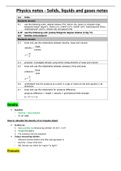
Physics notes - Solids, liquids and gases notes
Density:
Equation
Density = mass/volume
Or: ρ = m/v
How to calculate the density of an irregular object
Eureka can
1. Use a eureka can/measuring cylinder nb 1ml = 1 cm2
2. Weigh the object
3. Put numbers into the equation
Using a measuring cylinder:
Measure volume before and after placing object in
Density = mass/ Vol2-Vol1
NB: Density can either be in g/cm3 or kg/m3
Pressure:
, Equations
Pressure = force/area
P= F/A
Pressure is measured in pascals
1 pascal/ 1 Pa = 1N/m2
Gas pressure:
The pressure In a liquid or a gas at a particular point acts equally in all directions
The particle theory explains gas in the following way:
1. Gas molecules travel in a constant random motion
2. When a molecule collides with a surface it exerts a force on the surface as it changes direction
3. The pressure exerted by the gas is equal to the total force exerted by the molecules over an area of the
surface, divided by area.
Can be increased by
Increasing kinetic energy- heating
Decreasing surface area
Pressure in liquids:
The pressure In a liquid at a particular point acts equally in all directions
What affects pressure
The pressure in a liquid or gas increases with depth.
Pressure depends on the density of the liquid/gas- higher density = higher pressure
Pressure does not depend on the shape of the container
Equation
Pressure = density x height (how deep in the water) x gravity
P= ρ gh
The density of water is 1000N/m3
Density:
Equation
Density = mass/volume
Or: ρ = m/v
How to calculate the density of an irregular object
Eureka can
1. Use a eureka can/measuring cylinder nb 1ml = 1 cm2
2. Weigh the object
3. Put numbers into the equation
Using a measuring cylinder:
Measure volume before and after placing object in
Density = mass/ Vol2-Vol1
NB: Density can either be in g/cm3 or kg/m3
Pressure:
, Equations
Pressure = force/area
P= F/A
Pressure is measured in pascals
1 pascal/ 1 Pa = 1N/m2
Gas pressure:
The pressure In a liquid or a gas at a particular point acts equally in all directions
The particle theory explains gas in the following way:
1. Gas molecules travel in a constant random motion
2. When a molecule collides with a surface it exerts a force on the surface as it changes direction
3. The pressure exerted by the gas is equal to the total force exerted by the molecules over an area of the
surface, divided by area.
Can be increased by
Increasing kinetic energy- heating
Decreasing surface area
Pressure in liquids:
The pressure In a liquid at a particular point acts equally in all directions
What affects pressure
The pressure in a liquid or gas increases with depth.
Pressure depends on the density of the liquid/gas- higher density = higher pressure
Pressure does not depend on the shape of the container
Equation
Pressure = density x height (how deep in the water) x gravity
P= ρ gh
The density of water is 1000N/m3