Physics notes – Electricity
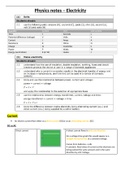
Quantity Symbol Unit Unit symbol
Time t Seconds s
Potential difference (voltage) V Volts V
Current I Amps A
Resistance R Ohms Ω
Charge Q Coulombs C
Power P Watts W
Energy (word done) E (or W) Joules J
Current
An electric current flow either as a direct current (DC)or as an alternating current. (DC)
DC vs AC
Direct current A direct current flows in only one direction.
On a voltage-time graph this would appear as a
straight horizontal line at a constant voltage.
Comes from batteries + cells
A constant, fixed value of current as the electrons are
being pushed the same amount and in the same
direction by a DC Voltage.
, Alternating current An alternating current regularly changes direction.
On a voltage-time graph, this would appear as a curve
alternating between positive and negative voltages.
The positive and negative values indicate the direction
of current flow.
Household electricity
Plugs
A plug connects a device to the mains electricity supply.
The cable between the device and the three-pin plug contains
three copper wires
Wires in a plug
Type of wire Characteristics and function
Neutral wire Coated with blue plastic
Connects to the cable in the wall
Completes the circuit – safe for normal use
Earth wire Coated in striped plastic
Provides a path for current to flow from the case of the device to the ground if there is a fault
Safety feature
Live wire Coated with brown plastic
Delivers Alternating Current
Most dangerous part of the plug
Do all appliances require an Earth?
Sealed plastic appliances (e.g. hairdryers) don’t require an earth as the fact they are in a plastic case means
the current can’t flow anywhere else.
Appliances or wires with two lots of insulation (double insulated) also do not.
Materials used
Wires – copper (good electrical conductor + bends easily)
Pins – brass (good electrical conductor + doesn’t rust or oxidise easily)
Sockets and plug cases – stiff plastic (good electrical insulator)
Around the wires – rubber or flexible plastic (good electrical insulator + bends easily)
Other features of a plug
Features of a plug Function
Quantity Symbol Unit Unit symbol
Time t Seconds s
Potential difference (voltage) V Volts V
Current I Amps A
Resistance R Ohms Ω
Charge Q Coulombs C
Power P Watts W
Energy (word done) E (or W) Joules J
Current
An electric current flow either as a direct current (DC)or as an alternating current. (DC)
DC vs AC
Direct current A direct current flows in only one direction.
On a voltage-time graph this would appear as a
straight horizontal line at a constant voltage.
Comes from batteries + cells
A constant, fixed value of current as the electrons are
being pushed the same amount and in the same
direction by a DC Voltage.
, Alternating current An alternating current regularly changes direction.
On a voltage-time graph, this would appear as a curve
alternating between positive and negative voltages.
The positive and negative values indicate the direction
of current flow.
Household electricity
Plugs
A plug connects a device to the mains electricity supply.
The cable between the device and the three-pin plug contains
three copper wires
Wires in a plug
Type of wire Characteristics and function
Neutral wire Coated with blue plastic
Connects to the cable in the wall
Completes the circuit – safe for normal use
Earth wire Coated in striped plastic
Provides a path for current to flow from the case of the device to the ground if there is a fault
Safety feature
Live wire Coated with brown plastic
Delivers Alternating Current
Most dangerous part of the plug
Do all appliances require an Earth?
Sealed plastic appliances (e.g. hairdryers) don’t require an earth as the fact they are in a plastic case means
the current can’t flow anywhere else.
Appliances or wires with two lots of insulation (double insulated) also do not.
Materials used
Wires – copper (good electrical conductor + bends easily)
Pins – brass (good electrical conductor + doesn’t rust or oxidise easily)
Sockets and plug cases – stiff plastic (good electrical insulator)
Around the wires – rubber or flexible plastic (good electrical insulator + bends easily)
Other features of a plug
Features of a plug Function