Notes created using BPP materials and statute for the purpose of assisting existing BPP LPC students in BPP LPC exams only. They are
intended to be used as a supplemental tool to aid revision in conjunction with BPP materials, not as a replacement for them.
FINANCIAL STATEMENTS AND SOLE TRADERS
ALCIE classification
= system of categorising the trial balance entries
Assets Something you own
Separate accounts for each asset category eg vehicles
Fixed (non-current) = LT: tangible/intangible that enables a business to make a profit
Current = ST: cash/items which can be quickly turned into cash eg stock
Liabilities Something you owe
Separate accounts for each type of liability eg loans, trade debts
Current (paid within a year) eg overdraft or long-term (due after 1 year) eg loan
Capital Injection of value from the owner/investor – not money accruing from customers
Represents the owner of the business
Income Comes from regular sources
Separate accounts for each income source eg ticket sales, venue hire
Expenses Separate accounts for each expense source eg heating, postage bills
Day-to-day spending, NOT to be confused with capital expenditure ie buying assets
Trial balance used to construct the P&L Account and Balance Sheet
P&L Account =
Records the income of a business throughout an accounting period minus expenses incurred in that period,
to arrive at a net profit/loss figure for that period
Generally, only the income and expense entries from the trial balance are transferred into the P&L Account
Cost of sales = Opening stock + Purchase – Closing stock = Cost of sales
Profit and Loss Account used to construct the Balance Sheet
Balance Sheet
• Records the position re asset, liability and capital accounts from the trial balance
• Tells a reader:
o NAV – net worth/net asset value → recorded in the top half
o Capital invested in the business to achieve that net worth → recorded in the bottom half
→ these figures will be the same unless something has gone wrong – 2 halves must balance
Net assets = Fixed Assets (Net Book Value) + Net Current Assets = LT Liabilities
Drawings = withdrawals
, Business Accounts
YEAR-END ADJUSTMENTS
= modifications to the account entries on trial balance → made before financial statements are prepared to:
• Ensure all income and expenditure shown relates only to the relevant accounting period
• Anticipate current obligations as liabilities
DEPRECIATION
Deals with decline in value of fixed assets → 2 common ways used to depreciate assets:
1. Straight-line method
• Spreads the depreciation charge evenly over the life of the asset
• Gives rise to the same charge for depreciation each year
→ used where the service provided continues throughout its economic life on a consistent basis
2. Reducing balance method
• The depreciation charge each year is expressed as a % of the reducing balance (eg 20%)
• More depreciation is charged in earlier years since the net book value of the assets reduces each year
→ used where an asset loses a large part of its value in the first few years
Recorded in an:
• Expense account (as asset values are falling); and
• Liability account
COST – ACCUMULATED DEPRECIATION = NET BOOK VALUE
Net book value = estimate of the current value of the asset to the business
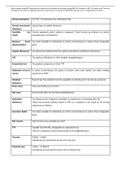
Category of fixed/ Depreciation charge for the year Prov’n for dep’n at start Accum’d dep’n at
non-current assets (P&L) of year (Trial balance) end of year (BS)
Asset in q Take asset cost from TB and apply Take straight from TB 2nd column + 3rd
straight line or reducing balance column
method, depending on q
Straight line method
Charge depreciation as a % of cost
Reducing balance
If it says 25% of Reducing Balance →
Original cost of asset (80k) – Provision
for depreciation (20k) cost = Reduced
Balance (60k)
THEN 25% of Reduced Balance (60k)
Buildings 2,000 (2% of 100,000) 39,600 41,600
2
intended to be used as a supplemental tool to aid revision in conjunction with BPP materials, not as a replacement for them.
FINANCIAL STATEMENTS AND SOLE TRADERS
ALCIE classification
= system of categorising the trial balance entries
Assets Something you own
Separate accounts for each asset category eg vehicles
Fixed (non-current) = LT: tangible/intangible that enables a business to make a profit
Current = ST: cash/items which can be quickly turned into cash eg stock
Liabilities Something you owe
Separate accounts for each type of liability eg loans, trade debts
Current (paid within a year) eg overdraft or long-term (due after 1 year) eg loan
Capital Injection of value from the owner/investor – not money accruing from customers
Represents the owner of the business
Income Comes from regular sources
Separate accounts for each income source eg ticket sales, venue hire
Expenses Separate accounts for each expense source eg heating, postage bills
Day-to-day spending, NOT to be confused with capital expenditure ie buying assets
Trial balance used to construct the P&L Account and Balance Sheet
P&L Account =
Records the income of a business throughout an accounting period minus expenses incurred in that period,
to arrive at a net profit/loss figure for that period
Generally, only the income and expense entries from the trial balance are transferred into the P&L Account
Cost of sales = Opening stock + Purchase – Closing stock = Cost of sales
Profit and Loss Account used to construct the Balance Sheet
Balance Sheet
• Records the position re asset, liability and capital accounts from the trial balance
• Tells a reader:
o NAV – net worth/net asset value → recorded in the top half
o Capital invested in the business to achieve that net worth → recorded in the bottom half
→ these figures will be the same unless something has gone wrong – 2 halves must balance
Net assets = Fixed Assets (Net Book Value) + Net Current Assets = LT Liabilities
Drawings = withdrawals
, Business Accounts
YEAR-END ADJUSTMENTS
= modifications to the account entries on trial balance → made before financial statements are prepared to:
• Ensure all income and expenditure shown relates only to the relevant accounting period
• Anticipate current obligations as liabilities
DEPRECIATION
Deals with decline in value of fixed assets → 2 common ways used to depreciate assets:
1. Straight-line method
• Spreads the depreciation charge evenly over the life of the asset
• Gives rise to the same charge for depreciation each year
→ used where the service provided continues throughout its economic life on a consistent basis
2. Reducing balance method
• The depreciation charge each year is expressed as a % of the reducing balance (eg 20%)
• More depreciation is charged in earlier years since the net book value of the assets reduces each year
→ used where an asset loses a large part of its value in the first few years
Recorded in an:
• Expense account (as asset values are falling); and
• Liability account
COST – ACCUMULATED DEPRECIATION = NET BOOK VALUE
Net book value = estimate of the current value of the asset to the business
Category of fixed/ Depreciation charge for the year Prov’n for dep’n at start Accum’d dep’n at
non-current assets (P&L) of year (Trial balance) end of year (BS)
Asset in q Take asset cost from TB and apply Take straight from TB 2nd column + 3rd
straight line or reducing balance column
method, depending on q
Straight line method
Charge depreciation as a % of cost
Reducing balance
If it says 25% of Reducing Balance →
Original cost of asset (80k) – Provision
for depreciation (20k) cost = Reduced
Balance (60k)
THEN 25% of Reduced Balance (60k)
Buildings 2,000 (2% of 100,000) 39,600 41,600
2