A cognition is a mental process in gaining knowledge and comprehension. We can explain behaviour by
looking at perception, language, attention and memory
The principles of cognitive psychology are that:
1. All mental systems have a limited capacity
2. A control mechanism oversees all mental processes
3. There is a 2 way flow of information
Cognitive neuroscience took off in the 70’s. It maps human behaviour to brain function, using brain
imaging techniques, which allows psychologists to discover when and where things happen in the brain in
relation to behaviour.
Methods used include:
1. Lesion studies – looking at people with brain damage to see how behaviour is affected
2. Electrophysiology – using electric and magnetic fields to measure brain activity and brain waves
3. Neuroimaging – pinpointing areas of the brain which are active when a task is performed
Strengths Weaknesses
Considers all mental processes that can Research is often artificial and has very
often be overlooked low ecological validity
Had a big influence on the development of Fails to take individual differences into
other therapies account and assumes we all process
things in the same way
Coding is about the way in which information is stored in memory. STM keeps information active by
repeating it (acoustic coding). LTM is semantic, it is more useful to code through the meaning of words
rather than sounds or appearance.
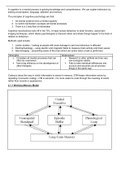
2.1.1 Working Memory Model
, This was developed by Baddely and Hitch in 1974. It says STM is an active processer with several
different stores. The central executive is the key component, and is described as attention. It has a limited
capacity and controls the slave systems.
1) Phonological loop -> deals with speech based information, is made of the phonological store (inner
ear) and the articulatory process (inner voice).
2) Visuo-Spatial Sketchpad -> aka VSSP, involves the temporary storage of visual and spatial
information
3) Episodic Buffer -> added in 2000, briefly stores information from the other sub-systems and
integrates them to create scenes
The model came from experimental evidence, and was based on studies that used “interference tasks”.
Ppts were asked to simultaneously perform two tasks using the same system -> performance was
affected (i.e. saying “the” over and over while reading silently is very hard). According to the WMM this is
because both tasks use the phonological loop, which has a limited capacity so cannot do both. If the tasks
had different systems, performance would not be affected.
Strengths Weaknesses
Shallice and Warrington (1974) studied KF Idea of central executive is simplistic and
(a person with brain damage and an vague, it doesn’t explain it other than
impaired STM) who had problems with attention
immediate recall of verbally presented The model explains how information gets
words but not with visual information -> this into STM not how it is transferred into LTM
suggests an impaired articulatory loop but Research backing this up is low in
intact VSSP ecological validity
Gathercole and Baddeley (1993) shows Does not explain confabulation
evidence for unaffected performance when
different sub systems are used
Model has less emphasis on rehearsal,
which explains why in reality some things
end up in LTM when they are not
rehearsed
2.1.2 MSM Model of Memory
looking at perception, language, attention and memory
The principles of cognitive psychology are that:
1. All mental systems have a limited capacity
2. A control mechanism oversees all mental processes
3. There is a 2 way flow of information
Cognitive neuroscience took off in the 70’s. It maps human behaviour to brain function, using brain
imaging techniques, which allows psychologists to discover when and where things happen in the brain in
relation to behaviour.
Methods used include:
1. Lesion studies – looking at people with brain damage to see how behaviour is affected
2. Electrophysiology – using electric and magnetic fields to measure brain activity and brain waves
3. Neuroimaging – pinpointing areas of the brain which are active when a task is performed
Strengths Weaknesses
Considers all mental processes that can Research is often artificial and has very
often be overlooked low ecological validity
Had a big influence on the development of Fails to take individual differences into
other therapies account and assumes we all process
things in the same way
Coding is about the way in which information is stored in memory. STM keeps information active by
repeating it (acoustic coding). LTM is semantic, it is more useful to code through the meaning of words
rather than sounds or appearance.
2.1.1 Working Memory Model
, This was developed by Baddely and Hitch in 1974. It says STM is an active processer with several
different stores. The central executive is the key component, and is described as attention. It has a limited
capacity and controls the slave systems.
1) Phonological loop -> deals with speech based information, is made of the phonological store (inner
ear) and the articulatory process (inner voice).
2) Visuo-Spatial Sketchpad -> aka VSSP, involves the temporary storage of visual and spatial
information
3) Episodic Buffer -> added in 2000, briefly stores information from the other sub-systems and
integrates them to create scenes
The model came from experimental evidence, and was based on studies that used “interference tasks”.
Ppts were asked to simultaneously perform two tasks using the same system -> performance was
affected (i.e. saying “the” over and over while reading silently is very hard). According to the WMM this is
because both tasks use the phonological loop, which has a limited capacity so cannot do both. If the tasks
had different systems, performance would not be affected.
Strengths Weaknesses
Shallice and Warrington (1974) studied KF Idea of central executive is simplistic and
(a person with brain damage and an vague, it doesn’t explain it other than
impaired STM) who had problems with attention
immediate recall of verbally presented The model explains how information gets
words but not with visual information -> this into STM not how it is transferred into LTM
suggests an impaired articulatory loop but Research backing this up is low in
intact VSSP ecological validity
Gathercole and Baddeley (1993) shows Does not explain confabulation
evidence for unaffected performance when
different sub systems are used
Model has less emphasis on rehearsal,
which explains why in reality some things
end up in LTM when they are not
rehearsed
2.1.2 MSM Model of Memory