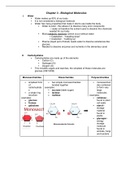
Chapter 3 - Biological Molecules
I. Water
Water makes up 80% of our body
It is not considered a biological molecule
Water has many properties that make it vital to use inside the body
Water is polar - this allows it to dissolve many ionic compounds
→ water is therefore the solvent used to dissolve the chemicals
needed for our body
Most metabolic reactions cannot occur without water
> Catabolism - “breaking down”
> Anabolism - “building up”
Plasma (liquid part of blood) needs water to dissolve substances like
glucose
Needed to dissolve enzymes and nutrients in the alimentary canal
II. Carbohydrates
Carbohydrates are made up of the elements
Carbon (C)
Hydrogen (H)
Oxygen (O)
This includes sugars and starches, the simpliest of these molecules are
glucose (C6H12O6)
Monosaccharides Disaccharides Polysaccharides
simpliest form
two simple monosaccharides monosacchari
of bonded together des combined
carbohydrate examples: to form very
s sucrose (table sugar) large
a single ring lactose molecules
structure maltose examples:
examples: cellulose -
glucose found in plant
frutose cell walls
galactose starch -
storage
material
found in
plants
glycogen -
energy
storage
molecule
found in
animals, fungi
and bacteria
, Function of Carbohydrates
o One gram of carbohydrate releases 17 kJ of energy
o Glucose is used in respiration and transport in an animals body
Sucrose is used for transport in plants
o Plants store carbs as starch
o Animals store carbs as glycogen in the liver and muscles as an immediate
source of energy
o Cellulose makes up plant cell wall and help maintain plant shape
III. Fats/Lipids
Fats are made up of the elements
Carbon (C)
Hydrogen (H)
Oxygen (O)
Fats are made up of 4 small molecules
→ triglycerides
1 glycerol
3 fatty acid chains
Fats are insoluable in water
Phospholipids have a phosphorus group in place of the third fatty acid →
these make up the phospholipid bilayer of the cells
Function of Fats
o Fats also store energy. One gram of fat has around 39 kJ of energy
o Most cells use carbs first as a source of energy and will only burn fats
when all carbs have been used
o Animals build up fat to store energy for lean times and to insulate their
body
o Plants store oils in their seed to provide energy for germination
IV. Proteins
Proteins are made up of the elements
Carbon (C)
I. Water
Water makes up 80% of our body
It is not considered a biological molecule
Water has many properties that make it vital to use inside the body
Water is polar - this allows it to dissolve many ionic compounds
→ water is therefore the solvent used to dissolve the chemicals
needed for our body
Most metabolic reactions cannot occur without water
> Catabolism - “breaking down”
> Anabolism - “building up”
Plasma (liquid part of blood) needs water to dissolve substances like
glucose
Needed to dissolve enzymes and nutrients in the alimentary canal
II. Carbohydrates
Carbohydrates are made up of the elements
Carbon (C)
Hydrogen (H)
Oxygen (O)
This includes sugars and starches, the simpliest of these molecules are
glucose (C6H12O6)
Monosaccharides Disaccharides Polysaccharides
simpliest form
two simple monosaccharides monosacchari
of bonded together des combined
carbohydrate examples: to form very
s sucrose (table sugar) large
a single ring lactose molecules
structure maltose examples:
examples: cellulose -
glucose found in plant
frutose cell walls
galactose starch -
storage
material
found in
plants
glycogen -
energy
storage
molecule
found in
animals, fungi
and bacteria
, Function of Carbohydrates
o One gram of carbohydrate releases 17 kJ of energy
o Glucose is used in respiration and transport in an animals body
Sucrose is used for transport in plants
o Plants store carbs as starch
o Animals store carbs as glycogen in the liver and muscles as an immediate
source of energy
o Cellulose makes up plant cell wall and help maintain plant shape
III. Fats/Lipids
Fats are made up of the elements
Carbon (C)
Hydrogen (H)
Oxygen (O)
Fats are made up of 4 small molecules
→ triglycerides
1 glycerol
3 fatty acid chains
Fats are insoluable in water
Phospholipids have a phosphorus group in place of the third fatty acid →
these make up the phospholipid bilayer of the cells
Function of Fats
o Fats also store energy. One gram of fat has around 39 kJ of energy
o Most cells use carbs first as a source of energy and will only burn fats
when all carbs have been used
o Animals build up fat to store energy for lean times and to insulate their
body
o Plants store oils in their seed to provide energy for germination
IV. Proteins
Proteins are made up of the elements
Carbon (C)