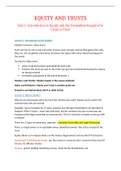
EQUITY AND TRUSTS
Unit 1- Introduction to Equity and the Formalities Required to
Create a Trust
Lecture 1- Introduction to the Module
Module Convenor- Steve Evans
Each unit has its own tutorial (8 units), themes and concepts overlap throughout the units,
they are not completely stand alone (however the topics will not be mixed/overlapped in
the exam)
Top tips for high marks-
Listen to all the lectures (unit guide for each unit)
Tutorial- the more you put in, the more you get out (recommend having the camera
on during tutorial)
Formative assessment at the end of Semester 1
Hanbury and Martin- Modern Equity is the course textbook
Haley and McMurtry- Equity and Trusts is another good one
Property Law Statute Book (2019 or 2020 is fine)
Lecture 2- What is Equity?
Why do we need equity when we have the common law rules? Equity can be used if the
common law rules are not fair
Example: I go to Australia for 10 years and give you the legal ownership to my farmland in
England. When I return, I want that land back, but the common law says no because you
transferred the legal ownership to someone else. This isn’t fair/just so equity comes up with
a solution
There are 2 layers of ownership, separate – Equitable Ownership and Legal Ownership
There is a legal owner or an equitable owner (beneficial owner)- this is the concept of the
trust
Equity allows us to impose duties on the trustee (legal owner) and sue him if he breaches
Investment Trusts/Pension trusts- put the money in someone else’s name but they invest it
for you, its still your money
Trustee- person holding something (money, land) for the beneficiaries use.
, Historians think the concept of trust in English law is the greatest contribution to the world
of law. Now legal jurisdictions who have common law use this concept.
Offshore Trusts- transfer your money to another jurisdiction, money is still yours, but it is
someone else’s name. (can be used for tax avoidance)
Trusts for when you die- wills and trusts funds
Settlement- documents setting out the terms of the lifetime trust
Settlor- the person who makes the settlement
Testator- If your killed off
Do not need to set a trust in a will, all the money goes to executors and then they sort it
between the beneficiaries.
If the will states money goes to the children once they reach 18, a trust must be set up.
Executor becomes the trustee until the child is 18. (they look after the money until then)
Princess Diana left a trust in her will for her estate to go to Will and Harry when they were
25.
Pilot trust- add to your already set up trust in you will (when I die the trustee gets the rest of
my estate as well as what I arranged before)
Limited Interest- do not get to spend the estate left after death, they get the income ie:
dividends, rent on investments
Absolute Interest- Can spend all the capital that is left in the will
In possession- can have the money now
In remainder- can only have the money later (eg: when someone else dies (spouse))
Can have a contingency to fulfil before they get the money (eg: turning 25)
Vested- if you have no contingency to fulfil, you get the money outright straight away.
If you agree you can “bust the trust” split the money between the beneficiaries if the
law/wording of the trust permits it.
Fixed Trust- straightforward trust (you get this and then you get this at this time)
Discretionary Trust- when the beneficiaries can decide what happens to the money
Bare Trust- Have to do what their told about the money that they are holding for somebody
else (bare trustee) (bank, stockbroker)
Unconscionability- a word used to justify equity, can’t usually define it
Unit 1- Introduction to Equity and the Formalities Required to
Create a Trust
Lecture 1- Introduction to the Module
Module Convenor- Steve Evans
Each unit has its own tutorial (8 units), themes and concepts overlap throughout the units,
they are not completely stand alone (however the topics will not be mixed/overlapped in
the exam)
Top tips for high marks-
Listen to all the lectures (unit guide for each unit)
Tutorial- the more you put in, the more you get out (recommend having the camera
on during tutorial)
Formative assessment at the end of Semester 1
Hanbury and Martin- Modern Equity is the course textbook
Haley and McMurtry- Equity and Trusts is another good one
Property Law Statute Book (2019 or 2020 is fine)
Lecture 2- What is Equity?
Why do we need equity when we have the common law rules? Equity can be used if the
common law rules are not fair
Example: I go to Australia for 10 years and give you the legal ownership to my farmland in
England. When I return, I want that land back, but the common law says no because you
transferred the legal ownership to someone else. This isn’t fair/just so equity comes up with
a solution
There are 2 layers of ownership, separate – Equitable Ownership and Legal Ownership
There is a legal owner or an equitable owner (beneficial owner)- this is the concept of the
trust
Equity allows us to impose duties on the trustee (legal owner) and sue him if he breaches
Investment Trusts/Pension trusts- put the money in someone else’s name but they invest it
for you, its still your money
Trustee- person holding something (money, land) for the beneficiaries use.
, Historians think the concept of trust in English law is the greatest contribution to the world
of law. Now legal jurisdictions who have common law use this concept.
Offshore Trusts- transfer your money to another jurisdiction, money is still yours, but it is
someone else’s name. (can be used for tax avoidance)
Trusts for when you die- wills and trusts funds
Settlement- documents setting out the terms of the lifetime trust
Settlor- the person who makes the settlement
Testator- If your killed off
Do not need to set a trust in a will, all the money goes to executors and then they sort it
between the beneficiaries.
If the will states money goes to the children once they reach 18, a trust must be set up.
Executor becomes the trustee until the child is 18. (they look after the money until then)
Princess Diana left a trust in her will for her estate to go to Will and Harry when they were
25.
Pilot trust- add to your already set up trust in you will (when I die the trustee gets the rest of
my estate as well as what I arranged before)
Limited Interest- do not get to spend the estate left after death, they get the income ie:
dividends, rent on investments
Absolute Interest- Can spend all the capital that is left in the will
In possession- can have the money now
In remainder- can only have the money later (eg: when someone else dies (spouse))
Can have a contingency to fulfil before they get the money (eg: turning 25)
Vested- if you have no contingency to fulfil, you get the money outright straight away.
If you agree you can “bust the trust” split the money between the beneficiaries if the
law/wording of the trust permits it.
Fixed Trust- straightforward trust (you get this and then you get this at this time)
Discretionary Trust- when the beneficiaries can decide what happens to the money
Bare Trust- Have to do what their told about the money that they are holding for somebody
else (bare trustee) (bank, stockbroker)
Unconscionability- a word used to justify equity, can’t usually define it