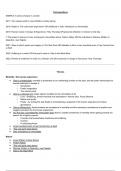
Quadratics Completing the square
Function where the highest power is x².
3 1. (x+a)²+b x²+2ax+a²+b
Without cal. - ax²+bx+c
−b ± √ b2−4 ac e.g. x²+4x+10. 2ax =4x so a must be
Calculator formula- x=
2a 2. Then if 2² is 4, b must be 10-4= 6.
You should get 2 answers. Remember √x could Ans= (x+2)²+6. If needed put equal to
be a positive AND negative number. zero and solve.
For graphs: c = y intercept 2. When there is a number in front of x².
x values= x intercepts (Including a minus). a(x+b)²+c.
First factorise to get rid of the x²
coefficient. Then, do exactly the same
Volume
as before with the numbers Inside the
Cuboid-=Length x width x height
bracket to get 2((x+2)²+1). Then
Triangular prism= L x W x H
expand the outer bracket. 2(x+2)²+2
Cylinder- ¿ π r 2 h
For graphs: The last number is the
1
Pyramid= × base area ×height minimum point and the opposite of
3
the number inside the bracket is the
Sphere formula is give but remember to
line of symmetry of the graph.
divide by 2 for a hemisphere.
Together they make the vertex co-
Formula for a cone is given.
ordinates.
Pythagoras’ theorem Trigonometry
h²=a²+b² In right-angled triangles
So ca to
h h h
Non-right-angled triangles
Sine rule 5 5
Side- e.g. cos60= x=
a b c x cos 60
= = For sides
sin A sin B sin C 10 10
Angle-e.g. tanθ= θ=tan−1 ( )
11 11
sin A sin B sin C
= = For angles Exact values of sin/cos/tan
a b c
30° 45° 60°
For the sine rule we need a matching pair of an sin 1 1 √3
angle and side. 2 √2 2
cos √3 1 1
2 √2 2
tan 1 1 √3
Cosine rule
√ 3Surface area
We use the cosine rule when there are no
matching pairs. We just need two sides and the Find the area of each individual shape that
angle between them. makes the one larger shape.
a²=b²+c²-(2 x b x c x cos A ) For a side For a cylinder find the area of the two
(Remember to square root the answer) circles but also find the circumference
of one of the circles to find the length
x=cos−1 ¿ ¿ ) For an angle of the rectangle that curls around to
form the cylinder.
For pyramids the height of the triangle
is not always given and you may need
Area of a non-right-angled triangle to use Pythagoras’ theorem to find it.
For cones you need to find the slant
1
× a× b ×sin C length-L. SA= πrl
2
Function where the highest power is x².
3 1. (x+a)²+b x²+2ax+a²+b
Without cal. - ax²+bx+c
−b ± √ b2−4 ac e.g. x²+4x+10. 2ax =4x so a must be
Calculator formula- x=
2a 2. Then if 2² is 4, b must be 10-4= 6.
You should get 2 answers. Remember √x could Ans= (x+2)²+6. If needed put equal to
be a positive AND negative number. zero and solve.
For graphs: c = y intercept 2. When there is a number in front of x².
x values= x intercepts (Including a minus). a(x+b)²+c.
First factorise to get rid of the x²
coefficient. Then, do exactly the same
Volume
as before with the numbers Inside the
Cuboid-=Length x width x height
bracket to get 2((x+2)²+1). Then
Triangular prism= L x W x H
expand the outer bracket. 2(x+2)²+2
Cylinder- ¿ π r 2 h
For graphs: The last number is the
1
Pyramid= × base area ×height minimum point and the opposite of
3
the number inside the bracket is the
Sphere formula is give but remember to
line of symmetry of the graph.
divide by 2 for a hemisphere.
Together they make the vertex co-
Formula for a cone is given.
ordinates.
Pythagoras’ theorem Trigonometry
h²=a²+b² In right-angled triangles
So ca to
h h h
Non-right-angled triangles
Sine rule 5 5
Side- e.g. cos60= x=
a b c x cos 60
= = For sides
sin A sin B sin C 10 10
Angle-e.g. tanθ= θ=tan−1 ( )
11 11
sin A sin B sin C
= = For angles Exact values of sin/cos/tan
a b c
30° 45° 60°
For the sine rule we need a matching pair of an sin 1 1 √3
angle and side. 2 √2 2
cos √3 1 1
2 √2 2
tan 1 1 √3
Cosine rule
√ 3Surface area
We use the cosine rule when there are no
matching pairs. We just need two sides and the Find the area of each individual shape that
angle between them. makes the one larger shape.
a²=b²+c²-(2 x b x c x cos A ) For a side For a cylinder find the area of the two
(Remember to square root the answer) circles but also find the circumference
of one of the circles to find the length
x=cos−1 ¿ ¿ ) For an angle of the rectangle that curls around to
form the cylinder.
For pyramids the height of the triangle
is not always given and you may need
Area of a non-right-angled triangle to use Pythagoras’ theorem to find it.
For cones you need to find the slant
1
× a× b ×sin C length-L. SA= πrl
2