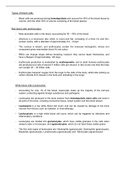
Types of blood cells
- Blood cells are produced during hematopoiesis and account for 45% of the blood tissue by
volume, with the other 55% of volume consisting of the blood plasma
Red blood cells (erythrocytes)
- Most abundant cells in the blood, accounting for 40 – 45% of the blood
- Structure is a biconcave disc which is round and flat, consisting of a thick rim and thin,
sunken centre, with a diameter of approximately 6.2 – 8.2µm
- The nucleus is absent, and erythrocytes contain the molecule hemoglobin, whose iron
component gives mammalian blood it’s red colour
- RBCs can change shape without breaking, however they cannot repair themselves, and
have a lifespan of approximately 120 days
- Erythrocyte production is moderated by erythropoietin, and in adult humans erythrocytes
are produced at a rate of around 4 million cells per second, in fact at any one time the body
can contain 20 – 30 trillion cells
- Erythrocytes transport oxygen from the lungs to the cells of the body, whilst also picking up
carbon dioxide from tissues in the body and unloading in the lungs
White blood cells (Leukocytes)
- Accounting for only 1% of the blood, leukocytes make up the majority of the immune
system, protecting against foreign substances and pathogens
- Leukocytes are produced in the bone marrow from hematopoietic stem cells and exist in
all parts of the body, including connective tissue, lymph system and the blood stream
- Leukopenia is a low white blood cell count, and can be caused by damage to the bone
marrow from factors such as radiation or chemotherapy
- Leukocytosis is a high white blood cell count, which can be triggered by infections and
inflammatory conditions
- Leukocytes are divided into granulocytes, which have visible granules in the cells when
viewed under a microscope, and agranulocytes, which do not have these visible grains
- The five main types of leukocytes are: Neutrophils (granulocyte), Eosinophils (granulocyte),
Basophils (granulocyte), Lymphocytes (agranulocyte) and Monocytes (agranulocyte)
- Blood cells are produced during hematopoiesis and account for 45% of the blood tissue by
volume, with the other 55% of volume consisting of the blood plasma
Red blood cells (erythrocytes)
- Most abundant cells in the blood, accounting for 40 – 45% of the blood
- Structure is a biconcave disc which is round and flat, consisting of a thick rim and thin,
sunken centre, with a diameter of approximately 6.2 – 8.2µm
- The nucleus is absent, and erythrocytes contain the molecule hemoglobin, whose iron
component gives mammalian blood it’s red colour
- RBCs can change shape without breaking, however they cannot repair themselves, and
have a lifespan of approximately 120 days
- Erythrocyte production is moderated by erythropoietin, and in adult humans erythrocytes
are produced at a rate of around 4 million cells per second, in fact at any one time the body
can contain 20 – 30 trillion cells
- Erythrocytes transport oxygen from the lungs to the cells of the body, whilst also picking up
carbon dioxide from tissues in the body and unloading in the lungs
White blood cells (Leukocytes)
- Accounting for only 1% of the blood, leukocytes make up the majority of the immune
system, protecting against foreign substances and pathogens
- Leukocytes are produced in the bone marrow from hematopoietic stem cells and exist in
all parts of the body, including connective tissue, lymph system and the blood stream
- Leukopenia is a low white blood cell count, and can be caused by damage to the bone
marrow from factors such as radiation or chemotherapy
- Leukocytosis is a high white blood cell count, which can be triggered by infections and
inflammatory conditions
- Leukocytes are divided into granulocytes, which have visible granules in the cells when
viewed under a microscope, and agranulocytes, which do not have these visible grains
- The five main types of leukocytes are: Neutrophils (granulocyte), Eosinophils (granulocyte),
Basophils (granulocyte), Lymphocytes (agranulocyte) and Monocytes (agranulocyte)