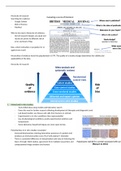
Hierarchy of research
Searching for evidence:
- Google Scholar
- Web of Science
- PubMed
Why do we need a hierarchy of evidence:
- Not all research designs are equal and
results are prone to different risk of
error and level of bias
Bias: unfair inclination or prejudice for or
against one result
Hierarchies of evidence were first popularised in 1979. The quality of a studies design determines the validity and
applicability of the data
Hierarchy of research:
1. Animal and In vitro studies:
- Tests initial ideas using models and laboratory search
- Paves the way for further research allowing development of therapies and diagnostic tools
- Lab-based studies: use tissues and cells from humans or animals
- Experimental vs in vitro conditions (less representable)
- Use of physiological conditions avoids experimental solutions and
temperature
- Some laboratory based techniques are more open to bias
Potential bias in in vitro studies: (example)
- Immunohistochemistry staining determines presence of a protein and
produces an immunoreactive score (% of cells stained + intensity)
- There is a potential difference in interpretation and ways of lowering this
bias is through: blind studies, agreement from multiple researchers and
computational image analysis (not human)
, Qualitative data: descriptive ex. can indicate the presence or absence of a protein
Quantitative data: numeric ex. can determined the relative amount of protein
- Quantitative data is less dependent on interpretation
- Quantitative above qualitative methodologies in the hierarchy
- Sometimes a qualitative technique is more appropriate to answer a question
Animal studies:
- Animal research is higher in hierarchy than laboratory studies
- Majority of animal studies are not representative of the human condition
Comparative physiology research: determines how species differ and helps to identify which animal models are most
physiological relevant in a study
An example of comparative physiology:
2. Editorials and expert opinion
- Expert opinion form authorities/expect committees
- Evidence based on physiology or laboratory research, like committee reports, textbooks, narrative reviews
+ A good convenient summary of background information; a foundation to develop understanding
- Very basic level
- Takes several years to be published
Observational studies:
- Case studies
- Surveys
- Cross-sections studies
- Case-control studies
- Cohort studies
Case studies and series’: Surveys:
Searching for evidence:
- Google Scholar
- Web of Science
- PubMed
Why do we need a hierarchy of evidence:
- Not all research designs are equal and
results are prone to different risk of
error and level of bias
Bias: unfair inclination or prejudice for or
against one result
Hierarchies of evidence were first popularised in 1979. The quality of a studies design determines the validity and
applicability of the data
Hierarchy of research:
1. Animal and In vitro studies:
- Tests initial ideas using models and laboratory search
- Paves the way for further research allowing development of therapies and diagnostic tools
- Lab-based studies: use tissues and cells from humans or animals
- Experimental vs in vitro conditions (less representable)
- Use of physiological conditions avoids experimental solutions and
temperature
- Some laboratory based techniques are more open to bias
Potential bias in in vitro studies: (example)
- Immunohistochemistry staining determines presence of a protein and
produces an immunoreactive score (% of cells stained + intensity)
- There is a potential difference in interpretation and ways of lowering this
bias is through: blind studies, agreement from multiple researchers and
computational image analysis (not human)
, Qualitative data: descriptive ex. can indicate the presence or absence of a protein
Quantitative data: numeric ex. can determined the relative amount of protein
- Quantitative data is less dependent on interpretation
- Quantitative above qualitative methodologies in the hierarchy
- Sometimes a qualitative technique is more appropriate to answer a question
Animal studies:
- Animal research is higher in hierarchy than laboratory studies
- Majority of animal studies are not representative of the human condition
Comparative physiology research: determines how species differ and helps to identify which animal models are most
physiological relevant in a study
An example of comparative physiology:
2. Editorials and expert opinion
- Expert opinion form authorities/expect committees
- Evidence based on physiology or laboratory research, like committee reports, textbooks, narrative reviews
+ A good convenient summary of background information; a foundation to develop understanding
- Very basic level
- Takes several years to be published
Observational studies:
- Case studies
- Surveys
- Cross-sections studies
- Case-control studies
- Cohort studies
Case studies and series’: Surveys: