

Polina Lobacheva
Atomic structure:
Mass of the atom: protons + neutrons
Mass number (A): the total number of proteins and neutrons in an atom.
mass of element compared to Carbon 12
Atomic number (Z): the number of protons in the nucleus. By default in a
atom, this is also the number of electrons as the charges between proton
electrons will cancel each other out.
Trace elements (required in small quantities)
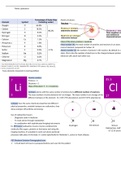
Atomic number:
Protons = 3
Electrons = 3
Mass of the atom: 7 - 3 = 4 neutrons
Isotopes: atoms with the same number of protons but a different number of neutrons
The mass number of some elements isn’t an integer. The mass number is an average of the
different isotopes of the element. Ex. Cl35 (75% abundance) and Cl37 (25% abundance)
Isotopes have the same chemical properties but different
physical properties, unstable isotopes are radioactive, they
decay and give off particles and energy.
Use of radioactive tracers:
- Diagnostic tools in medicine
- To track atoms through metabolism
- In combination with sophisticated imaging instruments
Ex. PET scans: radioactive tracers may be combined into
molecules like sugars, proteins or hormones and using the
imaging machine, it’s possible to work out where particular
processes take place in the body. It’s useful specifically for Alzheimer's, cancer or heart disease.
PET (Positron Emission Tomography) scan:
1. A fresh batch of tracers is prepared before each scan for the patient
, Polina Lobacheva
2. A radioactivity is produced using cyclotron, which smashes particles into ordinary atoms turning them into radioactive
atoms, which doesn’t last long
3. A biological molecule needs to be synthesised from the atoms’ radioactivity
4. This biological molecule can be synthesised to be any type of molecule, depending on what the aim of the scan is
5. Then the biological molecule is purified as it passes through quality control, and its functioning is checked
6. Tracer is ready
7. It’s injected into the patient’s blood stream
8. The radioactive atom on the tracer uses its radioactivity to give off a positron, and as soon as it hits an electron at the
right speed, they combine and destroy each other
9. The energy is released as 2 gamma rays being released to the external environment which is captured by the PET scan
Electron configuration: an orbital (shells) is the 3D space where an electron is found 90% of the time. The first shell can
only accommodate 2 electrons, while the rest of the shells - 8.
First shell has the lowest amount of energy, the second shell has a bit
more, and the third shell has more energy than the second shell.
Atomic structure:
Mass of the atom: protons + neutrons
Mass number (A): the total number of proteins and neutrons in an atom.
mass of element compared to Carbon 12
Atomic number (Z): the number of protons in the nucleus. By default in a
atom, this is also the number of electrons as the charges between proton
electrons will cancel each other out.
Trace elements (required in small quantities)
Atomic number:
Protons = 3
Electrons = 3
Mass of the atom: 7 - 3 = 4 neutrons
Isotopes: atoms with the same number of protons but a different number of neutrons
The mass number of some elements isn’t an integer. The mass number is an average of the
different isotopes of the element. Ex. Cl35 (75% abundance) and Cl37 (25% abundance)
Isotopes have the same chemical properties but different
physical properties, unstable isotopes are radioactive, they
decay and give off particles and energy.
Use of radioactive tracers:
- Diagnostic tools in medicine
- To track atoms through metabolism
- In combination with sophisticated imaging instruments
Ex. PET scans: radioactive tracers may be combined into
molecules like sugars, proteins or hormones and using the
imaging machine, it’s possible to work out where particular
processes take place in the body. It’s useful specifically for Alzheimer's, cancer or heart disease.
PET (Positron Emission Tomography) scan:
1. A fresh batch of tracers is prepared before each scan for the patient
, Polina Lobacheva
2. A radioactivity is produced using cyclotron, which smashes particles into ordinary atoms turning them into radioactive
atoms, which doesn’t last long
3. A biological molecule needs to be synthesised from the atoms’ radioactivity
4. This biological molecule can be synthesised to be any type of molecule, depending on what the aim of the scan is
5. Then the biological molecule is purified as it passes through quality control, and its functioning is checked
6. Tracer is ready
7. It’s injected into the patient’s blood stream
8. The radioactive atom on the tracer uses its radioactivity to give off a positron, and as soon as it hits an electron at the
right speed, they combine and destroy each other
9. The energy is released as 2 gamma rays being released to the external environment which is captured by the PET scan
Electron configuration: an orbital (shells) is the 3D space where an electron is found 90% of the time. The first shell can
only accommodate 2 electrons, while the rest of the shells - 8.
First shell has the lowest amount of energy, the second shell has a bit
more, and the third shell has more energy than the second shell.


