

Polina Lobacheva
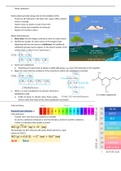
Hydrocarbons provide energy and are the backbone of life:
- Present in all molecules in the body: fats, sugars, DNA, proteins
- Source of energy
- Carbon cycle e.g. plants recycle it from CO2
- Allows variety and complexity of molecules
- Organic if it contains carbon
Alkane Nomenclature:
1. Base name: find the longest continuous chain of carbon atoms
2. Identify the number of carbon atoms in the longest chain,
beginning with the end nearest a substituent, the additional
substituent groups need to appear on the lowest number of the
carbon chain, so here it’s on 2 and not on 5.
3. Name each substituent:
a. Removing an H atom from an alkane is called alkyl group, e.g. from CH4 (methane) to CH3 (methyl)
4. Begin the name with the number(s) of the carbon(s) to which each substituent is bonded
5. When 2 or more substituents are present, list them in
alphabetical order
a. Prefix: di- (two), tri- (three), tetra- (four), penta-
(five) to show how many of the same substituent are present
Acids and bases
Brønsted-Lowry definition of
acids and bases:
- Transfer of H+ ions from one substance to another
- An acid is a substance (molecule or ion) that donates a proton to another substance.
- A base is a substance that accepts a proton.
The hydrogen ion (H+) interacts with water (H2O) and forms a hydr
onium ion (H3O+)
, Polina Lobacheva
Conjugate acid-base pairs Example:
- Covalent bond joins a functional group to the carbon skeleton of a large molecule
- Carboxyl group behaves as an acid in organic molecules
- Amino group behaves as a base in organic molecules
- Oxygen can only make 2 covalent bonds
- Carbon-based molecules can make 3D shapes, branch and have mirror-image version
- Miller and Urey were able to produce amino acids abiotically
Valence electrons:
Octet rule: 8 electrons in the outer shells, except for the first shell
Carbon has 4 valence electrons, so carbon can form 4 covalent bonds
Alkanes: simplest class of hydrocarbons, single bond
Alkanes (only single carbon bonds) ex. ethane
Alkenes (at least one double carbon bond) ex. ethene
Alkynes (at least one triple carbon bond) ex. Ethyne
Tetrahedral (can rotate
due to single carbon
bonds)
Planar (can’t rotate due
to double carbon
bonds)
Isomers: equal number of atoms of the same element; different structures and properties. There are 3 types:
Hydrocarbons provide energy and are the backbone of life:
- Present in all molecules in the body: fats, sugars, DNA, proteins
- Source of energy
- Carbon cycle e.g. plants recycle it from CO2
- Allows variety and complexity of molecules
- Organic if it contains carbon
Alkane Nomenclature:
1. Base name: find the longest continuous chain of carbon atoms
2. Identify the number of carbon atoms in the longest chain,
beginning with the end nearest a substituent, the additional
substituent groups need to appear on the lowest number of the
carbon chain, so here it’s on 2 and not on 5.
3. Name each substituent:
a. Removing an H atom from an alkane is called alkyl group, e.g. from CH4 (methane) to CH3 (methyl)
4. Begin the name with the number(s) of the carbon(s) to which each substituent is bonded
5. When 2 or more substituents are present, list them in
alphabetical order
a. Prefix: di- (two), tri- (three), tetra- (four), penta-
(five) to show how many of the same substituent are present
Acids and bases
Brønsted-Lowry definition of
acids and bases:
- Transfer of H+ ions from one substance to another
- An acid is a substance (molecule or ion) that donates a proton to another substance.
- A base is a substance that accepts a proton.
The hydrogen ion (H+) interacts with water (H2O) and forms a hydr
onium ion (H3O+)
, Polina Lobacheva
Conjugate acid-base pairs Example:
- Covalent bond joins a functional group to the carbon skeleton of a large molecule
- Carboxyl group behaves as an acid in organic molecules
- Amino group behaves as a base in organic molecules
- Oxygen can only make 2 covalent bonds
- Carbon-based molecules can make 3D shapes, branch and have mirror-image version
- Miller and Urey were able to produce amino acids abiotically
Valence electrons:
Octet rule: 8 electrons in the outer shells, except for the first shell
Carbon has 4 valence electrons, so carbon can form 4 covalent bonds
Alkanes: simplest class of hydrocarbons, single bond
Alkanes (only single carbon bonds) ex. ethane
Alkenes (at least one double carbon bond) ex. ethene
Alkynes (at least one triple carbon bond) ex. Ethyne
Tetrahedral (can rotate
due to single carbon
bonds)
Planar (can’t rotate due
to double carbon
bonds)
Isomers: equal number of atoms of the same element; different structures and properties. There are 3 types:


