

Metabolism: the sum total of the chemical processes that occur in living organisms, resulting in growth, production of
energy, elimination of waste material, etc.
A metabolic pathway begins with a specific molecule and
ends with a product. Each step is catalysed by a specific
enzyme. The following format allows the metabolic
pathways to be regulated and enzymes to contribute to
different pathways.
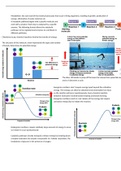
Chemistry recap: chemical reactions involve the transfer of energy
The structure of the molecule, most importantly the types and number
of bonds, determines its potential energy.
The diver still needs to jump off the board to release their potential ene
and so it becomes a cycle.
Exergonic reactions: don’t require energy input beyond the activation
energy. This energy can often be obtained environmentally from heat
so the reaction will occur spontaneously. Every chemical reaction
between molecules involved bonds breaking and bonds forming.
Exergonic reactions result in a net release of free energy but require
activation energy (Ea) to initiate the reaction.
Endergonic reactions: require relatively large amounts of energy to occur,
so it doesn’t occur spontaneously
Catabolic pathways (mostly exergonic) release energy by breaking down
complex molecules into simpler compounds. Ex. Cellular respiration, the
breakdown of glucose in the presence of oxygen.
, Anabolic pathways (endergonic) consume energy to build complex
molecules from simpler ones. Ex. the synthesis of protein from amino
acids
Enzymes in exergonic reactions: the introduction of an enzyme
reduced the activation energy required and speeds up the reaction
Enzyme characteristics:
- Organic molecules (proteins or RNAs) which speed up (catalyse)
chemical reactions by up to 10^12 fold without being used up (!)
- Highly specific: work only on a specific substrate
- Unaffected by the reaction they catalyse
- Can catalyse the same chemical reaction in the opposite direction
- The enzyme activity can be regulated
Enzymes active sites can lower the activation energy
needed by a reaction by:
- Orienting substrate correctly
- Straining substrate bonds
- Providing a favourable microenvironment
- Covalently bonding to the substrate
Energy-rich molecules power cellular work by coupling exergonic to endergonic reactions. Types of work in cells:
1. Chemical ex. Synthesis of polymers from monomers
energy, elimination of waste material, etc.
A metabolic pathway begins with a specific molecule and
ends with a product. Each step is catalysed by a specific
enzyme. The following format allows the metabolic
pathways to be regulated and enzymes to contribute to
different pathways.
Chemistry recap: chemical reactions involve the transfer of energy
The structure of the molecule, most importantly the types and number
of bonds, determines its potential energy.
The diver still needs to jump off the board to release their potential ene
and so it becomes a cycle.
Exergonic reactions: don’t require energy input beyond the activation
energy. This energy can often be obtained environmentally from heat
so the reaction will occur spontaneously. Every chemical reaction
between molecules involved bonds breaking and bonds forming.
Exergonic reactions result in a net release of free energy but require
activation energy (Ea) to initiate the reaction.
Endergonic reactions: require relatively large amounts of energy to occur,
so it doesn’t occur spontaneously
Catabolic pathways (mostly exergonic) release energy by breaking down
complex molecules into simpler compounds. Ex. Cellular respiration, the
breakdown of glucose in the presence of oxygen.
, Anabolic pathways (endergonic) consume energy to build complex
molecules from simpler ones. Ex. the synthesis of protein from amino
acids
Enzymes in exergonic reactions: the introduction of an enzyme
reduced the activation energy required and speeds up the reaction
Enzyme characteristics:
- Organic molecules (proteins or RNAs) which speed up (catalyse)
chemical reactions by up to 10^12 fold without being used up (!)
- Highly specific: work only on a specific substrate
- Unaffected by the reaction they catalyse
- Can catalyse the same chemical reaction in the opposite direction
- The enzyme activity can be regulated
Enzymes active sites can lower the activation energy
needed by a reaction by:
- Orienting substrate correctly
- Straining substrate bonds
- Providing a favourable microenvironment
- Covalently bonding to the substrate
Energy-rich molecules power cellular work by coupling exergonic to endergonic reactions. Types of work in cells:
1. Chemical ex. Synthesis of polymers from monomers


