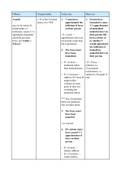
Offence Charged under: Actus reus Mens rea
Assault s. 39 of the Criminal 1. V must have 1. D must have
Justice Act 1988 apprehended the intended to cause
any act by which D, infliction of force V’s apprehension
intentionally or on their person of immediate
recklessly, causes V to unlawful force on
apprehend immediate - R v Lamb — their person OR
unlawful personal apprehension does not been reckless as
force, per Collins v necessarily mean fear, to whether V
Wilcock but expectation; would apprehend
the infliction of
2. The force must immediate
have been unlawful force on
immediate their person
- R v Ireland — - R v Venna —
imminent rather reference to
than instantaneous; Cunningham
recklessness, i.e.
- R v Constanza — subjective foresight of
suffices if V fears D risk;
might inflict
violence at some
point in time not
excluding the
imminent future;
*** fear of imminent
harm not imminent
fear of future harm.
3. The force must
have been
unlawful
- no consent;
4. D’s actions must
have caused V’s
apprehension of
force on their
person
- R v Ireland —
silence suffices;
- R v Constanza —
words suffice;
,Offence Charged under: Actus reus Mens rea
Battery s. 39 of the Criminal 1. D must have 1. D must have
Justice Act 1988 inflicted force on intended to inflict
any act by which D, V unlawful force on
intentionally or V OR been
recklessly, inflicts - R v Ireland — no reckless as to
unlawful personal radical difference whether unlawful
violence on V, per between inflicting force would be
and causing;
Collins v Wilcock inflicted on V
- Collins v Wilcock —
if physical contact - see above;
is unnecessary, V
does not consent to
it and physically
restrains from it =>
battery.
- R v Thomas —
touching someone’s
clothes suffices.
- Haystead v Chief
Constable of
Derbyshire —
indirect application
of force suffices;
- DPP v K —
application of force
through a medium,
e.g. object, suffices;
- DPP v Santana-
Bermudez —
exposing someone
to a reasonably
foreseeable risk of
injury by acts/
words/ combination
of the two suffices.
- R v Fagan —
continuing acts
suffice.
2. The force must
have been
unlawful
- no consent
, Offence Charged under: Actus reus Mens rea
Assault occasioning s. 47 of the Offences 1. D must have 1. No additional
ABH Against the Person Act committed an fault element =>
1861 assault or a suffices to prove
any assault OR battery battery mens rea for
by which V suffers assault OR
ABH - see above; battery
2. V must have - see above;
suffered ABH
- R v Miller — any
hurt or injury
interfering with the
health and comfort
of V;
- R v Donovan — but
more than transient
or trifling;
- R v Chan Fook —
must not be
insignificant, re:
does not include
mere emotions
- DPP v Smith —
physical pain as
consequence
unnecessary;
- T v DPP — any
injurious
impairment of V’s
sensory functions;
- R v Ireland —
includes recognised
psychiatric
conditions.
3. The assault
committed by D
must have
occasioned the
ABH
Assault s. 39 of the Criminal 1. V must have 1. D must have
Justice Act 1988 apprehended the intended to cause
any act by which D, infliction of force V’s apprehension
intentionally or on their person of immediate
recklessly, causes V to unlawful force on
apprehend immediate - R v Lamb — their person OR
unlawful personal apprehension does not been reckless as
force, per Collins v necessarily mean fear, to whether V
Wilcock but expectation; would apprehend
the infliction of
2. The force must immediate
have been unlawful force on
immediate their person
- R v Ireland — - R v Venna —
imminent rather reference to
than instantaneous; Cunningham
recklessness, i.e.
- R v Constanza — subjective foresight of
suffices if V fears D risk;
might inflict
violence at some
point in time not
excluding the
imminent future;
*** fear of imminent
harm not imminent
fear of future harm.
3. The force must
have been
unlawful
- no consent;
4. D’s actions must
have caused V’s
apprehension of
force on their
person
- R v Ireland —
silence suffices;
- R v Constanza —
words suffice;
,Offence Charged under: Actus reus Mens rea
Battery s. 39 of the Criminal 1. D must have 1. D must have
Justice Act 1988 inflicted force on intended to inflict
any act by which D, V unlawful force on
intentionally or V OR been
recklessly, inflicts - R v Ireland — no reckless as to
unlawful personal radical difference whether unlawful
violence on V, per between inflicting force would be
and causing;
Collins v Wilcock inflicted on V
- Collins v Wilcock —
if physical contact - see above;
is unnecessary, V
does not consent to
it and physically
restrains from it =>
battery.
- R v Thomas —
touching someone’s
clothes suffices.
- Haystead v Chief
Constable of
Derbyshire —
indirect application
of force suffices;
- DPP v K —
application of force
through a medium,
e.g. object, suffices;
- DPP v Santana-
Bermudez —
exposing someone
to a reasonably
foreseeable risk of
injury by acts/
words/ combination
of the two suffices.
- R v Fagan —
continuing acts
suffice.
2. The force must
have been
unlawful
- no consent
, Offence Charged under: Actus reus Mens rea
Assault occasioning s. 47 of the Offences 1. D must have 1. No additional
ABH Against the Person Act committed an fault element =>
1861 assault or a suffices to prove
any assault OR battery battery mens rea for
by which V suffers assault OR
ABH - see above; battery
2. V must have - see above;
suffered ABH
- R v Miller — any
hurt or injury
interfering with the
health and comfort
of V;
- R v Donovan — but
more than transient
or trifling;
- R v Chan Fook —
must not be
insignificant, re:
does not include
mere emotions
- DPP v Smith —
physical pain as
consequence
unnecessary;
- T v DPP — any
injurious
impairment of V’s
sensory functions;
- R v Ireland —
includes recognised
psychiatric
conditions.
3. The assault
committed by D
must have
occasioned the
ABH