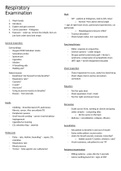
Respiratory
Examination Neck
- JVP – patient at 45degrees, look to left, relax!
1. Wash hands o Normal <4cm above sternal angle
2. Introduce
sign of right heart strain, pulmonary hypertension, cor
3. Explain and gain consent
pulmonale
4. Correct position – 45degrees
o Hepatojugular pressure reflex?
5. Exposure – waist up, remove bra ideally, but can
- Tracheal deviation?
just look under band and straps
- Check lymph nodes; incl. supraclavicular
General inspection:
Face/mouth/eyes
Surroundings:
- Pallor; anaemia in conjunctiva
- Oxygen/CPAP/nebuliser masks
- Central cyanosis – under tongue
- Saturations probe
- Droopy eyelid/constricted pupil = Horner’s
- Sputum pot
syndrome, compression of sympathetic chain
- Cigarettes
- URTI signs = tonsil enlargement/exudate
- Inhalers
- IV breathing aids
- Walking aid? Chest inspection
Patient-based: - Closer inspection for scars, under bra band/strap
- Breathless? Sat forward to help breathe? - Chest shape; barrel, pectus excavatum,
- Respiratory rate? carinatum
- Cyanotic?
- In pain?
Palpation
- Any scars?
- Using accessory muscles to breathe? - Feel for apex beat
- Bruises – from steroids - Chest expansion; front + back
- Feel for right ventricular heave
Hands
Percussion
- Clubbing – bronchiectasis (CF), pulmonary
- Snake across front, starting at clavicle and going
fibrosis, cancer. Also sarcoidosis/TB
under armpits – comparing sides
- Peripheral cyanosis
o Do the same on the back
- Small muscle wasting – cancer; brachial plexus
- Dullness = consolidation, collapse, effusion
impingement
- Cigarette/tar staining
- CO2 retention flap – asterixis Auscultation
- Ask patient to breathe in and out of mouth
Wrists/arm - Same snake pattern as percussion
- Listen for breath sounds; vesicular, bronchial?
- Pulse – rate, rhythm, bounding? – sepsis, CO 2
o Added sounds? Crackles, wheezes, rubs?
retention
- Respiratory rate - Vocal resonance, ask patient to say ‘99’
- Blood pressure
- Tremor – beta-agonist use; salbutamol Peripheral examination
- Pitting oedema – press shin for 5 seconds
- Calves swelling/pain/red = signs of DVT
Examination Neck
- JVP – patient at 45degrees, look to left, relax!
1. Wash hands o Normal <4cm above sternal angle
2. Introduce
sign of right heart strain, pulmonary hypertension, cor
3. Explain and gain consent
pulmonale
4. Correct position – 45degrees
o Hepatojugular pressure reflex?
5. Exposure – waist up, remove bra ideally, but can
- Tracheal deviation?
just look under band and straps
- Check lymph nodes; incl. supraclavicular
General inspection:
Face/mouth/eyes
Surroundings:
- Pallor; anaemia in conjunctiva
- Oxygen/CPAP/nebuliser masks
- Central cyanosis – under tongue
- Saturations probe
- Droopy eyelid/constricted pupil = Horner’s
- Sputum pot
syndrome, compression of sympathetic chain
- Cigarettes
- URTI signs = tonsil enlargement/exudate
- Inhalers
- IV breathing aids
- Walking aid? Chest inspection
Patient-based: - Closer inspection for scars, under bra band/strap
- Breathless? Sat forward to help breathe? - Chest shape; barrel, pectus excavatum,
- Respiratory rate? carinatum
- Cyanotic?
- In pain?
Palpation
- Any scars?
- Using accessory muscles to breathe? - Feel for apex beat
- Bruises – from steroids - Chest expansion; front + back
- Feel for right ventricular heave
Hands
Percussion
- Clubbing – bronchiectasis (CF), pulmonary
- Snake across front, starting at clavicle and going
fibrosis, cancer. Also sarcoidosis/TB
under armpits – comparing sides
- Peripheral cyanosis
o Do the same on the back
- Small muscle wasting – cancer; brachial plexus
- Dullness = consolidation, collapse, effusion
impingement
- Cigarette/tar staining
- CO2 retention flap – asterixis Auscultation
- Ask patient to breathe in and out of mouth
Wrists/arm - Same snake pattern as percussion
- Listen for breath sounds; vesicular, bronchial?
- Pulse – rate, rhythm, bounding? – sepsis, CO 2
o Added sounds? Crackles, wheezes, rubs?
retention
- Respiratory rate - Vocal resonance, ask patient to say ‘99’
- Blood pressure
- Tremor – beta-agonist use; salbutamol Peripheral examination
- Pitting oedema – press shin for 5 seconds
- Calves swelling/pain/red = signs of DVT