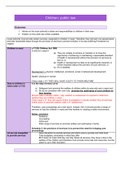
Children: public law
Outcomes
1. Advise on the local authority’s duties and responsibilities to children in their area
2. Explain on the public law orders available
Local Authority must provide certain services, especially to children in need. Therefore, they will carry out assessments
and take reasonable steps through the provision of services to prevent children in its area suffering ill treatment or
neglect.
Children in need s.17(10) Children Act 1989
A child is in need if-
(a) They are unlikely to achieve or maintain or to have the
opportunity of achieving or maintaining a reasonable standard
of health or development without the provision of services by
the LA; or
(b) Health or development is likely to be significantly impaired, or
further impaired without the provision of such services; or
(c) He is disabled
Development = physical, intellectual, emotional, social or behavioural development.
Health= physical or mental
If they meet s.17= THEY WILL HAVE A DUTY TO THEIR WELFARE
Duty to children in It is the duty of every LA to:
need under s.17(1)
a) Safeguard and promote the welfare of children within its area who are in need and;
b) So far as consistent with such duty, promote the upbringing of such children by
their families
Should make a decision within 1 day whether an assessment is required to determine
whether they are children in need.
If they need s.17- they will require further investigation to decide whether they should take
further action to promote welfare under s.47 assessment
Therefore, care proceedings are a last resort. Instead, the LA should provide a range of
services to help the children in need and their families in creating a better environment.
Duties- provision
- Guidance
- Counselling
- Child-care
- Wide range of services to promote welfare and upbringing in family
Schedule 2: the provision of services is to prevent the need for bringing care
proceedings
LA are not compelled - Have discretion to provide services and which ones to provide and what level
to provide services - Take budgetary constraints in what they offer
- BUT does not mean that they can fully refuse all services, they have a duty to the
welfare of the children and therefore must provide some help and resources, but the
extent is up to their discretion
, Provision of accommodation s.20
LA must provide accommodation for any child in need within its area if there is no person who has PR for them, he is
lose or abandoned or the person who has been caring for him is prevented from providing suitable accommodation or
care.
- CANNOT PROVIDE IF ANYONE WITH PR DOES NOT CONSENT if they are willing to provide
Limits of providing LA may not provide accommodation is anyone with PR, who is willing and able to
accommodation provide accommodation, objects. (if joint PR and one puts the child into care, other
parent can remove).
- Right to remove does not extend to someone named in CAO
- Right to remove does not apply where the child is 16 or over and consents to being
accommodated by LA s.20(11)
Preventing removal from The LA should ensure that all those with PR are involved in the initial negotiations and
accommodation agree on the provisions of accommodation.
- If the LA suspect that one parent is seeking to remove the child, could suggest that
the other seeks a CAO naming them as a person with whom the child is to live with
to prevent removal
Looked after by LA Children Looked after by LA
- Children in care or provided accommodation for longer than 24 hours are looked
after by the LA
- They are under a duty to safeguard and promote the child’s welfare, by
making use of services available for their benefit
The LA should not seek to initiate care proceedings from the get to, only where there is
clear evidence that the provisions of services has failed to meet the child’s needs, or is
likely to be unsuccessful in meeting them.
Parents should be advised to co-operate and therefore shift the onus onto the LA to show
that it has done everything reasonable to assist the child and parents.
LA required to explain:
a) What steps it took to identify the child was in need
b) What its plans are if a care order is made, particularly, what services it would then
provide that it could not provide without a court order
c) What evidence there is that what the LA is seeking to achieve through a court order
could not be satisfactorily achieved by the provisions of services, with the child
remaining at home.
Challenging LA- if they There is no specific procedure for challenging the LA but there is a complaints
refuse to provide services procedure under s.26
you want
If not satisfied- send to review panel
It will then be referred to a review panel and if it fails to follow the panel’s
recommendations, actions may be taken to subject LA decision to judicial review
- If LA have not provided appropriate services or you are unhappy- refer to
complaints procedure and panel review
Outcomes
1. Advise on the local authority’s duties and responsibilities to children in their area
2. Explain on the public law orders available
Local Authority must provide certain services, especially to children in need. Therefore, they will carry out assessments
and take reasonable steps through the provision of services to prevent children in its area suffering ill treatment or
neglect.
Children in need s.17(10) Children Act 1989
A child is in need if-
(a) They are unlikely to achieve or maintain or to have the
opportunity of achieving or maintaining a reasonable standard
of health or development without the provision of services by
the LA; or
(b) Health or development is likely to be significantly impaired, or
further impaired without the provision of such services; or
(c) He is disabled
Development = physical, intellectual, emotional, social or behavioural development.
Health= physical or mental
If they meet s.17= THEY WILL HAVE A DUTY TO THEIR WELFARE
Duty to children in It is the duty of every LA to:
need under s.17(1)
a) Safeguard and promote the welfare of children within its area who are in need and;
b) So far as consistent with such duty, promote the upbringing of such children by
their families
Should make a decision within 1 day whether an assessment is required to determine
whether they are children in need.
If they need s.17- they will require further investigation to decide whether they should take
further action to promote welfare under s.47 assessment
Therefore, care proceedings are a last resort. Instead, the LA should provide a range of
services to help the children in need and their families in creating a better environment.
Duties- provision
- Guidance
- Counselling
- Child-care
- Wide range of services to promote welfare and upbringing in family
Schedule 2: the provision of services is to prevent the need for bringing care
proceedings
LA are not compelled - Have discretion to provide services and which ones to provide and what level
to provide services - Take budgetary constraints in what they offer
- BUT does not mean that they can fully refuse all services, they have a duty to the
welfare of the children and therefore must provide some help and resources, but the
extent is up to their discretion
, Provision of accommodation s.20
LA must provide accommodation for any child in need within its area if there is no person who has PR for them, he is
lose or abandoned or the person who has been caring for him is prevented from providing suitable accommodation or
care.
- CANNOT PROVIDE IF ANYONE WITH PR DOES NOT CONSENT if they are willing to provide
Limits of providing LA may not provide accommodation is anyone with PR, who is willing and able to
accommodation provide accommodation, objects. (if joint PR and one puts the child into care, other
parent can remove).
- Right to remove does not extend to someone named in CAO
- Right to remove does not apply where the child is 16 or over and consents to being
accommodated by LA s.20(11)
Preventing removal from The LA should ensure that all those with PR are involved in the initial negotiations and
accommodation agree on the provisions of accommodation.
- If the LA suspect that one parent is seeking to remove the child, could suggest that
the other seeks a CAO naming them as a person with whom the child is to live with
to prevent removal
Looked after by LA Children Looked after by LA
- Children in care or provided accommodation for longer than 24 hours are looked
after by the LA
- They are under a duty to safeguard and promote the child’s welfare, by
making use of services available for their benefit
The LA should not seek to initiate care proceedings from the get to, only where there is
clear evidence that the provisions of services has failed to meet the child’s needs, or is
likely to be unsuccessful in meeting them.
Parents should be advised to co-operate and therefore shift the onus onto the LA to show
that it has done everything reasonable to assist the child and parents.
LA required to explain:
a) What steps it took to identify the child was in need
b) What its plans are if a care order is made, particularly, what services it would then
provide that it could not provide without a court order
c) What evidence there is that what the LA is seeking to achieve through a court order
could not be satisfactorily achieved by the provisions of services, with the child
remaining at home.
Challenging LA- if they There is no specific procedure for challenging the LA but there is a complaints
refuse to provide services procedure under s.26
you want
If not satisfied- send to review panel
It will then be referred to a review panel and if it fails to follow the panel’s
recommendations, actions may be taken to subject LA decision to judicial review
- If LA have not provided appropriate services or you are unhappy- refer to
complaints procedure and panel review