

Week 1
CB765: Corporate Finance
LECTURE 2
Another market imperfection: taxes
Impact of depreciation, interest expense and capital expenditure on taxes
Estimating free cash flow while considering sunk costs, opportunity costs and changes in
working capital in
investment appraisal
TAXATION AND INVESTMENT APPRAISAL
Taxes (cash outflows) are payable on the profits generated by the firm
Taxes are considered on marginal profit from the project
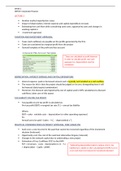
General template of the profit and loss account
*Taxes are calculated on profit however
in order to calculate profit, non-cash
expenses (i.e. depreciation) must be
considered
DEPRECIATION, INTEREST EXPENSE AND CAPITAL EXPENDITURE
Interest expense: paid on borrowed amount and is typically not included as a cash outflow
The reason for this is that the project should be judged on its own, disregarding how it will
be financed (debt/equity/combination)
Moreover, the discount rate/opportunity cost of capital used in NPV calculations to discount
cashflows, takes care of this aspect
TAX LIABILITY ON PRE-TAX PROFIT
Tax payable on pre-tax profit is calculated as:
Pre-tax profit (EBIT) x marginal tax rate (T c ) = annual tax liability
Where:
EBIT = sales - variable costs – depreciation (or other operating expenses)
So,
Annual tax to be paid = (sales – V.C. – depreciation) x T c
PRACTICAL CONSIDERATIONS IN PROJECT APPRAISAL: FREE CASHFLOW
Sunk cost: a cost incurred in the past that cannot be recovered regardless of the investment
decision (irrelevant)
Opportunity cost: the cost of the next best alternative forgone (relevant)
Changes in the network capital due to undertaking a new project
Estimation of Free Cashflows (FCF) to find NPV
FCF = (revenues – costs – depreciation) x (1 – T c ) *Subtracting depreciation helps to reduce a firm’s tax
+ depreciation – CapEx - ∆NWC liability but is added on after calculating the NOPAT as it is
a non-cash item (not relevant in investment decision)
CB765: Corporate Finance
LECTURE 2
Another market imperfection: taxes
Impact of depreciation, interest expense and capital expenditure on taxes
Estimating free cash flow while considering sunk costs, opportunity costs and changes in
working capital in
investment appraisal
TAXATION AND INVESTMENT APPRAISAL
Taxes (cash outflows) are payable on the profits generated by the firm
Taxes are considered on marginal profit from the project
General template of the profit and loss account
*Taxes are calculated on profit however
in order to calculate profit, non-cash
expenses (i.e. depreciation) must be
considered
DEPRECIATION, INTEREST EXPENSE AND CAPITAL EXPENDITURE
Interest expense: paid on borrowed amount and is typically not included as a cash outflow
The reason for this is that the project should be judged on its own, disregarding how it will
be financed (debt/equity/combination)
Moreover, the discount rate/opportunity cost of capital used in NPV calculations to discount
cashflows, takes care of this aspect
TAX LIABILITY ON PRE-TAX PROFIT
Tax payable on pre-tax profit is calculated as:
Pre-tax profit (EBIT) x marginal tax rate (T c ) = annual tax liability
Where:
EBIT = sales - variable costs – depreciation (or other operating expenses)
So,
Annual tax to be paid = (sales – V.C. – depreciation) x T c
PRACTICAL CONSIDERATIONS IN PROJECT APPRAISAL: FREE CASHFLOW
Sunk cost: a cost incurred in the past that cannot be recovered regardless of the investment
decision (irrelevant)
Opportunity cost: the cost of the next best alternative forgone (relevant)
Changes in the network capital due to undertaking a new project
Estimation of Free Cashflows (FCF) to find NPV
FCF = (revenues – costs – depreciation) x (1 – T c ) *Subtracting depreciation helps to reduce a firm’s tax
+ depreciation – CapEx - ∆NWC liability but is added on after calculating the NOPAT as it is
a non-cash item (not relevant in investment decision)



