

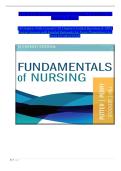
TEST BANK for Fundamentals of Nursing, 11th Edition by
Patricia A. Potter
All Chapters Fully Covered 1-50 Chapters| Verified Questions & 100%
Correct Answers with Detailed Rationales for Exam Preparations| A+
PASS GUARANTEED
Fr
an
kl
yn
e
A
pl
u sP
1|Page
as
s
, Chapter 01: Nursing Today
MULTIPLE CHOICE
1. Which nurse most likely kept records on sanitation techniques and the effects on health? a.
Florence Nightingale
b. Mary Nutting
c. Clara Barton
d. Lillian Wald
ANS: A
Nightingale was the first practicing nurse epidemiologist. Her statistical analyses connected poor
sanitation with cholera and dysentery. Mary Nutting, Clara Barton, and Lillian Wald came after
Nightingale, each contributing to the nursing profession in her own way. Mary Nutting was
instrumental in moving nursing education into universities. Clara Barton founded the American
Red Cross. Lillian Wald helped open the Henry Street Settlement.
DIF: Understand (comprehension)
OBJ: Discuss the influence of social, historical, political, and economic changes on nursing practices.
TOP: Evaluation MSC: Health Promotion and Maintenance
2. The nurse prescribes strategies and alternatives to attain expected outcome. Which standard of
nursing practice is the nurse following? a. Assessment
b. Diagnosis
c. Planning
d. Implementation
ANS: C
In planning, the registered nurse develops a plan that prescribes strategies and alternatives to
attain expected outcomes. During assessment, the registered nurse collects comprehensive data
pertinent to the patient’s health and/or the situation. In diagnosis, the registered nurse analyzes
Fr
the assessment data to determine the diagnoses or issues. During implementation, the registered
nurse implements (carries out) the identified plan.
an
DIF: Understand (comprehension)
kl
OBJ: Discuss the development of professional nursing roles. TOP:
Planning MSC:
yn
Management of Care
e
3. An experienced medical-surgical nurse chooses to work in obstetrics. Which level of
proficiency is the nurse upon initial transition to the obstetrical floor? a. Novice
A
b. Proficient
c. Competent
pl
d. Advanced beginner
ANS: A
u
A beginning nursing student or any nurse entering a situation in which there is no previous level
sP
of experience (e.g., an experienced operating room nurse chooses to now practice in home health)
is an example of a novice nurse. A proficient nurse perceives a patient’s clinical situation as a
2|Page
as
s
, whole, is able to assess an entire situation, and can readily transfer knowledge gained from
multiple previous experiences to a situation. A competent nurse understands the organization and
specific care required by the type of patients (e.g., surgical, oncology, or orthopedic patients).
This nurse is a competent practitioner who is able to anticipate nursing care and establish long-
range goals. A nurse who has had some level of experience with the situation is an advanced
beginner. This experience may only be observational in nature, but the nurse is able to identify
meaningful aspects or principles of nursing care.
DIF: Apply (application)
OBJ: Discuss the development of professional nursing roles. TOP:
Evaluation MSC:
Management of Care
4. A nurse assesses a patient’s fluid status and decides that the patient needs to drink more
fluids. The nurse then encourages the patient to drink more fluids. Which concept is the
nurse demonstrating? a. Licensure
b. Autonomy
c. Certification
d. Accountability
ANS: B
Autonomy is an essential element of professional nursing that involves the initiation of
independent nursing interventions without medical orders. To obtain licensure in the United
States, the RN candidate must pass the NCLEX-RN . Beyond the NCLEX-RN , the nurse may
choose to work toward certification in a specific area of nursing practice. Accountability
means that you are responsible, professionally and legally, for the type and quality of nursing care
provided.
DIF: Apply (application)
OBJ: Discuss the roles and career opportunities for nurses. TOP: Implementation MSC:
Management of Care
5. A nurse prepares the budget and policies for an intensive care unit. Which role is the nurse
implementing?
a. Educator
b. Manager
c. Advocate
Fr
d. Caregiver
an
ANS: B
A manager coordinates the activities of members of the nursing staff in delivering nursing care
and has personnel, policy, and budgetary responsibility for a specific nursing unit or facility. As
kl
an educator, you explain concepts and facts about health, describe the reason for routine care
activities, demonstrate procedures such as self-care activities, reinforce learning or patient
yn
behavior, and evaluate the patient’s progress in learning. As a patient advocate, you protect your
patient’s human and legal rights and provide assistance in asserting these rights if the need arises.
e
As a caregiver, you help patients maintain and regain health, manage disease and symptoms, and
attain a maximal level function and independence through the healing process.
A
DIF: Apply (application)
pl
OBJ: Discuss the roles and career opportunities for nurses. TOP: Implementation MSC:
Management of Care
u sP
6. The nurse has been working in the clinical setting for several years as an advanced practice
nurse. However, the nurse has a strong desire to pursue research and theory development. To
3|Page
as
s
, fulfill this desire, which program should the nurse attend? a. Doctor of Nursing Science degree
(DNSc)
b. Doctor of Philosophy degree (PhD)
c. Doctor of Nursing Practice degree (DNP)
d. Doctor in the Science of Nursing degree (DSN)
ANS: B
Some doctoral programs prepare nurses for more rigorous research and theory development and
award the research-oriented Doctor of Philosophy (PhD) in nursing. Professional doctoral
programs in nursing (DSN or DNSc) prepare graduates to apply research findings to clinical
nursing. The DNP is a practice doctorate that prepares advanced practice nurses such as nurse
practitioners.
DIF: Understand (comprehension)
OBJ: Compare and contrast the educational programs available for professional registered nurse
(RN) education. TOP: Teaching/Learning MSC: Management of Care
7. A nurse attends a workshop on current nursing issues provided by the American Nurses
Association. Which type of education did the nurse receive? a. Graduate education
b. Inservice education
c. Continuing education
d. Registered nurse education
ANS: C
Continuing education involves formal, organized educational programs offered by universities,
hospitals, state nurses associations, professional nursing organizations, and educational and
health care institutions. After obtaining a baccalaureate degree in nursing, you can pursue
graduate education leading to a master’s or doctoral degree in any number of graduate fields,
including nursing. Inservice education programs are instruction or training provided by a health
care facility or institution. Registered nurse education is the education preparation for an
individual intending to be an RN.
DIF: Apply (application)
OBJ: Compare and contrast the educational programs available for professional registered nurse
(RN) education. TOP: Teaching/Learning MSC: Management of Care
8. A nurse identifies gaps between local and best practices. Which Quality and Safety Education for
Nurses (QSEN) competency is the nurse demonstrating? a. Safety
b. Patient-centered care
Fr
c. Quality improvement
d. Teamwork and collaboration
an
ANS: C
Quality improvement identifies gaps between local and best practices. Safety minimizes risk of
kl
harm to patients and providers through both system effectiveness and individual performance.
Patient-centered care recognizes the patient or designee as the source of control and full partner in
yn
providing compassionate and coordinated care based on respect for patient’s preferences, values,
and needs. Teamwork and collaboration allows effective functioning within nursing and
e
interprofessional teams, fostering open communication, mutual respect, and shared decision
making.
A
DIF: Understand (comprehension)
pl
OBJ: Discuss the roles and career opportunities for nurses. TOP: Evaluation
MSC: Management of Care
u sP
9. A nurse has compassion fatigue. What is the nurse experiencing?
a. Lateral violence and intrapersonal conflict
4|Page
as
s
Patricia A. Potter
All Chapters Fully Covered 1-50 Chapters| Verified Questions & 100%
Correct Answers with Detailed Rationales for Exam Preparations| A+
PASS GUARANTEED
Fr
an
kl
yn
e
A
pl
u sP
1|Page
as
s
, Chapter 01: Nursing Today
MULTIPLE CHOICE
1. Which nurse most likely kept records on sanitation techniques and the effects on health? a.
Florence Nightingale
b. Mary Nutting
c. Clara Barton
d. Lillian Wald
ANS: A
Nightingale was the first practicing nurse epidemiologist. Her statistical analyses connected poor
sanitation with cholera and dysentery. Mary Nutting, Clara Barton, and Lillian Wald came after
Nightingale, each contributing to the nursing profession in her own way. Mary Nutting was
instrumental in moving nursing education into universities. Clara Barton founded the American
Red Cross. Lillian Wald helped open the Henry Street Settlement.
DIF: Understand (comprehension)
OBJ: Discuss the influence of social, historical, political, and economic changes on nursing practices.
TOP: Evaluation MSC: Health Promotion and Maintenance
2. The nurse prescribes strategies and alternatives to attain expected outcome. Which standard of
nursing practice is the nurse following? a. Assessment
b. Diagnosis
c. Planning
d. Implementation
ANS: C
In planning, the registered nurse develops a plan that prescribes strategies and alternatives to
attain expected outcomes. During assessment, the registered nurse collects comprehensive data
pertinent to the patient’s health and/or the situation. In diagnosis, the registered nurse analyzes
Fr
the assessment data to determine the diagnoses or issues. During implementation, the registered
nurse implements (carries out) the identified plan.
an
DIF: Understand (comprehension)
kl
OBJ: Discuss the development of professional nursing roles. TOP:
Planning MSC:
yn
Management of Care
e
3. An experienced medical-surgical nurse chooses to work in obstetrics. Which level of
proficiency is the nurse upon initial transition to the obstetrical floor? a. Novice
A
b. Proficient
c. Competent
pl
d. Advanced beginner
ANS: A
u
A beginning nursing student or any nurse entering a situation in which there is no previous level
sP
of experience (e.g., an experienced operating room nurse chooses to now practice in home health)
is an example of a novice nurse. A proficient nurse perceives a patient’s clinical situation as a
2|Page
as
s
, whole, is able to assess an entire situation, and can readily transfer knowledge gained from
multiple previous experiences to a situation. A competent nurse understands the organization and
specific care required by the type of patients (e.g., surgical, oncology, or orthopedic patients).
This nurse is a competent practitioner who is able to anticipate nursing care and establish long-
range goals. A nurse who has had some level of experience with the situation is an advanced
beginner. This experience may only be observational in nature, but the nurse is able to identify
meaningful aspects or principles of nursing care.
DIF: Apply (application)
OBJ: Discuss the development of professional nursing roles. TOP:
Evaluation MSC:
Management of Care
4. A nurse assesses a patient’s fluid status and decides that the patient needs to drink more
fluids. The nurse then encourages the patient to drink more fluids. Which concept is the
nurse demonstrating? a. Licensure
b. Autonomy
c. Certification
d. Accountability
ANS: B
Autonomy is an essential element of professional nursing that involves the initiation of
independent nursing interventions without medical orders. To obtain licensure in the United
States, the RN candidate must pass the NCLEX-RN . Beyond the NCLEX-RN , the nurse may
choose to work toward certification in a specific area of nursing practice. Accountability
means that you are responsible, professionally and legally, for the type and quality of nursing care
provided.
DIF: Apply (application)
OBJ: Discuss the roles and career opportunities for nurses. TOP: Implementation MSC:
Management of Care
5. A nurse prepares the budget and policies for an intensive care unit. Which role is the nurse
implementing?
a. Educator
b. Manager
c. Advocate
Fr
d. Caregiver
an
ANS: B
A manager coordinates the activities of members of the nursing staff in delivering nursing care
and has personnel, policy, and budgetary responsibility for a specific nursing unit or facility. As
kl
an educator, you explain concepts and facts about health, describe the reason for routine care
activities, demonstrate procedures such as self-care activities, reinforce learning or patient
yn
behavior, and evaluate the patient’s progress in learning. As a patient advocate, you protect your
patient’s human and legal rights and provide assistance in asserting these rights if the need arises.
e
As a caregiver, you help patients maintain and regain health, manage disease and symptoms, and
attain a maximal level function and independence through the healing process.
A
DIF: Apply (application)
pl
OBJ: Discuss the roles and career opportunities for nurses. TOP: Implementation MSC:
Management of Care
u sP
6. The nurse has been working in the clinical setting for several years as an advanced practice
nurse. However, the nurse has a strong desire to pursue research and theory development. To
3|Page
as
s
, fulfill this desire, which program should the nurse attend? a. Doctor of Nursing Science degree
(DNSc)
b. Doctor of Philosophy degree (PhD)
c. Doctor of Nursing Practice degree (DNP)
d. Doctor in the Science of Nursing degree (DSN)
ANS: B
Some doctoral programs prepare nurses for more rigorous research and theory development and
award the research-oriented Doctor of Philosophy (PhD) in nursing. Professional doctoral
programs in nursing (DSN or DNSc) prepare graduates to apply research findings to clinical
nursing. The DNP is a practice doctorate that prepares advanced practice nurses such as nurse
practitioners.
DIF: Understand (comprehension)
OBJ: Compare and contrast the educational programs available for professional registered nurse
(RN) education. TOP: Teaching/Learning MSC: Management of Care
7. A nurse attends a workshop on current nursing issues provided by the American Nurses
Association. Which type of education did the nurse receive? a. Graduate education
b. Inservice education
c. Continuing education
d. Registered nurse education
ANS: C
Continuing education involves formal, organized educational programs offered by universities,
hospitals, state nurses associations, professional nursing organizations, and educational and
health care institutions. After obtaining a baccalaureate degree in nursing, you can pursue
graduate education leading to a master’s or doctoral degree in any number of graduate fields,
including nursing. Inservice education programs are instruction or training provided by a health
care facility or institution. Registered nurse education is the education preparation for an
individual intending to be an RN.
DIF: Apply (application)
OBJ: Compare and contrast the educational programs available for professional registered nurse
(RN) education. TOP: Teaching/Learning MSC: Management of Care
8. A nurse identifies gaps between local and best practices. Which Quality and Safety Education for
Nurses (QSEN) competency is the nurse demonstrating? a. Safety
b. Patient-centered care
Fr
c. Quality improvement
d. Teamwork and collaboration
an
ANS: C
Quality improvement identifies gaps between local and best practices. Safety minimizes risk of
kl
harm to patients and providers through both system effectiveness and individual performance.
Patient-centered care recognizes the patient or designee as the source of control and full partner in
yn
providing compassionate and coordinated care based on respect for patient’s preferences, values,
and needs. Teamwork and collaboration allows effective functioning within nursing and
e
interprofessional teams, fostering open communication, mutual respect, and shared decision
making.
A
DIF: Understand (comprehension)
pl
OBJ: Discuss the roles and career opportunities for nurses. TOP: Evaluation
MSC: Management of Care
u sP
9. A nurse has compassion fatigue. What is the nurse experiencing?
a. Lateral violence and intrapersonal conflict
4|Page
as
s


