

lOMoARcPSD|44532475
8/11/2026, 1:11:03 PM NR 507 EDAPT Week 6 Alterations NR
in the
507Endocrine
EDAPT System
Week 6- converted_removed.pdf
Alterations in the Endocrine System - converted_removed.pdf
ENDOCRENE
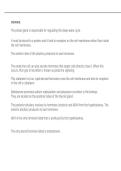
The pineal gland is responsible for regulating the sleep-wake cycle.
It must be bound to a protein and it bind to receptors on the cell membrane rather than inside
the cell membrane.
The anterior lobe of the pituitary produces its own hormones.
The endocrine cell can also secrete hormones that target cells directly close it. When this
occurs, this type of secretion is known as paracrine signaling.
This statement is true. Lipid-derived hormones cross the cell membrane and bind to receptors
in the cell’s cytoplasm.
Aldosterone promotes sodium reabsorption and potassium excretion in the kidneys.
They are located on the posterior lobes of the thyroid gland.
The posterior pituitary receives its hormones (oxytocin and ADH) from the hypothalamus. The
anterior pituitary produces its own hormones.
ADH is the only hormone listed that is produced by the hypothalamus.
The only steroid hormone listed is testosterone.
NR 507 EDAPT Week 6 Alterations NR
in the
507Endocrine
EDAPT System
Week
Downloaded 6- converted_removed.pdf
Alterations
by madiba NR
in the
South Africa 507Endocrine
stuvia EDAPT System
Week 6- converted_removed.pdf
Alterations in the Endocrine System - converted_removed.pdf
()
, lOMoARcPSD|44532475
8/11/2026, 1:11:03 PM NR 507 EDAPT Week 6 Alterations NR
in the
507Endocrine
EDAPT System
Week 6- converted_removed.pdf
Alterations in the Endocrine System - converted_removed.pdf
Overview of the Endocrine System
The purpose of the endocrine system is to maintain the body’s homeostasis using hormones.
Hormones are signaling molecules. Although a wide variety of hormones function within the
body, they share certain general characteristics:
1. Hormones have speci昀椀c rates and rhythms of secretion. Three basic secretion patterns
are: (1) circadian or diurnal patterns, (2) pulsatile and cyclic patterns, and (3) patterns
that depend on levels of circulating substrates (e.g., calcium, sodium, potassium, or the
hormones themselves).
2. Hormones operate within feedback systems, either positive or negative, to maintain an
optimal internal environment.
3. Hormones a昀昀ect only cells with speci昀椀c receptors and then act on those cells to initiate
speci昀椀c cell functions or activities.
When an endocrine cell receives a stimulus or command, this stimulates the endocrine cell to
secrete hormones into the blood stream. The hormones will then target and bind onto a
speci昀椀c receptor on a target cell. This will cause the target cell to initiate a response as shown
in the diagram below:
NR 507 EDAPT Week 6 Alterations NR
in the
507Endocrine
EDAPT System
Week
Downloaded 6- converted_removed.pdf
Alterations
by madiba NR
in the
South Africa 507Endocrine
stuvia EDAPT System
Week 6- converted_removed.pdf
Alterations in the Endocrine System - converted_removed.pdf
()
, lOMoARcPSD|44532475
8/11/2026, 1:11:03 PM NR 507 EDAPT Week 6 Alterations NR
in the
507Endocrine
EDAPT System
Week 6- converted_removed.pdf
Alterations in the Endocrine System - converted_removed.pdf
Signaling Hormones
NR 507 EDAPT Week 6 Alterations NR
in the
507Endocrine
EDAPT System
Week
Downloaded 6- converted_removed.pdf
Alterations
by madiba NR
in the
South Africa 507Endocrine
stuvia EDAPT System
Week 6- converted_removed.pdf
Alterations in the Endocrine System - converted_removed.pdf
()
, lOMoARcPSD|44532475
8/11/2026, 1:11:03 PM NR 507 EDAPT Week 6 Alterations NR
in the
507Endocrine
EDAPT System
Week 6- converted_removed.pdf
Alterations in the Endocrine System - converted_removed.pdf
It is important to understand the signaling aspect of hormones. First, there are three types of
signaling hormones, steroid, peptide and amine. The table below provides a description of the
signaling hormones and their properties.
Class Description Properties Examples
Steroid Lipids derived from cholesterol Lipophilic – can cross membrane Testosterone
Undergoes constitutive secretion Estrogen / Progesterone
Peptide Short polypeptide chains Hydrophilic – cannot cross membrane Insulin
Undergoes regulatory secretion Glucagon
Amine Derived from aromatic amino acid Hydrophilic – cannot cross membrane Thyroxine
Undergoes regulatory secretion
Note that peptide and amine hormones are hydrophilic (water-soluble). This means that they
are easily dissolved in 昀氀uid and do not have to bind to a protein in order to circulate.
Characteristically, they also have a short half-life of just seconds to minutes as they are
catabolized by circulating enzymes. Insulin, for example is a peptide hormone. Shortly after its
release, it is catabolized by insulinase enzymes within 3-5 minutes.
Lipid-soluble hormones, in contrast, are transported bound to a protein. Because they are
bound, they can remain in the blood for hours to days. It is very important to note here that
when a hormone is bound to a protein, it cannot exert its e昀昀ects. Only free circulating
hormones can initiate responses inside of a target cell. This will be revisited as we delve into
the diseases of the endocrine system. Upon arrival to the cell membrane, the protein-bound
hormone must disengage from the protein in order to di昀昀use into the cell where its e昀昀ects can
be exerted.
NR 507 EDAPT Week 6 Alterations NR
in the
507Endocrine
EDAPT System
Week
Downloaded 6- converted_removed.pdf
Alterations
by madiba NR
in the
South Africa 507Endocrine
stuvia EDAPT System
Week 6- converted_removed.pdf
Alterations in the Endocrine System - converted_removed.pdf
()
8/11/2026, 1:11:03 PM NR 507 EDAPT Week 6 Alterations NR
in the
507Endocrine
EDAPT System
Week 6- converted_removed.pdf
Alterations in the Endocrine System - converted_removed.pdf
ENDOCRENE
The pineal gland is responsible for regulating the sleep-wake cycle.
It must be bound to a protein and it bind to receptors on the cell membrane rather than inside
the cell membrane.
The anterior lobe of the pituitary produces its own hormones.
The endocrine cell can also secrete hormones that target cells directly close it. When this
occurs, this type of secretion is known as paracrine signaling.
This statement is true. Lipid-derived hormones cross the cell membrane and bind to receptors
in the cell’s cytoplasm.
Aldosterone promotes sodium reabsorption and potassium excretion in the kidneys.
They are located on the posterior lobes of the thyroid gland.
The posterior pituitary receives its hormones (oxytocin and ADH) from the hypothalamus. The
anterior pituitary produces its own hormones.
ADH is the only hormone listed that is produced by the hypothalamus.
The only steroid hormone listed is testosterone.
NR 507 EDAPT Week 6 Alterations NR
in the
507Endocrine
EDAPT System
Week
Downloaded 6- converted_removed.pdf
Alterations
by madiba NR
in the
South Africa 507Endocrine
stuvia EDAPT System
Week 6- converted_removed.pdf
Alterations in the Endocrine System - converted_removed.pdf
()
, lOMoARcPSD|44532475
8/11/2026, 1:11:03 PM NR 507 EDAPT Week 6 Alterations NR
in the
507Endocrine
EDAPT System
Week 6- converted_removed.pdf
Alterations in the Endocrine System - converted_removed.pdf
Overview of the Endocrine System
The purpose of the endocrine system is to maintain the body’s homeostasis using hormones.
Hormones are signaling molecules. Although a wide variety of hormones function within the
body, they share certain general characteristics:
1. Hormones have speci昀椀c rates and rhythms of secretion. Three basic secretion patterns
are: (1) circadian or diurnal patterns, (2) pulsatile and cyclic patterns, and (3) patterns
that depend on levels of circulating substrates (e.g., calcium, sodium, potassium, or the
hormones themselves).
2. Hormones operate within feedback systems, either positive or negative, to maintain an
optimal internal environment.
3. Hormones a昀昀ect only cells with speci昀椀c receptors and then act on those cells to initiate
speci昀椀c cell functions or activities.
When an endocrine cell receives a stimulus or command, this stimulates the endocrine cell to
secrete hormones into the blood stream. The hormones will then target and bind onto a
speci昀椀c receptor on a target cell. This will cause the target cell to initiate a response as shown
in the diagram below:
NR 507 EDAPT Week 6 Alterations NR
in the
507Endocrine
EDAPT System
Week
Downloaded 6- converted_removed.pdf
Alterations
by madiba NR
in the
South Africa 507Endocrine
stuvia EDAPT System
Week 6- converted_removed.pdf
Alterations in the Endocrine System - converted_removed.pdf
()
, lOMoARcPSD|44532475
8/11/2026, 1:11:03 PM NR 507 EDAPT Week 6 Alterations NR
in the
507Endocrine
EDAPT System
Week 6- converted_removed.pdf
Alterations in the Endocrine System - converted_removed.pdf
Signaling Hormones
NR 507 EDAPT Week 6 Alterations NR
in the
507Endocrine
EDAPT System
Week
Downloaded 6- converted_removed.pdf
Alterations
by madiba NR
in the
South Africa 507Endocrine
stuvia EDAPT System
Week 6- converted_removed.pdf
Alterations in the Endocrine System - converted_removed.pdf
()
, lOMoARcPSD|44532475
8/11/2026, 1:11:03 PM NR 507 EDAPT Week 6 Alterations NR
in the
507Endocrine
EDAPT System
Week 6- converted_removed.pdf
Alterations in the Endocrine System - converted_removed.pdf
It is important to understand the signaling aspect of hormones. First, there are three types of
signaling hormones, steroid, peptide and amine. The table below provides a description of the
signaling hormones and their properties.
Class Description Properties Examples
Steroid Lipids derived from cholesterol Lipophilic – can cross membrane Testosterone
Undergoes constitutive secretion Estrogen / Progesterone
Peptide Short polypeptide chains Hydrophilic – cannot cross membrane Insulin
Undergoes regulatory secretion Glucagon
Amine Derived from aromatic amino acid Hydrophilic – cannot cross membrane Thyroxine
Undergoes regulatory secretion
Note that peptide and amine hormones are hydrophilic (water-soluble). This means that they
are easily dissolved in 昀氀uid and do not have to bind to a protein in order to circulate.
Characteristically, they also have a short half-life of just seconds to minutes as they are
catabolized by circulating enzymes. Insulin, for example is a peptide hormone. Shortly after its
release, it is catabolized by insulinase enzymes within 3-5 minutes.
Lipid-soluble hormones, in contrast, are transported bound to a protein. Because they are
bound, they can remain in the blood for hours to days. It is very important to note here that
when a hormone is bound to a protein, it cannot exert its e昀昀ects. Only free circulating
hormones can initiate responses inside of a target cell. This will be revisited as we delve into
the diseases of the endocrine system. Upon arrival to the cell membrane, the protein-bound
hormone must disengage from the protein in order to di昀昀use into the cell where its e昀昀ects can
be exerted.
NR 507 EDAPT Week 6 Alterations NR
in the
507Endocrine
EDAPT System
Week
Downloaded 6- converted_removed.pdf
Alterations
by madiba NR
in the
South Africa 507Endocrine
stuvia EDAPT System
Week 6- converted_removed.pdf
Alterations in the Endocrine System - converted_removed.pdf
()


