

Page |1
AAERT CDR CONDENSED STUDY GUIDE
High-Yield Topics & Flashcards
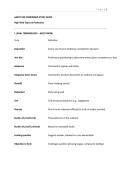
I. LEGAL TERMINOLOGY – MUST KNOW
Term Definition
Deposition Sworn out-of-court testimony recorded for discovery
Voir dire Preliminary questioning to determine witness/juror competency or bias
Subpoena Command to appear and testify
Subpoena duces tecum Command to produce documents or evidence and appear
Plaintiff Party initiating lawsuit
Defendant Party being sued
Tort Civil wrong causing harm (e.g., negligence)
Hearsay Out-of-court statement offered for truth of matter asserted
Burden of proof (civil) Preponderance of the evidence
Burden of proof (criminal) Beyond a reasonable doubt
Leading question Suggests answer; allowed on cross-examination
Objection to form Challenges question phrasing (vague, compound, leading)
, Page |2
Term Definition
Stipulation Agreement between parties
Work product Attorney's mental impressions/trial preparation materials
Privilege Right to refuse disclosure (attorney-client, doctor-patient)
Exhibit Physical/documentary evidence introduced
Foundation Preliminary facts establishing admissibility
Best evidence rule Original document required when content is at issue
Chain of custody Documentation of evidence handling
Motion in limine Pre-trial motion to exclude evidence
Motion to compel Request to force compliance with discovery
Summary judgment Judgment without trial when no material facts in dispute
Dismissal with prejudice Bars refiling same claim
Statute of limitations Time limit to file lawsuit
Perjury Lying under oath
Impeachment Challenging witness credibility
II. DEPOSITION PROCEDURES – HIGH-YIELD
AAERT CDR CONDENSED STUDY GUIDE
High-Yield Topics & Flashcards
I. LEGAL TERMINOLOGY – MUST KNOW
Term Definition
Deposition Sworn out-of-court testimony recorded for discovery
Voir dire Preliminary questioning to determine witness/juror competency or bias
Subpoena Command to appear and testify
Subpoena duces tecum Command to produce documents or evidence and appear
Plaintiff Party initiating lawsuit
Defendant Party being sued
Tort Civil wrong causing harm (e.g., negligence)
Hearsay Out-of-court statement offered for truth of matter asserted
Burden of proof (civil) Preponderance of the evidence
Burden of proof (criminal) Beyond a reasonable doubt
Leading question Suggests answer; allowed on cross-examination
Objection to form Challenges question phrasing (vague, compound, leading)
, Page |2
Term Definition
Stipulation Agreement between parties
Work product Attorney's mental impressions/trial preparation materials
Privilege Right to refuse disclosure (attorney-client, doctor-patient)
Exhibit Physical/documentary evidence introduced
Foundation Preliminary facts establishing admissibility
Best evidence rule Original document required when content is at issue
Chain of custody Documentation of evidence handling
Motion in limine Pre-trial motion to exclude evidence
Motion to compel Request to force compliance with discovery
Summary judgment Judgment without trial when no material facts in dispute
Dismissal with prejudice Bars refiling same claim
Statute of limitations Time limit to file lawsuit
Perjury Lying under oath
Impeachment Challenging witness credibility
II. DEPOSITION PROCEDURES – HIGH-YIELD


