

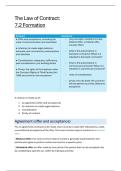
The Law of Contract:
7.2 Formation
Content Guidance
¨ O#er and acceptance, including the – key concepts: invitation to treat,
rules of communication and revocation bilateral o#er, unilateral o#er,
counter o#ers
¨ Intention to create legal relations:
domestic and commercial, presumptions – what is the presumption in
and rebuttals domestic contracts? When is it
rebutted in domestic contracts?
¨ Consideration: adequacy, su#iciency,
past consideration, pre-existing duties – what is the presumption in
commercial contracts? When is it
¨ Privity: the rights of third parties under rebutted in commercial contracts?
the Contract (Rights of Third Parties) Act
1999 and common law exceptions – rules of consideration
– privity: the rule itself, the common
law exceptions to privity; Statutory
exceptions
A contract is made up of:
1. An agreement (o#er and acceptance)
2. An intention to create legal relations
3. Consideration
4. Privity of contract
Agreement (o+er and acceptance)
For an agreement (contract) to be made, there must be a valid o#er followed by a valid,
unconditional acceptance of the o#er. The most common type of contract is a bilateral
o#er.
Bilateral o0er: the most common type of contract, generally made between two
parties who agree to perform certain services for a specific price.
Unilateral o0er: an o#er made by one person that person that can be accepted only
by completing a specific act, rather by making a promise.
,The O&er
O0er: an expression of one party’s willingness to contract on certain terms, made with
the intention that it will be legally binding upon acceptance.
The party making the o#er is known as the o#eror, while the party to whom the o#er is
made is known as the o#eree.
The o#eror will usually state verbally or in writing that they will be bound by the terms of
the o#er following a valid acceptance and that they have an intention to create legal
relations. The contract will not be formed until the o#eree accepts the terms in the o#er.
Invitation to treat
Invitation to treat: the early stages of forming the agreement, often not considered to
be o#ers but simply invitations for parties to make o#ers.
Where problems have arisen is in the di#erence between a valid o#er and what the law
calls an “invitation to treat”. An o#er will most likely lead to a binding contract, but an
invitation to treat is simply an invitation to make o#ers and can be seen in the early
stages of contractual negotiations.
Since negotiations to strike some sort of agreement may take some time, the early
stages of forming the agreement are often not considered to be o#ers but simply
invitations for parties to make o#ers.
Goods on display in shops or the internet
Such items will not be considered to be an o#er. The law says that the display of goods
is an invitation to treat and by picking up the item, and taking to the till, the customer
makes an o#er to buy, and the shop owner can choose whether to accept the o#er to
buy or not.
Pharmaceutical Society of Great Britain v Boots Cash Chemists Ltd
Boots introduced a self-service system where customers selected medicines from
shelves and then paid at the cashier. The Pharmaceutical Society argued that the sale
took place when the customer picked up the goods, meaning medicines were being
sold without the supervision of a pharmacist.
Principle: In a shop, the display of goods is an invitation to treat, not an o#er. The
customer makes the o#er when presenting the goods at the cashier, and the shop
accepts the o#er when payment is taken. (Boots not guilty of breaching pharmacy
laws)
, Fisher v Bell (1961)
D had a click knife on display in his shop window. Statute made it an o#ence to ‘o#er’
for sale such an item.
Principle: it is not an o#er but an invitation to treat.
Fisher v Bell (1961) is an updated version of Pharmaceutical Society of Great Britain v
Boots Cash Chemists Ltd (1953), which reflects on the same principle.
Goods or services advertised in newspapers, magazines and other
media
The advertisement is not an o#er but instead an invitation to treat. It is up to the person
who acts on the advertisement to make an o#er to buy what is advertised. This can then
be accepted by the advertiser, forming a contract.
Partridge v Crittenden (1968)
P was charged with ‘o#ering for sale’ several wild birds, which was a criminal o#ence,
after placing an advertisement in a newspaper.
Principle: His advertisement was an invitation to treat and therefore no o#er to sell
had been made.
Nevertheless, there are some exceptions to this rule in advertisements:
• If an advertisement is made where a reward will be paid.
Þ For example, for finding a lost cat, and the cat is returned, then the person
making the advertisement cannot rely on the reward being an o#er to treat
Þ Instead, the law will treat it as what is called a unilateral o#er – see Carlill v
Carbolic Smoke Ball Co. (1893)
Carlill v Carbolic Smoke Ball Co. (1893)
C bought and used a medical product correctly but still caught the ‘flu. She sued for
£100.
Principle: the advert was not a true o#er: it was an example of an unilateral o#er.
7.2 Formation
Content Guidance
¨ O#er and acceptance, including the – key concepts: invitation to treat,
rules of communication and revocation bilateral o#er, unilateral o#er,
counter o#ers
¨ Intention to create legal relations:
domestic and commercial, presumptions – what is the presumption in
and rebuttals domestic contracts? When is it
rebutted in domestic contracts?
¨ Consideration: adequacy, su#iciency,
past consideration, pre-existing duties – what is the presumption in
commercial contracts? When is it
¨ Privity: the rights of third parties under rebutted in commercial contracts?
the Contract (Rights of Third Parties) Act
1999 and common law exceptions – rules of consideration
– privity: the rule itself, the common
law exceptions to privity; Statutory
exceptions
A contract is made up of:
1. An agreement (o#er and acceptance)
2. An intention to create legal relations
3. Consideration
4. Privity of contract
Agreement (o+er and acceptance)
For an agreement (contract) to be made, there must be a valid o#er followed by a valid,
unconditional acceptance of the o#er. The most common type of contract is a bilateral
o#er.
Bilateral o0er: the most common type of contract, generally made between two
parties who agree to perform certain services for a specific price.
Unilateral o0er: an o#er made by one person that person that can be accepted only
by completing a specific act, rather by making a promise.
,The O&er
O0er: an expression of one party’s willingness to contract on certain terms, made with
the intention that it will be legally binding upon acceptance.
The party making the o#er is known as the o#eror, while the party to whom the o#er is
made is known as the o#eree.
The o#eror will usually state verbally or in writing that they will be bound by the terms of
the o#er following a valid acceptance and that they have an intention to create legal
relations. The contract will not be formed until the o#eree accepts the terms in the o#er.
Invitation to treat
Invitation to treat: the early stages of forming the agreement, often not considered to
be o#ers but simply invitations for parties to make o#ers.
Where problems have arisen is in the di#erence between a valid o#er and what the law
calls an “invitation to treat”. An o#er will most likely lead to a binding contract, but an
invitation to treat is simply an invitation to make o#ers and can be seen in the early
stages of contractual negotiations.
Since negotiations to strike some sort of agreement may take some time, the early
stages of forming the agreement are often not considered to be o#ers but simply
invitations for parties to make o#ers.
Goods on display in shops or the internet
Such items will not be considered to be an o#er. The law says that the display of goods
is an invitation to treat and by picking up the item, and taking to the till, the customer
makes an o#er to buy, and the shop owner can choose whether to accept the o#er to
buy or not.
Pharmaceutical Society of Great Britain v Boots Cash Chemists Ltd
Boots introduced a self-service system where customers selected medicines from
shelves and then paid at the cashier. The Pharmaceutical Society argued that the sale
took place when the customer picked up the goods, meaning medicines were being
sold without the supervision of a pharmacist.
Principle: In a shop, the display of goods is an invitation to treat, not an o#er. The
customer makes the o#er when presenting the goods at the cashier, and the shop
accepts the o#er when payment is taken. (Boots not guilty of breaching pharmacy
laws)
, Fisher v Bell (1961)
D had a click knife on display in his shop window. Statute made it an o#ence to ‘o#er’
for sale such an item.
Principle: it is not an o#er but an invitation to treat.
Fisher v Bell (1961) is an updated version of Pharmaceutical Society of Great Britain v
Boots Cash Chemists Ltd (1953), which reflects on the same principle.
Goods or services advertised in newspapers, magazines and other
media
The advertisement is not an o#er but instead an invitation to treat. It is up to the person
who acts on the advertisement to make an o#er to buy what is advertised. This can then
be accepted by the advertiser, forming a contract.
Partridge v Crittenden (1968)
P was charged with ‘o#ering for sale’ several wild birds, which was a criminal o#ence,
after placing an advertisement in a newspaper.
Principle: His advertisement was an invitation to treat and therefore no o#er to sell
had been made.
Nevertheless, there are some exceptions to this rule in advertisements:
• If an advertisement is made where a reward will be paid.
Þ For example, for finding a lost cat, and the cat is returned, then the person
making the advertisement cannot rely on the reward being an o#er to treat
Þ Instead, the law will treat it as what is called a unilateral o#er – see Carlill v
Carbolic Smoke Ball Co. (1893)
Carlill v Carbolic Smoke Ball Co. (1893)
C bought and used a medical product correctly but still caught the ‘flu. She sued for
£100.
Principle: the advert was not a true o#er: it was an example of an unilateral o#er.


