

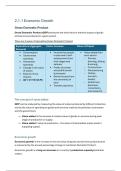
2.1.1 Economic Growth
Gross Domestic Product
Gross Domestic Product (GDP) measures the total value of national output of goods
and services produced in a given period.
There are 3 ways of calculating Gross Domestic Product
Expenditure (Aggregate Factor Incomes Value of Output
Demand)
• Consumption • Incomes for people • Value added from
• Government in jobs and in self- each sector:
spending employment (from – Primary
• Investment their wages and (farming, fishing
spending salaries & mining)
• Change in the value • Profits of private – Construction
of stocks and public sector – Manufacturing
• Exports minus businesses – Tertiary
imports • Rental income from (tourism,
• AD = C+I+G+(X-M) the ownership of health)
land – Quaternary
• Transfer payments (business
consultancy
and research)
The concept of value added
GDP can be analysed by measuring the value of output produced by diOerent industries
and by the value of spending on goods and services made by households, businesses
and the government.
Þ Value added is the increase in market value of goods or services during each
stage of production or supply.
Þ Value added = value of production – the value of intermediate inputs used in
supplying a good.
Economic growth
Economic growth is the increase in the real value of goods and services produced and
is measured by the annual percentage change in real Gross Domestic Product.
Economic growth is a long run increase in a country's productive capacity/potential
output.
, Real and Nominal GDP
Nominal GDP is the monetary value of the national output of goods and services
measured at current prices.
Real GDP takes inflation into account – where money GDP is adjusted for changes in
the general price level. Real GDP is measured at constant prices meaning that we have
taken away (deflated) the eOects of inflation.
Real GDP Per Capita and Real Disposable Income
Real GDP per capita is the real income per head of population expressed at constant
prices.
Real Disposable Income is the income after deduction of taxes + benefits and
adjusted for the eOects of inflation.
Includes earnings from:
– Employment
– Private pensions
– Investments
– Benefits by the state
Gross National Product/Income (GNI)
GNI is GDP plus net property income from overseas (NPIO).
Property income (NPIO) can come in the form of interest profits and dividends from
overseas investments.
Purchasing Power Parity (PPP)
Purchasing power parity measures how many units of one country's currency are
needed to buy the same basket of goods and services as can be bought with a given
amount of another currency.
In countries where the relative cost of living is high such as Norway and Switzerland,
there will be a downward adjustment to the nation's PPP-adjusted GNI per capita.
In nations where the relative cost of living is low such as India, the real purchasing
power of 1000 dollars will be higher, and this leads to these countries seeing their PPP-
adjusted per capita incomes rising in global league tables.
Gross Domestic Product
Gross Domestic Product (GDP) measures the total value of national output of goods
and services produced in a given period.
There are 3 ways of calculating Gross Domestic Product
Expenditure (Aggregate Factor Incomes Value of Output
Demand)
• Consumption • Incomes for people • Value added from
• Government in jobs and in self- each sector:
spending employment (from – Primary
• Investment their wages and (farming, fishing
spending salaries & mining)
• Change in the value • Profits of private – Construction
of stocks and public sector – Manufacturing
• Exports minus businesses – Tertiary
imports • Rental income from (tourism,
• AD = C+I+G+(X-M) the ownership of health)
land – Quaternary
• Transfer payments (business
consultancy
and research)
The concept of value added
GDP can be analysed by measuring the value of output produced by diOerent industries
and by the value of spending on goods and services made by households, businesses
and the government.
Þ Value added is the increase in market value of goods or services during each
stage of production or supply.
Þ Value added = value of production – the value of intermediate inputs used in
supplying a good.
Economic growth
Economic growth is the increase in the real value of goods and services produced and
is measured by the annual percentage change in real Gross Domestic Product.
Economic growth is a long run increase in a country's productive capacity/potential
output.
, Real and Nominal GDP
Nominal GDP is the monetary value of the national output of goods and services
measured at current prices.
Real GDP takes inflation into account – where money GDP is adjusted for changes in
the general price level. Real GDP is measured at constant prices meaning that we have
taken away (deflated) the eOects of inflation.
Real GDP Per Capita and Real Disposable Income
Real GDP per capita is the real income per head of population expressed at constant
prices.
Real Disposable Income is the income after deduction of taxes + benefits and
adjusted for the eOects of inflation.
Includes earnings from:
– Employment
– Private pensions
– Investments
– Benefits by the state
Gross National Product/Income (GNI)
GNI is GDP plus net property income from overseas (NPIO).
Property income (NPIO) can come in the form of interest profits and dividends from
overseas investments.
Purchasing Power Parity (PPP)
Purchasing power parity measures how many units of one country's currency are
needed to buy the same basket of goods and services as can be bought with a given
amount of another currency.
In countries where the relative cost of living is high such as Norway and Switzerland,
there will be a downward adjustment to the nation's PPP-adjusted GNI per capita.
In nations where the relative cost of living is low such as India, the real purchasing
power of 1000 dollars will be higher, and this leads to these countries seeing their PPP-
adjusted per capita incomes rising in global league tables.


