

Sir Sardar + 92 3169752996
DC Motor
Sir Sardar + 92 3169752996 1
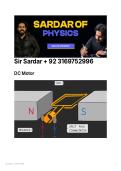
, Components of a DC Motor
Coil (armature): Carries current and experiences a force in the magnetic field,
causing rotation.
Field magnets (permanent magnets/electromagnets): Provide a magnetic
field for the motor to operate.
Split-ring commutator: Reverses the current every half turn to keep the coil
rotating in the same direction.
Carbon brushes: Transfer current from the power supply to the rotating
commutator.
Working of a DC Motor
1. In a DC motor, a current-carrying coil (armature) is placed in a magnetic field
between the poles of magnets.
2. When direct current flows through the coil, each side of the coil experiences
a force due to the magnetic field, with forces acting in opposite directions on
the two sides. This creates a turning effect that causes the coil to rotate.
3. As the coil completes half a turn, the split-ring commutator reverses the
direction of current in the coil, ensuring that the forces continue to act in a
way that keeps the coil rotating in the same direction.
4. The carbon brushes maintain electrical contact with the rotating commutator,
allowing continuous current flow from the power supply. As a result, the coil
continues to spin, converting electrical energy into mechanical energy.
Sir Sardar + 92 3169752996 2
DC Motor
Sir Sardar + 92 3169752996 1
, Components of a DC Motor
Coil (armature): Carries current and experiences a force in the magnetic field,
causing rotation.
Field magnets (permanent magnets/electromagnets): Provide a magnetic
field for the motor to operate.
Split-ring commutator: Reverses the current every half turn to keep the coil
rotating in the same direction.
Carbon brushes: Transfer current from the power supply to the rotating
commutator.
Working of a DC Motor
1. In a DC motor, a current-carrying coil (armature) is placed in a magnetic field
between the poles of magnets.
2. When direct current flows through the coil, each side of the coil experiences
a force due to the magnetic field, with forces acting in opposite directions on
the two sides. This creates a turning effect that causes the coil to rotate.
3. As the coil completes half a turn, the split-ring commutator reverses the
direction of current in the coil, ensuring that the forces continue to act in a
way that keeps the coil rotating in the same direction.
4. The carbon brushes maintain electrical contact with the rotating commutator,
allowing continuous current flow from the power supply. As a result, the coil
continues to spin, converting electrical energy into mechanical energy.
Sir Sardar + 92 3169752996 2


