

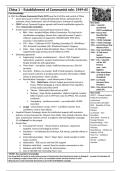
China 1 – Establishment of Communist rule, 1949-65
Core knowledge
In 1949 the Chinese Communist Party (CCP) won the Civil War and control of China
Issues they faced in 1949: Continued Nationalist threat, administrative &
economic chaos, lawlessness, lack of infrastructure, transport & expertise Key dates
CPPCC set up. Common Program agreed until formal constitution agreed in 1949 – 1 Oct PRC
1954. Democratic Centralism proclaimed
3 inter-woven strands to Communist Government in China. CPPCC established
o PLA – Mao = headed Military Affairs Commission. PLA had role in 1950 – Korean War
reunification campaigns, Korean War, regional bureaux (2 posts = Reunification
military), suppression of opponents (100,000 killed 1950-53) & Campaigns
economy. Conscription law 1955. 1951 – 3 Antis Campaign
o CCP – Mao = Chairman of CCP. Standing Committee (5) Politburo 1952 – 5 Antis Campaign
1953 – End of Korean War
(25) Central Committee (49) National People’s Congress
Reform of PLA
o State – Mao = Head of State (President). Zhou = Premier. 24 Ministries 1954 – New Constitution
supported by large bureaucracy (8 million by 1959) 1956 – 25 Feb Secret
Defeating opponents Speech
o Suppressing ‘counter-revolutionaries’ – March 1950. Targeted Hundred Flowers
nationalists, academics, western businessmen & Christian missionaries. 1957 – Feb – repeated
People tricked into self-registration. call for 100
o Three Antis – corruption, waste, inefficient bureaucracy. Old civil Flowers
June – Anti-
servants.
Rightists
o Five Antis – bribery, tax evasion, theft of state property, cheating on
1958 – Mao stood down
government contracts & stealing state economic information. Middle as Head of State
classes & businessmen. Many suicides. (President)
o Reunification Campaigns – most distant parts of China 1959 – Liu Shaoqi
Tibet – Dalai Llama a threat. Puppet government set up in becomes State
Lhasa. Tibetan language & culture attacked. Han migration President
(1952). Dalai Llama fled (1959) 1962 – Mao retreats from
Taiwan – Nationalists fled and set up ROC. public life
Xinjiang – large Muslim population. Uighurs targeted. Leaders Key words
killed in plane crash in 1949 (en route to CPPCC). PLA crushed CPPCC – Chinese People’s
resistance. Political Consultative
Conference
Guangdong – southern province – pro-nationalist. 28,000
Democratic Centralism
executed.
ROC – Republic of China
o Laogai – prison/labour camps. 1955 = 1.3milliion inmates. Poor (Taiwan)
conditions, used as slave labour. Danwei
Hundred Flowers Campaign: desire for intellectual support with economic Liu Shaoqi – Vice
policies, remove bureaucrats, distance from Stalin. Mao invited criticisms. Slow President
start. Surprised by criticism of CCP. Crackdown with Anti-Rightists Campaign. Zhou Enlai – Premier &
5% of Danwei’s to be purged. Foreign Minister
Korean War Deng Xiaoping – Vice-
o Increased CCP control – ‘Resist America, Aid Korea’, opponents Premier and Finance
Minister.
targeted, rumours of biological warfare
Peng Dehuai – Minister of
o Patriotism – not defeated by UN troops; PLA heroes; patriotic efforts in Defence (1954)
factories Chen Yun – politburo
o International prestige – West = Paper Tigers. Good example to other member
Asian countries Zhu De – politburo
o Nationalists – ROC secure and had USA support member
o Relations with West – soured. Need to contain communism in Asia
o Relations with USSR – reliant for aid and advice
o Loss of 400,000 men (including Mao’s son)
‘WOW’ the examiner knowledge
Gao Gang (held all 4 posts in north-eastern bureau of Manchuria) & Rao Shushi (party leader in Shanghai) – accused of factionalism (&
Gao of plotting to replace Zhou Enlai) in 1953. Gao committed suicide. Rao died in prison in 1975.
Ding Ling was a loyal communist denounced as part of the Anti-Rightists campaign
Core knowledge
In 1949 the Chinese Communist Party (CCP) won the Civil War and control of China
Issues they faced in 1949: Continued Nationalist threat, administrative &
economic chaos, lawlessness, lack of infrastructure, transport & expertise Key dates
CPPCC set up. Common Program agreed until formal constitution agreed in 1949 – 1 Oct PRC
1954. Democratic Centralism proclaimed
3 inter-woven strands to Communist Government in China. CPPCC established
o PLA – Mao = headed Military Affairs Commission. PLA had role in 1950 – Korean War
reunification campaigns, Korean War, regional bureaux (2 posts = Reunification
military), suppression of opponents (100,000 killed 1950-53) & Campaigns
economy. Conscription law 1955. 1951 – 3 Antis Campaign
o CCP – Mao = Chairman of CCP. Standing Committee (5) Politburo 1952 – 5 Antis Campaign
1953 – End of Korean War
(25) Central Committee (49) National People’s Congress
Reform of PLA
o State – Mao = Head of State (President). Zhou = Premier. 24 Ministries 1954 – New Constitution
supported by large bureaucracy (8 million by 1959) 1956 – 25 Feb Secret
Defeating opponents Speech
o Suppressing ‘counter-revolutionaries’ – March 1950. Targeted Hundred Flowers
nationalists, academics, western businessmen & Christian missionaries. 1957 – Feb – repeated
People tricked into self-registration. call for 100
o Three Antis – corruption, waste, inefficient bureaucracy. Old civil Flowers
June – Anti-
servants.
Rightists
o Five Antis – bribery, tax evasion, theft of state property, cheating on
1958 – Mao stood down
government contracts & stealing state economic information. Middle as Head of State
classes & businessmen. Many suicides. (President)
o Reunification Campaigns – most distant parts of China 1959 – Liu Shaoqi
Tibet – Dalai Llama a threat. Puppet government set up in becomes State
Lhasa. Tibetan language & culture attacked. Han migration President
(1952). Dalai Llama fled (1959) 1962 – Mao retreats from
Taiwan – Nationalists fled and set up ROC. public life
Xinjiang – large Muslim population. Uighurs targeted. Leaders Key words
killed in plane crash in 1949 (en route to CPPCC). PLA crushed CPPCC – Chinese People’s
resistance. Political Consultative
Conference
Guangdong – southern province – pro-nationalist. 28,000
Democratic Centralism
executed.
ROC – Republic of China
o Laogai – prison/labour camps. 1955 = 1.3milliion inmates. Poor (Taiwan)
conditions, used as slave labour. Danwei
Hundred Flowers Campaign: desire for intellectual support with economic Liu Shaoqi – Vice
policies, remove bureaucrats, distance from Stalin. Mao invited criticisms. Slow President
start. Surprised by criticism of CCP. Crackdown with Anti-Rightists Campaign. Zhou Enlai – Premier &
5% of Danwei’s to be purged. Foreign Minister
Korean War Deng Xiaoping – Vice-
o Increased CCP control – ‘Resist America, Aid Korea’, opponents Premier and Finance
Minister.
targeted, rumours of biological warfare
Peng Dehuai – Minister of
o Patriotism – not defeated by UN troops; PLA heroes; patriotic efforts in Defence (1954)
factories Chen Yun – politburo
o International prestige – West = Paper Tigers. Good example to other member
Asian countries Zhu De – politburo
o Nationalists – ROC secure and had USA support member
o Relations with West – soured. Need to contain communism in Asia
o Relations with USSR – reliant for aid and advice
o Loss of 400,000 men (including Mao’s son)
‘WOW’ the examiner knowledge
Gao Gang (held all 4 posts in north-eastern bureau of Manchuria) & Rao Shushi (party leader in Shanghai) – accused of factionalism (&
Gao of plotting to replace Zhou Enlai) in 1953. Gao committed suicide. Rao died in prison in 1975.
Ding Ling was a loyal communist denounced as part of the Anti-Rightists campaign


