

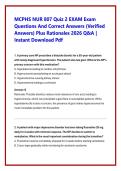
MCPHS NUR 807 Quiz 2 EXAM Exam
Questions And Correct Answers (Verified
Answers) Plus Rationales 2026 Q&A |
Instant Download Pdf
1. A primary care NP prescribes a thiazide diuretic for a 55-year-old patient
with newly diagnosed hypertension. The patient also has gout. What is the NP’s
primary concern with this medication?
A. Hypokalemia leading to cardiac arrhythmias
B. Hyperuricemia precipitating an acute gout attack
C. Hypercalcemia causing kidney stones
D. Hyponatremia leading to confusion
Answer: B
Rationale: Thiazide diuretics reduce renal clearance of uric acid, leading to
hyperuricemia, which can precipitate a gout flare in susceptible patients. While
hypokalemia (A) is also a concern, the presence of gout makes hyperuricemia the
most immediate problem for this patient.
2. A patient with major depressive disorder has been taking fluoxetine 20 mg
daily for 4 weeks with minimal response. The NP decides to switch to
venlafaxine. What is the most important consideration during the transition?
A. Fluoxetine must be completely stopped for 2 weeks before starting venlafaxine
B. Cross-taper gradually while monitoring for serotonin syndrome
,C. No washout is needed because both are SSRIs
D. Immediately discontinue fluoxetine and start venlafaxine the next day
Answer: B
Rationale: Fluoxetine has a long half-life (active metabolite norfluoxetine) and is an
SSRI; venlafaxine is an SNRI. Overlapping serotonergic activity can cause serotonin
syndrome. A slow cross-taper is recommended to minimize withdrawal and
serotonin toxicity. Fluoxetine’s long half-life provides some self-tapering, but
monitoring is still required.
3. Which laboratory value is most critical to monitor in a patient taking
spironolactone for heart failure?
A. Serum sodium
B. Serum potassium
C. Serum calcium
D. Fasting glucose
Answer: B
Rationale: Spironolactone is a potassium-sparing diuretic and aldosterone
antagonist. It can cause life-threatening hyperkalemia, especially in patients with
renal impairment or those also taking ACE inhibitors/ARBs.
4. A 65-year-old woman with atrial fibrillation has a CHA₂DS₂-VASc score of 4
and is prescribed apixaban. She asks why she needs an anticoagulant. The
NP’s best response is based on the knowledge that her annual stroke risk
without anticoagulation is approximately:
A. 1-2%
,B. 4-5%
C. 8-10%
D. 12-15%
Answer: B
Rationale: A CHA₂DS₂-VASc score of 4 corresponds to an approximate annual
stroke risk of 4-5%. Anticoagulation significantly reduces this risk. Scores of
0=1.3%, 1=2.2%, 2=3.2%, 3=3.9%, 4=5.5% etc. (varies by study). So 4-5% is
correct.
5. A patient with COPD is started on ipratropium bromide. What is the
mechanism of action?
A. Beta-2 adrenergic receptor agonism
B. Muscarinic receptor antagonism
C. Phosphodiesterase-4 inhibition
D. Leukotriene receptor antagonism
Answer: B
Rationale: Ipratropium is a short-acting anticholinergic (muscarinic antagonist) that
blocks M3 receptors in bronchial smooth muscle, leading to bronchodilation. It is
not a beta-agonist (A), PDE4 inhibitor (C), or leukotriene modifier (D).
6. A 58-year-old man with type 2 diabetes, hypertension, and albuminuria is
started on an SGLT2 inhibitor. What is the primary mechanism by which SGLT2
inhibitors provide renal protection?
A. Increasing insulin secretion
B. Blocking glucose reabsorption in the proximal tubule and reducing
, intraglomerular pressure
C. Decreasing hepatic gluconeogenesis
D. Increasing GLP-1 levels
Answer: B
Rationale: SGLT2 inhibitors block sodium-glucose cotransport in the proximal
tubule, leading to glycosuria and natriuresis. This increases distal sodium delivery
to the macula densa, activating tubuloglomerular feedback, causing afferent
arteriolar vasoconstriction, and reducing intraglomerular pressure—the key renal
protective mechanism.
7. A patient on warfarin has an INR of 6.0 without bleeding. The NP should:
A. Administer IV vitamin K and fresh frozen plasma
B. Hold warfarin for 1-2 doses, reduce the weekly dose, and recheck INR
C. Continue the same dose and recheck in 1 week
D. Administer protamine sulfate
Answer: B
Rationale: For an INR between 4.5 and 10 with no bleeding, guidelines recommend
holding 1-2 doses, monitoring INR, and resuming at a reduced dose. Oral vitamin K
may be considered if there is a high bleeding risk, but routine use is not
recommended.
8. Which antidepressant carries the highest risk of sexual dysfunction?
A. Bupropion
B. Mirtazapine
Questions And Correct Answers (Verified
Answers) Plus Rationales 2026 Q&A |
Instant Download Pdf
1. A primary care NP prescribes a thiazide diuretic for a 55-year-old patient
with newly diagnosed hypertension. The patient also has gout. What is the NP’s
primary concern with this medication?
A. Hypokalemia leading to cardiac arrhythmias
B. Hyperuricemia precipitating an acute gout attack
C. Hypercalcemia causing kidney stones
D. Hyponatremia leading to confusion
Answer: B
Rationale: Thiazide diuretics reduce renal clearance of uric acid, leading to
hyperuricemia, which can precipitate a gout flare in susceptible patients. While
hypokalemia (A) is also a concern, the presence of gout makes hyperuricemia the
most immediate problem for this patient.
2. A patient with major depressive disorder has been taking fluoxetine 20 mg
daily for 4 weeks with minimal response. The NP decides to switch to
venlafaxine. What is the most important consideration during the transition?
A. Fluoxetine must be completely stopped for 2 weeks before starting venlafaxine
B. Cross-taper gradually while monitoring for serotonin syndrome
,C. No washout is needed because both are SSRIs
D. Immediately discontinue fluoxetine and start venlafaxine the next day
Answer: B
Rationale: Fluoxetine has a long half-life (active metabolite norfluoxetine) and is an
SSRI; venlafaxine is an SNRI. Overlapping serotonergic activity can cause serotonin
syndrome. A slow cross-taper is recommended to minimize withdrawal and
serotonin toxicity. Fluoxetine’s long half-life provides some self-tapering, but
monitoring is still required.
3. Which laboratory value is most critical to monitor in a patient taking
spironolactone for heart failure?
A. Serum sodium
B. Serum potassium
C. Serum calcium
D. Fasting glucose
Answer: B
Rationale: Spironolactone is a potassium-sparing diuretic and aldosterone
antagonist. It can cause life-threatening hyperkalemia, especially in patients with
renal impairment or those also taking ACE inhibitors/ARBs.
4. A 65-year-old woman with atrial fibrillation has a CHA₂DS₂-VASc score of 4
and is prescribed apixaban. She asks why she needs an anticoagulant. The
NP’s best response is based on the knowledge that her annual stroke risk
without anticoagulation is approximately:
A. 1-2%
,B. 4-5%
C. 8-10%
D. 12-15%
Answer: B
Rationale: A CHA₂DS₂-VASc score of 4 corresponds to an approximate annual
stroke risk of 4-5%. Anticoagulation significantly reduces this risk. Scores of
0=1.3%, 1=2.2%, 2=3.2%, 3=3.9%, 4=5.5% etc. (varies by study). So 4-5% is
correct.
5. A patient with COPD is started on ipratropium bromide. What is the
mechanism of action?
A. Beta-2 adrenergic receptor agonism
B. Muscarinic receptor antagonism
C. Phosphodiesterase-4 inhibition
D. Leukotriene receptor antagonism
Answer: B
Rationale: Ipratropium is a short-acting anticholinergic (muscarinic antagonist) that
blocks M3 receptors in bronchial smooth muscle, leading to bronchodilation. It is
not a beta-agonist (A), PDE4 inhibitor (C), or leukotriene modifier (D).
6. A 58-year-old man with type 2 diabetes, hypertension, and albuminuria is
started on an SGLT2 inhibitor. What is the primary mechanism by which SGLT2
inhibitors provide renal protection?
A. Increasing insulin secretion
B. Blocking glucose reabsorption in the proximal tubule and reducing
, intraglomerular pressure
C. Decreasing hepatic gluconeogenesis
D. Increasing GLP-1 levels
Answer: B
Rationale: SGLT2 inhibitors block sodium-glucose cotransport in the proximal
tubule, leading to glycosuria and natriuresis. This increases distal sodium delivery
to the macula densa, activating tubuloglomerular feedback, causing afferent
arteriolar vasoconstriction, and reducing intraglomerular pressure—the key renal
protective mechanism.
7. A patient on warfarin has an INR of 6.0 without bleeding. The NP should:
A. Administer IV vitamin K and fresh frozen plasma
B. Hold warfarin for 1-2 doses, reduce the weekly dose, and recheck INR
C. Continue the same dose and recheck in 1 week
D. Administer protamine sulfate
Answer: B
Rationale: For an INR between 4.5 and 10 with no bleeding, guidelines recommend
holding 1-2 doses, monitoring INR, and resuming at a reduced dose. Oral vitamin K
may be considered if there is a high bleeding risk, but routine use is not
recommended.
8. Which antidepressant carries the highest risk of sexual dysfunction?
A. Bupropion
B. Mirtazapine


