

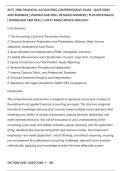
ACCT 2000 FINANCIAL ACCOUNTING COMPREHENSIVE EXAM – QUESTIONS
AND ANSWERS | VERIFIED AND WELL DETAILED ANSWERS | PLUS RATIONALES
| DOWNLOAD AND PASS | LATEST EXAM UPDATE 2026/2027
Core Domains:
1. The Accounting Cycle and Transaction Analysis
2. Financial Statement Preparation and Presentation (Balance Sheet, Income
Statement, Statement of Cash Flows)
3. Asset Valuation and Depreciation (PP&E, Intangibles, Inventory)
4. Liability Measurement and Classification (Current, Long-Term, Contingent)
5. Equity Transactions and Stockholders' Equity Reporting
6. Revenue Recognition Principles and Application
7. Internal Controls, Ethics, and Professional Standards
8. Financial Statement Analysis and Interpretation
9. Regulatory and Legal Compliance (GAAP, IFRS Convergence)
Introduction
This comprehensive examination is designed to rigorously assess your mastery of
foundational and applied financial accounting principles. The structure integrates
theoretical knowledge with practical, scenario-based multiple-choice questions that
challenge your ability to analyze transactions, prepare financial statements, and
make informed decisions. You will be evaluated on your understanding of the
accounting cycle, asset and liability valuation, equity reporting, and the application
of key standards like revenue recognition and internal controls. This assessment
emphasizes real-world application, critical thinking, and ethical reasoning, ensuring
you are prepared for professional accounting challenges. Approach each question
methodically, applying your knowledge to select the most defensible answer.
SECTION ONE: QUESTIONS 1 – 100
,1. A company receives cash in advance from a customer for services to be
performed next year. Under the accrual basis of accounting, how should this
transaction be recorded?
A. Debit Cash, Credit Service Revenue
B. Debit Cash, Credit Unearned Revenue
C. Debit Unearned Revenue, Credit Cash
D. Debit Service Revenue, Credit Cash
🟢B
🔴 Explanation: When cash is received before the service is performed, the
company has an obligation to provide the service in the future, creating a liability
called Unearned Revenue. Revenue is not recognized until the performance
obligation is satisfied. Therefore, the correct entry is a debit to Cash and a credit
to Unearned Revenue.
2. Which of the following is an example of a financing activity on the Statement
of Cash Flows?
A. Payment of interest on a loan
B. Purchase of equipment for cash
C. Issuance of common stock for cash
D. Collection of an accounts receivable
🟢C
🔴 Explanation: Financing activities involve transactions with owners and
creditors, such as issuing stock, borrowing money, and repaying debt. The
issuance of common stock for cash is a primary financing activity. Payment of
interest is an operating activity, purchasing equipment is an investing activity, and
collecting an account receivable is an operating activity under the indirect
method.
3. What is the effect of recording depreciation expense for the period?
A. Increases total assets and increases net income
B. Decreases total assets and decreases net income
,C. Decreases total assets and increases net income
D. Increases total assets and decreases net income
🟢B
🔴 Explanation: Depreciation expense allocates the cost of a tangible asset over
its useful life. The entry is a debit to Depreciation Expense (which decreases net
income) and a credit to Accumulated Depreciation (a contra-asset account that
decreases total assets). Thus, total assets and net income both decrease.
4. A company has a current ratio of 2.0. If the company uses cash to pay off a
portion of its accounts payable, what is the most likely effect on the current
ratio?
A. The current ratio will increase.
B. The current ratio will decrease.
C. The current ratio will remain the same.
D. The effect cannot be determined from the information given.
🟢A
🔴 Explanation: The current ratio is Current Assets / Current Liabilities. Paying
accounts payable with cash reduces both current assets (cash) and current
liabilities (accounts payable) by the same amount. If the ratio is greater than 1.0, a
proportional decrease in both the numerator and denominator will cause the
ratio to increase. For example, if CA = 200 and CL = 100, the ratio is 2.0. Paying 10
reduces CA to 190 and CL to 90, resulting in a new ratio of 2.11, an increase.
5. Under the allowance method, the write-off of an uncollectible account does
which of the following?
A. Increases net income for the period
B. Decreases total assets
C. Has no effect on total assets or net income
D. Increases total liabilities
🟢C
🔴 Explanation: The write-off of a specific account under the allowance method is
, recorded with a debit to Allowance for Doubtful Accounts and a credit to
Accounts Receivable. Both are balance sheet accounts, and this entry reduces
both the asset (Accounts Receivable) and the contra-asset (Allowance for
Doubtful Accounts) by the same amount, leaving total assets unchanged. Net
income is not affected as the expense was recognized in a prior period when the
allowance was established.
6. Which of the following is true regarding the LIFO inventory method?
A. It generally results in a higher ending inventory value during periods of rising
prices compared to FIFO.
B. It matches the most recent inventory costs with current revenue, providing a
better measure of current net income.
C. It is not permitted for use under U.S. GAAP.
D. It always provides the highest net income during periods of deflation.
🟢B
🔴 Explanation: The LIFO (Last-In, First-Out) method assumes that the most
recently purchased items are sold first. This matches the most recent costs (which
are higher during inflation) with current revenues, resulting in a better matching
of current costs and revenues and a more conservative net income figure. It is
permitted under U.S. GAAP and results in a lower ending inventory value during
rising prices.
**7. A company purchases a building for $500,000, pays $30,000 in real estate
commissions, and $10,000 to clear an old structure from the land. At what
amount should the building be initially recorded?**
A. $500,000
B. $530,000
C. $540,000
D. $510,000
🟢C
🔴 Explanation: The initial cost of a building includes the purchase price and all
AND ANSWERS | VERIFIED AND WELL DETAILED ANSWERS | PLUS RATIONALES
| DOWNLOAD AND PASS | LATEST EXAM UPDATE 2026/2027
Core Domains:
1. The Accounting Cycle and Transaction Analysis
2. Financial Statement Preparation and Presentation (Balance Sheet, Income
Statement, Statement of Cash Flows)
3. Asset Valuation and Depreciation (PP&E, Intangibles, Inventory)
4. Liability Measurement and Classification (Current, Long-Term, Contingent)
5. Equity Transactions and Stockholders' Equity Reporting
6. Revenue Recognition Principles and Application
7. Internal Controls, Ethics, and Professional Standards
8. Financial Statement Analysis and Interpretation
9. Regulatory and Legal Compliance (GAAP, IFRS Convergence)
Introduction
This comprehensive examination is designed to rigorously assess your mastery of
foundational and applied financial accounting principles. The structure integrates
theoretical knowledge with practical, scenario-based multiple-choice questions that
challenge your ability to analyze transactions, prepare financial statements, and
make informed decisions. You will be evaluated on your understanding of the
accounting cycle, asset and liability valuation, equity reporting, and the application
of key standards like revenue recognition and internal controls. This assessment
emphasizes real-world application, critical thinking, and ethical reasoning, ensuring
you are prepared for professional accounting challenges. Approach each question
methodically, applying your knowledge to select the most defensible answer.
SECTION ONE: QUESTIONS 1 – 100
,1. A company receives cash in advance from a customer for services to be
performed next year. Under the accrual basis of accounting, how should this
transaction be recorded?
A. Debit Cash, Credit Service Revenue
B. Debit Cash, Credit Unearned Revenue
C. Debit Unearned Revenue, Credit Cash
D. Debit Service Revenue, Credit Cash
🟢B
🔴 Explanation: When cash is received before the service is performed, the
company has an obligation to provide the service in the future, creating a liability
called Unearned Revenue. Revenue is not recognized until the performance
obligation is satisfied. Therefore, the correct entry is a debit to Cash and a credit
to Unearned Revenue.
2. Which of the following is an example of a financing activity on the Statement
of Cash Flows?
A. Payment of interest on a loan
B. Purchase of equipment for cash
C. Issuance of common stock for cash
D. Collection of an accounts receivable
🟢C
🔴 Explanation: Financing activities involve transactions with owners and
creditors, such as issuing stock, borrowing money, and repaying debt. The
issuance of common stock for cash is a primary financing activity. Payment of
interest is an operating activity, purchasing equipment is an investing activity, and
collecting an account receivable is an operating activity under the indirect
method.
3. What is the effect of recording depreciation expense for the period?
A. Increases total assets and increases net income
B. Decreases total assets and decreases net income
,C. Decreases total assets and increases net income
D. Increases total assets and decreases net income
🟢B
🔴 Explanation: Depreciation expense allocates the cost of a tangible asset over
its useful life. The entry is a debit to Depreciation Expense (which decreases net
income) and a credit to Accumulated Depreciation (a contra-asset account that
decreases total assets). Thus, total assets and net income both decrease.
4. A company has a current ratio of 2.0. If the company uses cash to pay off a
portion of its accounts payable, what is the most likely effect on the current
ratio?
A. The current ratio will increase.
B. The current ratio will decrease.
C. The current ratio will remain the same.
D. The effect cannot be determined from the information given.
🟢A
🔴 Explanation: The current ratio is Current Assets / Current Liabilities. Paying
accounts payable with cash reduces both current assets (cash) and current
liabilities (accounts payable) by the same amount. If the ratio is greater than 1.0, a
proportional decrease in both the numerator and denominator will cause the
ratio to increase. For example, if CA = 200 and CL = 100, the ratio is 2.0. Paying 10
reduces CA to 190 and CL to 90, resulting in a new ratio of 2.11, an increase.
5. Under the allowance method, the write-off of an uncollectible account does
which of the following?
A. Increases net income for the period
B. Decreases total assets
C. Has no effect on total assets or net income
D. Increases total liabilities
🟢C
🔴 Explanation: The write-off of a specific account under the allowance method is
, recorded with a debit to Allowance for Doubtful Accounts and a credit to
Accounts Receivable. Both are balance sheet accounts, and this entry reduces
both the asset (Accounts Receivable) and the contra-asset (Allowance for
Doubtful Accounts) by the same amount, leaving total assets unchanged. Net
income is not affected as the expense was recognized in a prior period when the
allowance was established.
6. Which of the following is true regarding the LIFO inventory method?
A. It generally results in a higher ending inventory value during periods of rising
prices compared to FIFO.
B. It matches the most recent inventory costs with current revenue, providing a
better measure of current net income.
C. It is not permitted for use under U.S. GAAP.
D. It always provides the highest net income during periods of deflation.
🟢B
🔴 Explanation: The LIFO (Last-In, First-Out) method assumes that the most
recently purchased items are sold first. This matches the most recent costs (which
are higher during inflation) with current revenues, resulting in a better matching
of current costs and revenues and a more conservative net income figure. It is
permitted under U.S. GAAP and results in a lower ending inventory value during
rising prices.
**7. A company purchases a building for $500,000, pays $30,000 in real estate
commissions, and $10,000 to clear an old structure from the land. At what
amount should the building be initially recorded?**
A. $500,000
B. $530,000
C. $540,000
D. $510,000
🟢C
🔴 Explanation: The initial cost of a building includes the purchase price and all


