NOTE : SUBMITTED ANSWERS ON TABLES 4,6,7 FOR 1-3 QUESTIONS & TABLE 5 FOR 4-6 Que
Q 1)
If one Pearson is selected at random from the population in Table 4, calculate the probability of a bl
Would you consider this result unusual – why or why not?
Thumb rule to decide is looking at a data histogram a good initial way to do. If the points collected in
normal distribution. It hardly shows as below
TABLE – 4
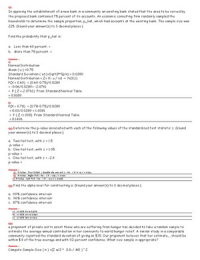
P(X > 136) = (136-120)/9.75
= 16/9.75 = 1.641
= P ( Z >1.641) From Standard Normal Table
= 0.0504
Result is usual as it lies in [0,1]
TABLE – 6
Mean of Sample 24 observations ( u ) = 113.85
Standard Deviation ( sd )=12.76
Normal Distribution = Z= X- u / sd ~ N(0,1)
P(X > 136) = (136-113.85)/12.76
= 22.15/12.76 = 1.7359
= P ( Z >1.736) From Standard Normal Table
= 0.0413
Result is usual as it lies in [0,1]
TABLE – 7
,If five people are selected at random, calculate the probability that their mean blood pressure is gr
this result unusual – why or why not?
TABLE – 4
P(X > 136) = (136-120)/9.75/ Sqrt ( 5 )
= 16/4.36= 3.6694
= P ( Z >3.6694) From Standard Normal Table
= 0.0001
Result is unusual as it lies almost in extremes[0,1]
TABLE – 6
P(X > 136) = (136-113.85)/12.76/ Sqrt ( 5 )
= 22.15/5.706= 3.8816
= P ( Z >3.8816) From Standard Normal Table
= 0.0001
Result is unusual as it lies almost in extremes[0,1]
TABLE – 7
P(X > 136) = (136-113.5)/11.12/ Sqrt ( 5 )
= 22.5/4.973= 4.5244
= P ( Z >4.5244) From Standard Normal Table
=0
Result is unusual as it lies at extremes [0,1]
Q 3) If five people are selected at random, calculate the probability that their mean blood pressure
TABLE – 4
To find P(a <= Z <=b) = F(b) - F(a)
, TABLE – 6
To find P(a <= Z <=b) = F(b) - F(a)
P(X < 130) = (130-113.85)/12.76/ Sqrt ( 5 )
= 16.15/5.7064
= 2.8301
= P ( Z <2.8301) From Standard Normal Table
= 0.99767
P(X < 136) = (136-113.85)/12.76/ Sqrt ( 5 )
= 22.15/5.7064 = 3.8816
= P ( Z <3.8816) From Standard Normal Table
= 0.99995
P(130 < X < 136) = 0.99995-0.99767
= 0.0023
TABLE – 7
To find P(a <= Z <=b) = F(b) - F(a)
P(X < 130) = (130-113.5)/11.12/ Sqrt ( 5 )
= 16.5/4.973
= 3.3179
= P ( Z <3.3179) From Standard Normal Table
= 0.99955
P(X < 136) = (136-113.5)/11.12/ Sqrt ( 5 )
= 22.5/4.973 = 4.5244
= P ( Z <4.5244) From Standard Normal Table
=1
P(130 < X < 136) = 1-0.99955
= 0.0005
Q 1)
If one Pearson is selected at random from the population in Table 4, calculate the probability of a bl
Would you consider this result unusual – why or why not?
Thumb rule to decide is looking at a data histogram a good initial way to do. If the points collected in
normal distribution. It hardly shows as below
TABLE – 4
P(X > 136) = (136-120)/9.75
= 16/9.75 = 1.641
= P ( Z >1.641) From Standard Normal Table
= 0.0504
Result is usual as it lies in [0,1]
TABLE – 6
Mean of Sample 24 observations ( u ) = 113.85
Standard Deviation ( sd )=12.76
Normal Distribution = Z= X- u / sd ~ N(0,1)
P(X > 136) = (136-113.85)/12.76
= 22.15/12.76 = 1.7359
= P ( Z >1.736) From Standard Normal Table
= 0.0413
Result is usual as it lies in [0,1]
TABLE – 7
,If five people are selected at random, calculate the probability that their mean blood pressure is gr
this result unusual – why or why not?
TABLE – 4
P(X > 136) = (136-120)/9.75/ Sqrt ( 5 )
= 16/4.36= 3.6694
= P ( Z >3.6694) From Standard Normal Table
= 0.0001
Result is unusual as it lies almost in extremes[0,1]
TABLE – 6
P(X > 136) = (136-113.85)/12.76/ Sqrt ( 5 )
= 22.15/5.706= 3.8816
= P ( Z >3.8816) From Standard Normal Table
= 0.0001
Result is unusual as it lies almost in extremes[0,1]
TABLE – 7
P(X > 136) = (136-113.5)/11.12/ Sqrt ( 5 )
= 22.5/4.973= 4.5244
= P ( Z >4.5244) From Standard Normal Table
=0
Result is unusual as it lies at extremes [0,1]
Q 3) If five people are selected at random, calculate the probability that their mean blood pressure
TABLE – 4
To find P(a <= Z <=b) = F(b) - F(a)
, TABLE – 6
To find P(a <= Z <=b) = F(b) - F(a)
P(X < 130) = (130-113.85)/12.76/ Sqrt ( 5 )
= 16.15/5.7064
= 2.8301
= P ( Z <2.8301) From Standard Normal Table
= 0.99767
P(X < 136) = (136-113.85)/12.76/ Sqrt ( 5 )
= 22.15/5.7064 = 3.8816
= P ( Z <3.8816) From Standard Normal Table
= 0.99995
P(130 < X < 136) = 0.99995-0.99767
= 0.0023
TABLE – 7
To find P(a <= Z <=b) = F(b) - F(a)
P(X < 130) = (130-113.5)/11.12/ Sqrt ( 5 )
= 16.5/4.973
= 3.3179
= P ( Z <3.3179) From Standard Normal Table
= 0.99955
P(X < 136) = (136-113.5)/11.12/ Sqrt ( 5 )
= 22.5/4.973 = 4.5244
= P ( Z <4.5244) From Standard Normal Table
=1
P(130 < X < 136) = 1-0.99955
= 0.0005