

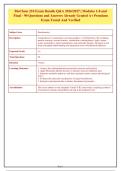
BioChem 210 Exam Bundle Q&A 2026/2027 | Modules 1-8 and
Final - 90 Questions and Answers Already Graded A+ Premium
Exam Tested And Verified
Subject Area Biochemistry
Description Comprehensive examination covering modules 1-8 of BioChem 210, including
protein structure, enzyme kinetics, metabolism (carbohydrates, lipids, amino
acids, nucleotides), signal transduction, and molecular biology. Designed to test
deep conceptual understanding and integration across biochemical pathways.
Expected Grade A+
Total Questions 90
Duration 3 hours
Learning Outcomes 1. Analyze the relationship between protein structure and function.
2. Apply Michaelis-Menten kinetics to interpret enzyme inhibition data.
3. Integrate metabolic pathways and their regulation under various physiological
states.
4. Evaluate the molecular mechanisms of signal transduction.
5. Interpret experimental data to deduce biochemical principles.
Accreditation This exam adheres to the standards of top US R1 universities, requiring synthesis
of advanced concepts and problem-solving at the graduate level.
Page 1
,1. In a patient with a deficiency in pyruvate carboxylase, which of the following
metabolic consequences is most likely to occur during fasting?
A. Increased oxaloacetate levels in the liver
B. Decreased gluconeogenesis from lactate
C. Enhanced ketogenesis due to excess acetyl-CoA
D. Elevated alanine transaminase activity
Answer: C. Enhanced ketogenesis due to excess acetyl-CoA
Pyruvate carboxylase converts pyruvate to oxaloacetate, a key intermediate for
gluconeogenesis and the TCA cycle. Deficiency reduces oxaloacetate, impairing
gluconeogenesis and TCA cycle flux, leading to acetyl-CoA accumulation and increased
ketogenesis. Options A and B are opposite; D is unrelated.
2. A mutation in the gene encoding the Rieske iron-sulfur protein of Complex III is
identified. Which of the following electron transport chain functions would be
directly impaired?
A. Transfer of electrons from NADH to CoQ
B. Transfer of electrons from succinate to CoQ
C. Transfer of electrons from reduced cytochrome c to oxygen
D. Transfer of electrons from ubiquinol to cytochrome c
Answer: D. Transfer of electrons from ubiquinol to cytochrome c
The Rieske iron-sulfur protein is a component of Complex III (cytochrome bc1
complex), which accepts electrons from ubiquinol and transfers them to cytochrome c.
Option A involves Complex I, B involves Complex II, and C involves Complex IV.
3. In a kinetic analysis, an enzyme with a Km of 50 µM for its substrate is assayed in
the presence of an inhibitor. The apparent Km increases to 200 µM, while Vmax
remains unchanged. Which type of inhibition is occurring?
A. Competitive inhibition
B. Noncompetitive inhibition
C. Uncompetitive inhibition
D. Mixed inhibition
Answer: A. Competitive inhibition
Competitive inhibition increases Km (apparent) without affecting Vmax, as the
inhibitor competes for the active site. Noncompetitive inhibition decreases Vmax,
uncompetitive decreases both, and mixed can affect both but typically changes Vmax.
Page 2
,4. A researcher treats a cell extract with an agent that specifically cleaves the
phosphodiester bond between the 5' phosphate of one nucleotide and the 3' hydroxyl
of the next in RNA. Which enzyme's activity is being mimicked?
A. DNA ligase
B. RNase H
C. Endonuclease IV
D. RNA polymerase
Answer: B. RNase H
RNase H specifically cleaves the phosphodiester bond in RNA strands of RNA-DNA
hybrids. DNA ligase joins ends, endonuclease IV is for DNA repair, and RNA
polymerase synthesizes RNA.
5. During prolonged exercise, skeletal muscle relies on the Cori cycle. Which of the
following best describes the net effect of this cycle on blood glucose levels?
A. It increases blood glucose by converting muscle-derived lactate to glucose in the liver
B. It decreases blood glucose by consuming glucose to produce lactate in muscle
C. It maintains blood glucose by recycling lactate into glucose without net consumption
D. It depletes blood glucose by converting glucose to lactate and then to CO2
Answer: C. It maintains blood glucose by recycling lactate into glucose without net
consumption
The Cori cycle involves lactate produced in muscle (from glycolysis) being transported
to the liver, where it is converted back to glucose via gluconeogenesis. The glucose
returns to muscle, maintaining blood glucose levels without net glucose consumption.
Option A implies net production, which is incorrect; B and D are opposite.
Page 3
, 6. A patient presents with elevated very-low-density lipoprotein (VLDL) and low
high-density lipoprotein (HDL) levels. Which of the following enzyme deficiencies is
most likely contributing to this profile?
A. Lipoprotein lipase deficiency
B. Hepatic lipase deficiency
C. Lecithin-cholesterol acyltransferase (LCAT) deficiency
D. Cholesteryl ester transfer protein (CETP) deficiency
Answer: A. Lipoprotein lipase deficiency
Lipoprotein lipase (LPL) hydrolyzes triglycerides in chylomicrons and VLDL,
promoting their clearance. Deficiency leads to accumulation of VLDL and decreased
HDL due to impaired transfer of surface components. Hepatic lipase deficiency affects
IDL/LDL, LCAT deficiency impairs HDL maturation, and CETP deficiency increases
HDL.
7. In a cell-free translation system using a synthetic mRNA with the sequence
5'-AUGUUUAAACCC-3', the addition of a tRNA with an anticodon 5'-AAA-3'
specific for phenylalanine is expected to result in which of the following?
A. Incorporation of phenylalanine at the second position of the nascent peptide
B. Incorporation of phenylalanine at the third position
C. No incorporation because the anticodon is mismatched
D. Premature termination of translation
Answer: A. Incorporation of phenylalanine at the second position of the nascent
peptide
The mRNA codons are AUG (start), UUU (Phe), AAA (Lys), CCC (Pro). The anticodon
5'-AAA-3' pairs with UUU (3'-AAU-5'? Actually, anticodon 5'-AAA-3' pairs with
3'-UUU-5'? Wait: tRNA anticodon reads mRNA codon in antiparallel. The anticodon
5'-AAA-3' will base-pair with mRNA codon 5'-UUU-3' (since 5'-AAA-3' pairs with
3'-UUU-5', but mRNA is 5'->3', so codon is UUU, anticodon is AAA). So it pairs with
the second codon (UUU) and incorporates Phe at position 2.
Page 4
Final - 90 Questions and Answers Already Graded A+ Premium
Exam Tested And Verified
Subject Area Biochemistry
Description Comprehensive examination covering modules 1-8 of BioChem 210, including
protein structure, enzyme kinetics, metabolism (carbohydrates, lipids, amino
acids, nucleotides), signal transduction, and molecular biology. Designed to test
deep conceptual understanding and integration across biochemical pathways.
Expected Grade A+
Total Questions 90
Duration 3 hours
Learning Outcomes 1. Analyze the relationship between protein structure and function.
2. Apply Michaelis-Menten kinetics to interpret enzyme inhibition data.
3. Integrate metabolic pathways and their regulation under various physiological
states.
4. Evaluate the molecular mechanisms of signal transduction.
5. Interpret experimental data to deduce biochemical principles.
Accreditation This exam adheres to the standards of top US R1 universities, requiring synthesis
of advanced concepts and problem-solving at the graduate level.
Page 1
,1. In a patient with a deficiency in pyruvate carboxylase, which of the following
metabolic consequences is most likely to occur during fasting?
A. Increased oxaloacetate levels in the liver
B. Decreased gluconeogenesis from lactate
C. Enhanced ketogenesis due to excess acetyl-CoA
D. Elevated alanine transaminase activity
Answer: C. Enhanced ketogenesis due to excess acetyl-CoA
Pyruvate carboxylase converts pyruvate to oxaloacetate, a key intermediate for
gluconeogenesis and the TCA cycle. Deficiency reduces oxaloacetate, impairing
gluconeogenesis and TCA cycle flux, leading to acetyl-CoA accumulation and increased
ketogenesis. Options A and B are opposite; D is unrelated.
2. A mutation in the gene encoding the Rieske iron-sulfur protein of Complex III is
identified. Which of the following electron transport chain functions would be
directly impaired?
A. Transfer of electrons from NADH to CoQ
B. Transfer of electrons from succinate to CoQ
C. Transfer of electrons from reduced cytochrome c to oxygen
D. Transfer of electrons from ubiquinol to cytochrome c
Answer: D. Transfer of electrons from ubiquinol to cytochrome c
The Rieske iron-sulfur protein is a component of Complex III (cytochrome bc1
complex), which accepts electrons from ubiquinol and transfers them to cytochrome c.
Option A involves Complex I, B involves Complex II, and C involves Complex IV.
3. In a kinetic analysis, an enzyme with a Km of 50 µM for its substrate is assayed in
the presence of an inhibitor. The apparent Km increases to 200 µM, while Vmax
remains unchanged. Which type of inhibition is occurring?
A. Competitive inhibition
B. Noncompetitive inhibition
C. Uncompetitive inhibition
D. Mixed inhibition
Answer: A. Competitive inhibition
Competitive inhibition increases Km (apparent) without affecting Vmax, as the
inhibitor competes for the active site. Noncompetitive inhibition decreases Vmax,
uncompetitive decreases both, and mixed can affect both but typically changes Vmax.
Page 2
,4. A researcher treats a cell extract with an agent that specifically cleaves the
phosphodiester bond between the 5' phosphate of one nucleotide and the 3' hydroxyl
of the next in RNA. Which enzyme's activity is being mimicked?
A. DNA ligase
B. RNase H
C. Endonuclease IV
D. RNA polymerase
Answer: B. RNase H
RNase H specifically cleaves the phosphodiester bond in RNA strands of RNA-DNA
hybrids. DNA ligase joins ends, endonuclease IV is for DNA repair, and RNA
polymerase synthesizes RNA.
5. During prolonged exercise, skeletal muscle relies on the Cori cycle. Which of the
following best describes the net effect of this cycle on blood glucose levels?
A. It increases blood glucose by converting muscle-derived lactate to glucose in the liver
B. It decreases blood glucose by consuming glucose to produce lactate in muscle
C. It maintains blood glucose by recycling lactate into glucose without net consumption
D. It depletes blood glucose by converting glucose to lactate and then to CO2
Answer: C. It maintains blood glucose by recycling lactate into glucose without net
consumption
The Cori cycle involves lactate produced in muscle (from glycolysis) being transported
to the liver, where it is converted back to glucose via gluconeogenesis. The glucose
returns to muscle, maintaining blood glucose levels without net glucose consumption.
Option A implies net production, which is incorrect; B and D are opposite.
Page 3
, 6. A patient presents with elevated very-low-density lipoprotein (VLDL) and low
high-density lipoprotein (HDL) levels. Which of the following enzyme deficiencies is
most likely contributing to this profile?
A. Lipoprotein lipase deficiency
B. Hepatic lipase deficiency
C. Lecithin-cholesterol acyltransferase (LCAT) deficiency
D. Cholesteryl ester transfer protein (CETP) deficiency
Answer: A. Lipoprotein lipase deficiency
Lipoprotein lipase (LPL) hydrolyzes triglycerides in chylomicrons and VLDL,
promoting their clearance. Deficiency leads to accumulation of VLDL and decreased
HDL due to impaired transfer of surface components. Hepatic lipase deficiency affects
IDL/LDL, LCAT deficiency impairs HDL maturation, and CETP deficiency increases
HDL.
7. In a cell-free translation system using a synthetic mRNA with the sequence
5'-AUGUUUAAACCC-3', the addition of a tRNA with an anticodon 5'-AAA-3'
specific for phenylalanine is expected to result in which of the following?
A. Incorporation of phenylalanine at the second position of the nascent peptide
B. Incorporation of phenylalanine at the third position
C. No incorporation because the anticodon is mismatched
D. Premature termination of translation
Answer: A. Incorporation of phenylalanine at the second position of the nascent
peptide
The mRNA codons are AUG (start), UUU (Phe), AAA (Lys), CCC (Pro). The anticodon
5'-AAA-3' pairs with UUU (3'-AAU-5'? Actually, anticodon 5'-AAA-3' pairs with
3'-UUU-5'? Wait: tRNA anticodon reads mRNA codon in antiparallel. The anticodon
5'-AAA-3' will base-pair with mRNA codon 5'-UUU-3' (since 5'-AAA-3' pairs with
3'-UUU-5', but mRNA is 5'->3', so codon is UUU, anticodon is AAA). So it pairs with
the second codon (UUU) and incorporates Phe at position 2.
Page 4


